



TL;DR
- What to run: 25 unbranded prompts and 5 branded control prompts, frozen for four weeks, with a list of aliases.
- Why unbranded: A prompt that names you inflates the rate. Report the unbranded rate first.
- What to count: Four fields per answer: named, cited, position, accuracy. Keep ChatGPT on its own row.
- How often: Weekly, and read three runs, not one.
- Who runs it: AI SEO Tracker scans five engines. The $49 audit covers up to 50 prompts and gives a report you keep.
Does AI name your brand? Check your site.
ChatGPT brand monitoring is a weekly check: the same unbranded buyer questions, the same match rules, and a count of the answers that name you.
Do not ask ChatGPT about your brand by name. The prompt hands the model your name, and the rate looks better than it is. Discovered Labs, an AEO agency, audited five B2B prompt sets from its clients. In the worst one, a reported mention rate of 10.8% fell to 1.9% on neutral prompts (source).
I have run this by hand. Spreadsheets lie fast. Answers drift. Names collide. Below: how to write the prompt set, what to count, one real question on five engines with the answers kept, and how often to run it.
If you want social listening inside ChatGPT, that is a different job. Brand24 ships a ChatGPT app for its mention, sentiment and influencer data. This post covers what ChatGPT says about you.
Why a branded prompt is a false positive
Discovered Labs calls this anchoring inflation and found it in all five prompt sets it audited. A prompt that names the brand makes the model much more likely to name it in the answer. Part of your "visibility" is your own question coming back.
So split your set:
| Prompt type | Example | What it measures |
|---|---|---|
| Unbranded | "Best AI visibility tracker for a 5-person SEO team" | Natural recall. This is the number that matters. |
| Category | "Tools that track ChatGPT citations" | Whether you belong in the category at all. |
| Comparison | "Profound vs Peec AI vs Otterly" | Whether you make the shortlist when peers are named. |
| Branded (control) | "What is AI SEO Tracker?" | Accuracy and hallucination, not visibility. |
Report unbranded mention rate first. Keep branded prompts as a fact-check. Never blend them into one percentage.
Some guides say the opposite. Tech Gadget Advisor tells you to include your brand name in every prompt. That measures whether ChatGPT can repeat a name you gave it. Dageno's tool roundup gives the warning I give: branded prompts must not inflate the baseline.
For how models pick the brands they name, see LLM SEO.
The prompt set to actually run
You do not need 2,000 prompts on day one. You need a set that looks like buyer language, not keyword fragments. Start with 25 unbranded prompts and 5 branded control prompts. You can grow it to 50.
Pull the unbranded ones from:
- Sales calls and support tickets
- Google Search Console queries that sound like full questions
- Reddit and review-site wording in your category
- "Best X for Y" and "X vs Y" pages that already rank
Write the long version. "Best CRM" is a search fragment. "Best CRM for a 5-person agency that already uses Slack" is a question a buyer asks a chatbot.
Keep a written list. Freeze it for at least four weeks. If you swap prompts every scan, you cannot tell whether the brand moved or the question changed.
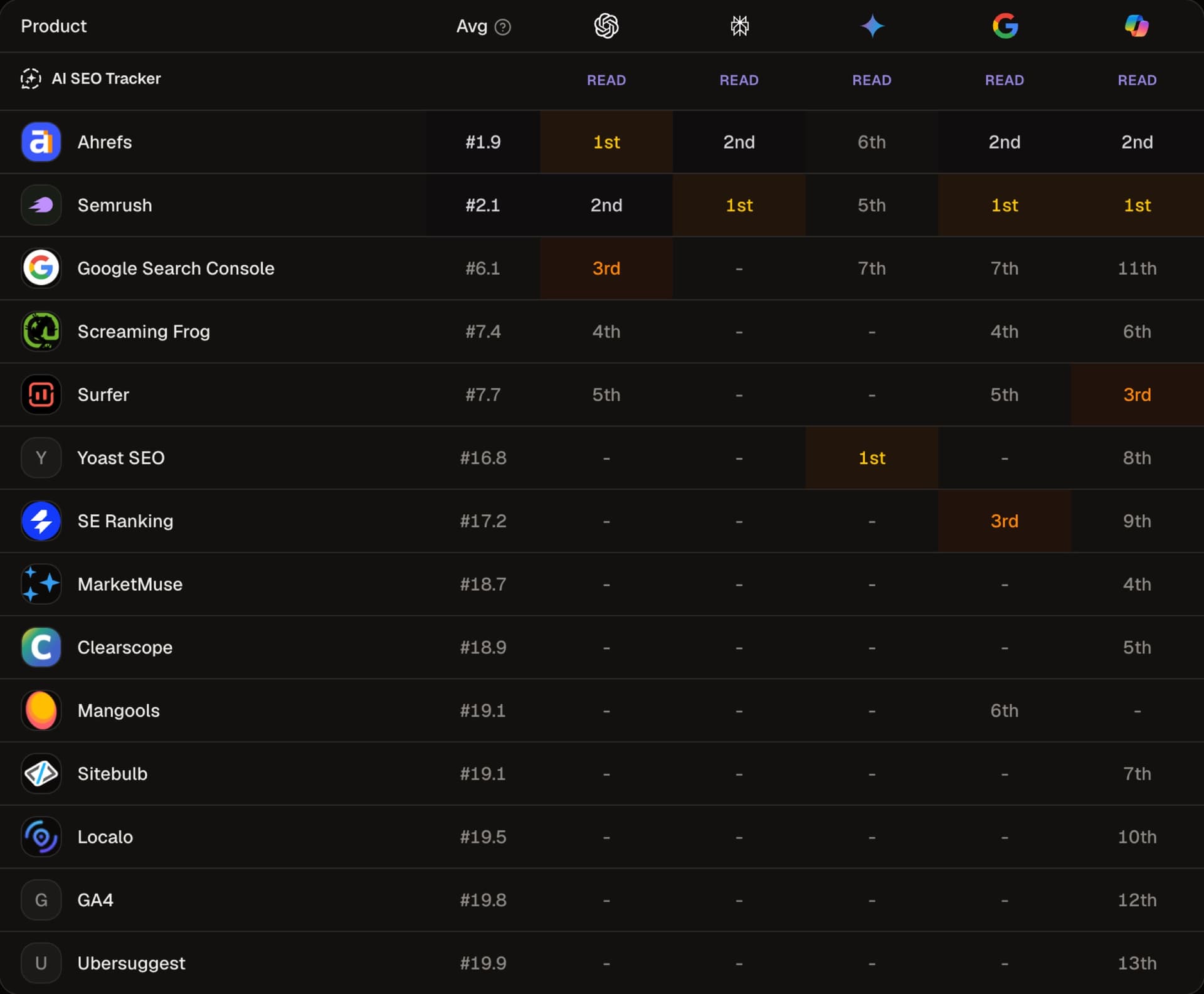
Add aliases. ChatGPT may write "AISEOTracker", "AI SEO Tracker", or a truncated name. List every variant, and match the full product name. Real answers show why. In AI SEO Tracker's scans, ChatGPT wrote "Surfer SEO" and "Close CRM", Google's AI Overview wrote "Screaming Frog SEO Spider", and Gemini wrote "Yoast SEO Premium". The leaderboard folds each to a short name. A brand with an everyday word for a name, such as Close or Monday, gets false hits from a rule that matches only the short name.
Skip leading questions:
- Bad: "Is AI SEO Tracker one of the best AI SEO tools?"
- Good: "What are the best AI SEO tools for tracking ChatGPT mentions?"
The first one is a test of politeness. The second one is a test of the market.
How to score mentions without fooling yourself
A mention is not a citation. A citation is not a recommendation.
Score each answer with four fields:
- Mentioned? Exact brand or alias in the answer text. Yes or no.
- Cited? A URL on your domain, or a named source card that points to you.
- Position? First named, second, later, or buried in a list of eight.
- Accuracy and tone? Positive, neutral, negative, or factually wrong.
Mention rate = answers that name you / answers in the set. Peec calls this Visibility.
Citation rate = answers that link or attribute your URL / answers in the set.
Peec splits the two as brand visibility (your name is in the response) and source visibility (your domain was used or cited, even if your name is not in the answer). You can have one without the other. Track both.
Here is one real answer, scored. It is ChatGPT's reply to "best SEO tool", stored in the 24 September 2026 scan on the AI SEO Tracker leaderboard:
| Brand | Named and cited | Position and tone |
|---|---|---|
| Ahrefs | Named. Cited: ahrefs.com/all | 1 of 5. Strong for backlinks and keyword research |
| Surfer SEO | Named. Not cited | 5 of 5. Specialized for content, not a full suite |
False positives to strip:
- A short name that matches another brand or a plain word ("Close", "Monday", or "AI" inside "OpenAI")
- The model repeating your name because the user already said it in a follow-up
- A hallucinated product that shares letters with yours
False negatives to catch:
- Abbreviations and old product names
- "They" after a first mention in the same answer (count the first mention, not every pronoun)
- Misspellings that still point at you
A mention that warns readers off you is still a mention. Mark the tone negative. If the answer names you with a wrong price or feature, mark it wrong and fix the source.
Keep screenshots or stored answer text. ChatGPT will not show you last Tuesday's reply. If you cannot reopen the answer, you cannot audit a dispute.
For the citation layer across engines, see what AI citations are. For share of voice across competitors, see share of voice measurement.
One question on five engines
The same question, "best SEO tool", in the 24 September 2026 scan on the leaderboard. Each engine's rank for three of the tools:
| Engine | Ahrefs | Semrush | Surfer |
|---|---|---|---|
| ChatGPT | 1st | 2nd | 5th |
| Perplexity | 2nd | 1st | not named |
| Gemini | 6th | 5th | not named |
| AI Overview | 2nd | 1st | 5th |
| Copilot | 2nd | 1st | 3rd |
Rank moves by engine. ChatGPT puts Ahrefs first and Semrush second. AI Overview puts them the other way round. Perplexity's answer names two tools. Copilot's names 13 on the leaderboard. SparkToro's study saw the same spread in list length, from 2 or 3 items to 10 or more. So report a rate over many prompts, not a rank from one.
A mention is not a citation. ChatGPT's answer ranks five tools and shows four sources: backlinko.com, ahrefs.com, seoexpert.sg and stridec.com. Only ahrefs.com is the domain of a named tool. Semrush, Google Search Console, Screaming Frog and Surfer SEO are named with no page on their own domain. That is brand visibility without source visibility, on live data.
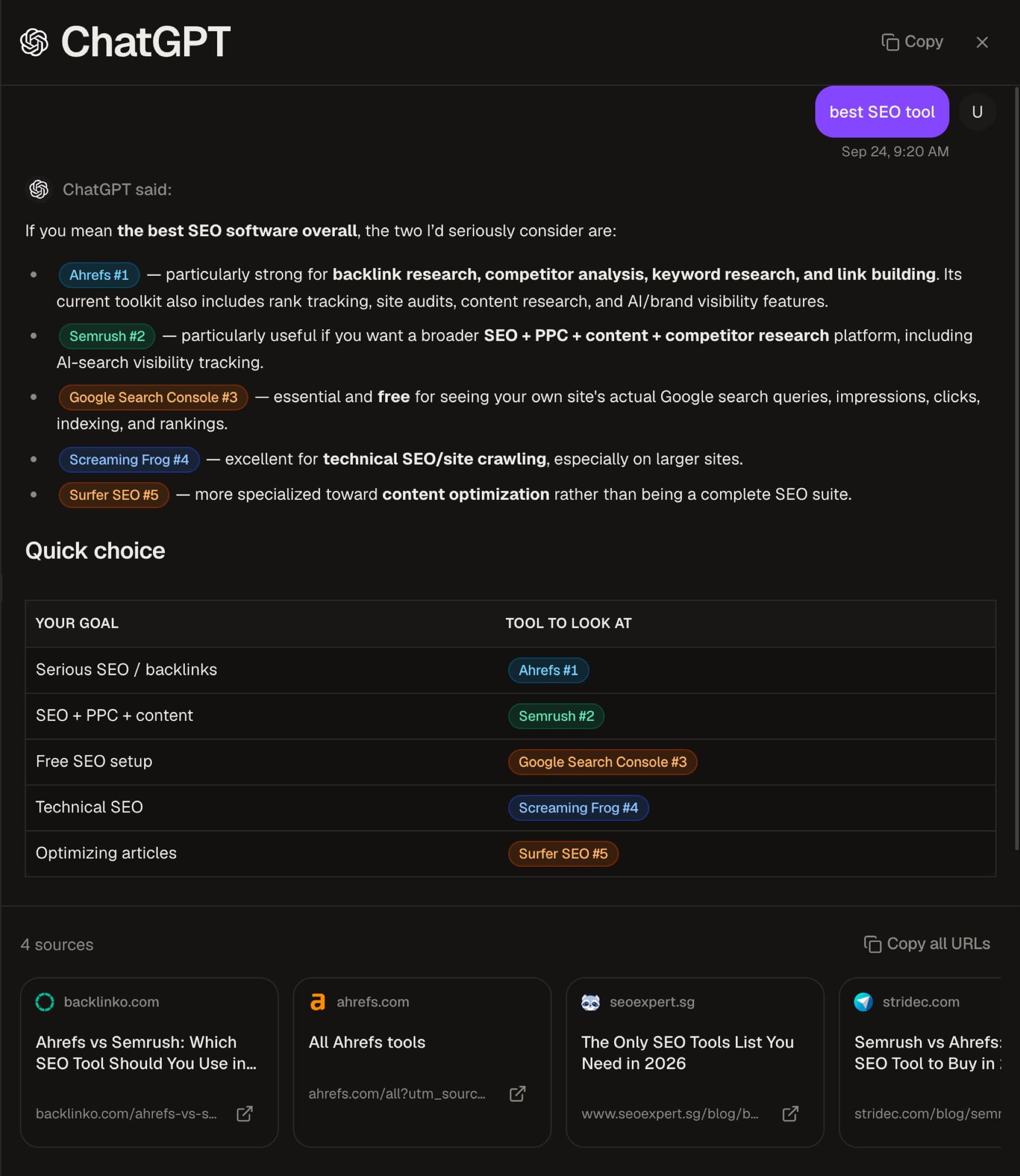
The click side is in the URL. Every source link in that stored ChatGPT answer ends in utm_source=chatgpt.com. So does every source link in the stored ChatGPT answer for the leaderboard's "best CRM for startups" question. Check your analytics for that source. It counts clicks from cited answers. This post counts mentions. It is what the stored answers show, not a documented rule.
So give ChatGPT its own row. Do not average it with Perplexity and Gemini: a blended score hides the engine that is failing.

Does AI name you?
See if AI mentions your brand. Then get the pages to fix.
A cadence that survives ChatGPT noise
Same prompt, same model, different day: different answer. Discovered Labs calls this structural, not a bug: most production endpoints sample with temperature above zero. Your 25 prompts are also a thin slice of what buyers ask.
SparkToro tested the spread. 600 volunteers ran 12 prompts through ChatGPT, Claude and Google's AI, 2,961 runs in all. There was under a 1 in 100 chance that two responses from ChatGPT or Google's AI gave the same list of brands.
So do not treat one chat as a rank. Treat a week of runs as a sample, and know the limit of a small one. With 25 prompts, one more answer that names you moves the rate by 4 points (1 divided by 25). Discovered Labs says most production benches run 500 to 2,000 prompts to detect a shift of 1 to 2 points. So 0 of 25 means "not named yet", not "never", and only a move that holds over three weekly runs counts.
| Cadence | When to use it | What you get |
|---|---|---|
| One-off audit | First look, or after a site rewrite | A baseline. Not a trend. |
| Weekly | Default for most teams | The floor for a sustained-shift test: three snapshots in a row above your baseline |
| Daily | After a launch, a new listicle, or another major content change | A tighter window. More cost. More noise per day. |
Three things also change an answer, per OpenAI's page on searching the web with ChatGPT. ChatGPT may search the web on its own, and those answers may include citations. If memory is on, it may use saved memories when it rewrites a search query. It may use an approximate location from your IP address. So log whether the answer showed sources, test in a clean session, and run from one place. Signed-out users get web search too.
For Google's layer, pair this with AI Overview tracking. Give it its own row.
Manual monitoring vs a real monitor
You can do the first audit by hand. Open ChatGPT. Paste prompt 1. Record the four fields. Repeat. Budget two to three hours for 20 prompts on one engine. That is useful once. It is a bad weekly job. To try one prompt before you commit, use the free AI Visibility Checker.
Problems show up fast:
- You change wording without noticing
- You forget an alias
- You score "kind of mentioned" as a yes on a tired Friday
- You cannot show a client the raw answer from three weeks ago
- You never run Gemini, Copilot, or AI Overviews, so ChatGPT becomes the whole story
AI SEO Tracker is the monitor I want for this job. You add the prompts. You name the brand and the competitors. It runs ChatGPT, Perplexity, Gemini, Copilot, and AI Overviews. You get mention rate, citation URLs, and an engine split instead of one blended score. It does not scan Google AI Mode, Claude, Grok, DeepSeek or Meta AI. If your buyers use one of those, run those prompts by hand.
Start with the $49 audit if you have never measured this. Up to 50 prompts, five engines, daily scans for 7 days, a report you keep. If ChatGPT never names you, you do not need a daily dashboard yet. You need pages, listicles, and consistent brand copy.
If you already know the gap, weekly tracking starts at $79/mo. MCP is there if you want the same data inside an agent. Page Inspector sits on the higher plan when you need to see how a specific URL reads to a model.
That is different from asking ChatGPT about yourself in a new chat every Monday.
Other trackers are compared in AI search monitoring tools and best AI visibility tools.
A 30-minute setup you can repeat
- Write 25 unbranded prompts and 5 branded control prompts. Freeze the list.
- List aliases: legal name, product name, common misspellings, and names that collide with yours.
- List 3 to 5 competitors that already show up in answers, including the ones you wish were irrelevant.
- Run the $49 audit, or a manual pass.
- Score mention rate on unbranded prompts only. Put ChatGPT on its own row.
- Pick three gaps. A prompt where a competitor is named and you are not beats a branded query you already win.
- Fix the page or the off-site mention, then wait. Do not rescan 12 hours later and call it a win.
- Rescan weekly for four weeks before you change the prompt set.
A founder does not need 40 prompt rows. Report four lines:
- ChatGPT named us in N of 25 unbranded prompts this week (was N-1 last week)
- Cited our URL in N of those
- Named Competitor A on the prompts we missed
- Top source URLs in those answers, so you know where to earn a mention
Add ChatGPT visits from utm_source=chatgpt.com in your analytics.
If those lines are stable for a month, your monitoring is working. If they swing 20 points every week (five answers out of 25), your prompt set is too small or too branded. Fix the set first.
Monitoring without distribution is a scoreboard with no game. The other half is listicles and how you rank in ChatGPT. The product page is the ChatGPT rank tracker.
What to do with the numbers
Monitoring shows whether answer engine optimization is working. It does not write the page that gets you in.
| What you see | What it means | First fix |
|---|---|---|
| Named, never cited | ChatGPT names you. No page of yours is cited. | Put a direct answer in the first two sentences of the page that matches the prompt. See AI search visibility. |
| Never named | The web does not repeat you yet. | Stop optimizing titles for a week. Get named on a third-party list that already gets cited. |
| Named with wrong facts | Sources often disagree. Price on the site versus price on G2 is a classic split. | Fix the conflicting sources. Add a facts block (price floor, engines, who it is for). Recheck the branded control prompts. |
| A competitor named on prompts you miss | The cited pages name them and not you. | Open the sources in those answers and earn a mention there. |
The "never named" fix has a number behind it. On the leaderboard's 343 questions, 77% of the pages cited in the scans were listicles and 10% were vendor pages (leaderboard, read 2 October 2026; the figure moves with each scan). Your homepage talking about yourself is one vendor page among many.
Run the audit. Freeze the prompts. Ignore branded vanity. Watch ChatGPT as its own engine. That is brand monitoring.