



TL;DR
- Find the pages first. On "best X" questions, 61.8% of the 7,960 pages that engines cited were listicles. Get onto the pages they already cite.
- Engines disagree. 86.8% of cited pages were cited by one engine only. Count each engine on its own.
- Write quotable sections. Make the heading the question. Answer it in two sentences. ChatGPT sees a page's title and URL before it opens the page.
- Be fetchable, then stop. Google says AI features need no extra markup. Allow the search bots. Schema and llms.txt showed no measured lift.
- Check on a fixed prompt set. Run the same 15 prompts on each engine every week.
Does AI name your brand? Check your site.
Want an AI to cite you?
Two jobs.
- Get onto the pages the engines already cite for your question.
- Write your own page so an engine can quote one section of it.
That's the post.
A citation is a source link inside the answer. ChatGPT shows Sources. Perplexity numbers its footnotes. Google shows supporting links.
(AI citations covers the definition, and how a citation differs from a mention.)
Rank alone does not decide it.
In an Ahrefs study of 15,000 prompts, on average only 12% of the links that four AI assistants cited were in Google's top 10 for the same prompt.
Perplexity was the outlier at 28.6%. ChatGPT, Gemini and Copilot sat near 8% (Ahrefs, 11 August 2025).
So what does decide it? I counted.
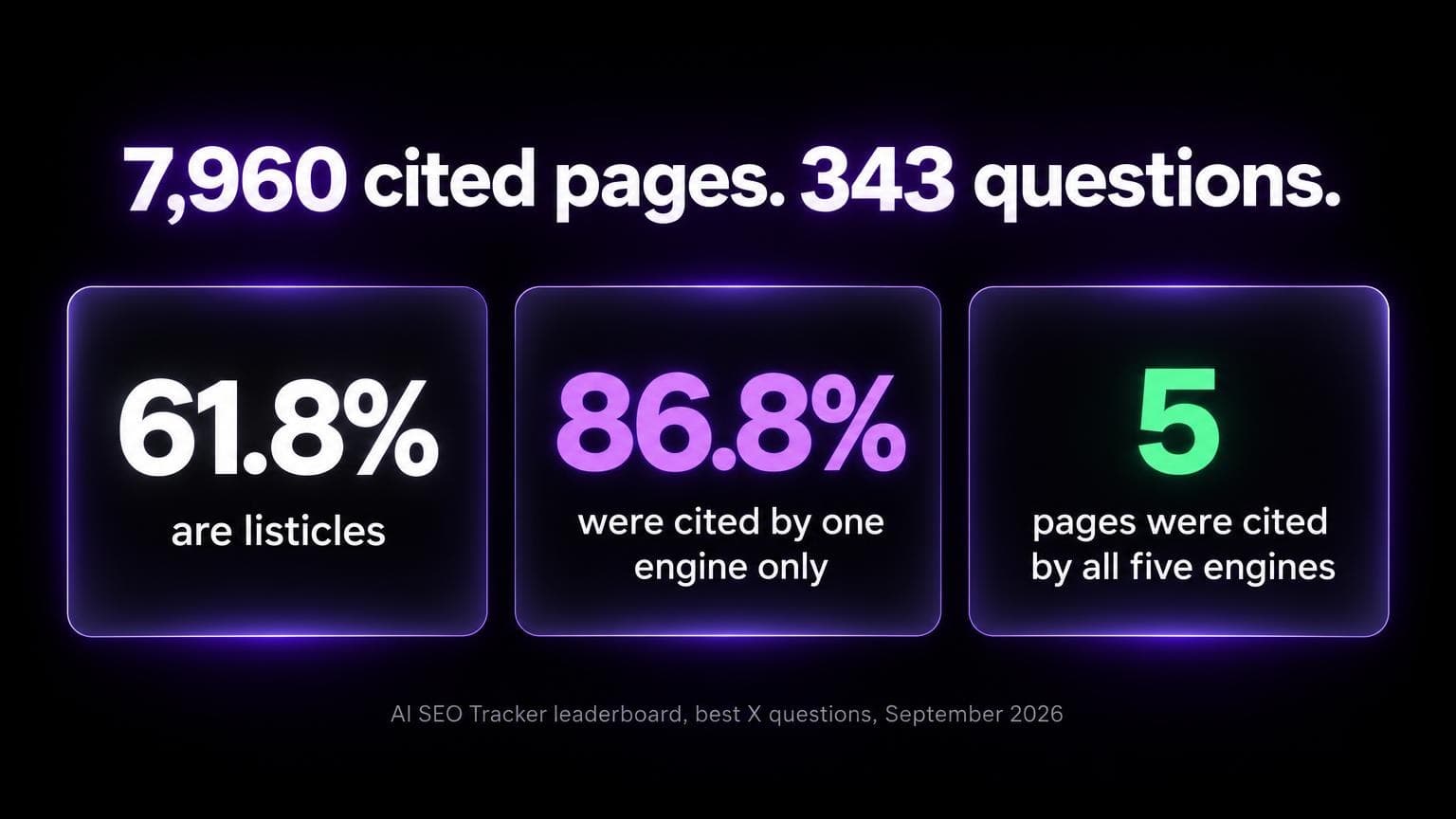
This post uses counts from the AI SEO Tracker leaderboard (7,960 cited pages on 343 questions) and a worked example.
Then it covers how to write, fetch and check a page.
It is about AI citing your site. Not about how to cite ChatGPT in an essay. (See the FAQ.)
What the leaderboard shows about cited pages
The AI SEO Tracker leaderboard scans "best X" buyer questions every month. On ChatGPT, Perplexity, Gemini, Copilot and Google AI Overviews.
Each question page has a Cited sources table.
I counted that table on all 343 question pages. (342 scanned on 23 and 24 September 2026, one on 5 September.)
The result: 7,960 cited pages and 9,307 page-and-engine citations.
A page cited for two questions counts twice. Open any question page to read the same table.
| Measure | Result | Note |
|---|---|---|
| Listicles, share of cited pages | 61.8% | Next: unclassified 17.9%, news 8.0%. |
| Pages cited by 2 or more engines | 13.2% (1,053) | 86.8% had one engine. 79.6% of the multi-engine pages are listicles. |
| Pages cited by 3 or more engines | 3.1% (244) | Five pages were cited by all five engines. |
| Median Domain Rating of the cited pages' sites | 89 | Shown for 6,367 of 7,960 pages. 4.0% are below 50. |
| Titles that contain "2026" | 47.8% | 61.1% of listicle titles. 76.6% of pages cited by 3 or more engines. |
Each engine leans on different sources.
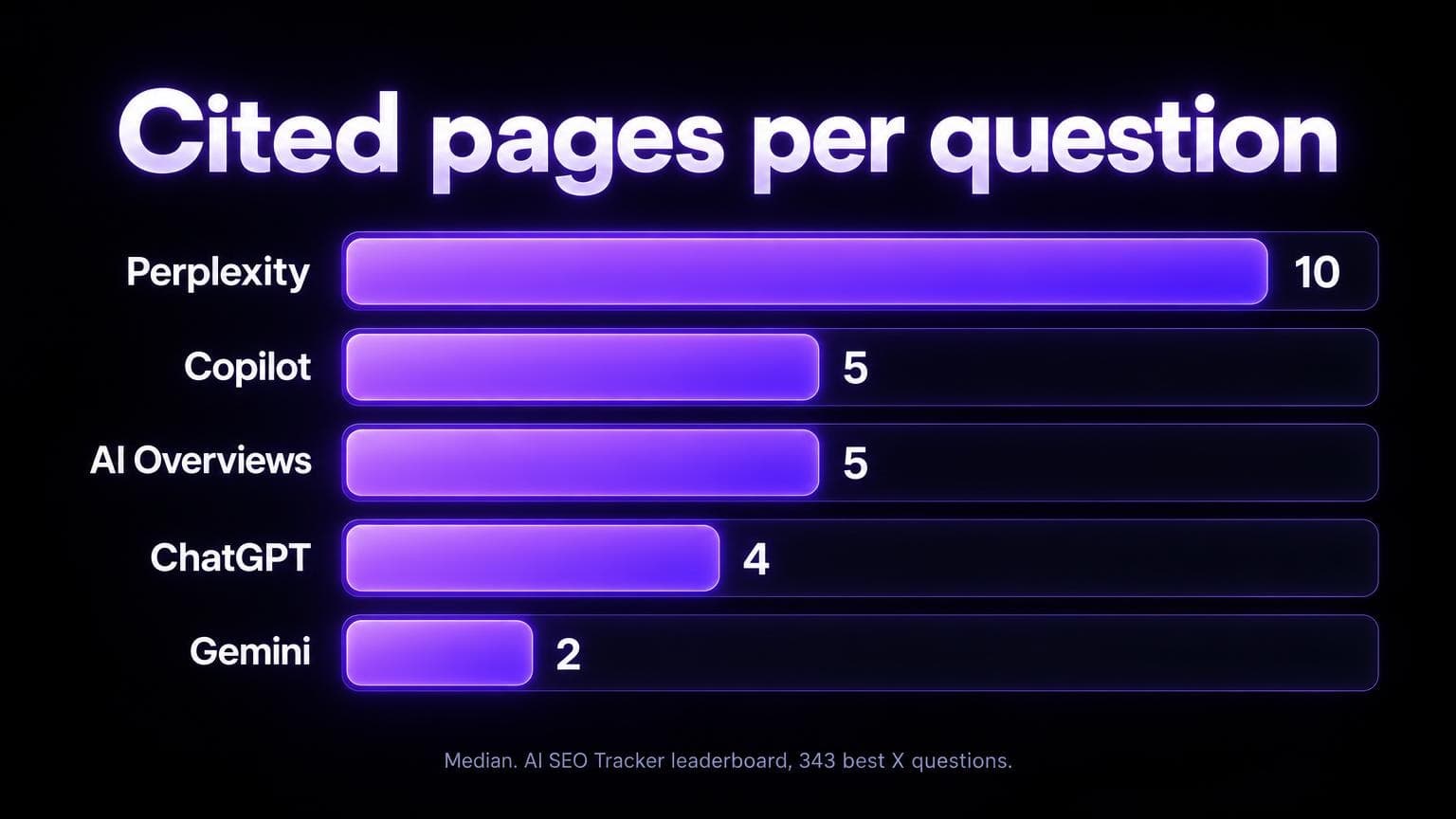
The shares below are of each engine's own cited pages, in this question set.
| Engine | Cited pages per question (median) | Biggest sources in this set |
|---|---|---|
| Perplexity | 10 | NYTimes 4.2%, PCMag 3.6%, Forbes 3.5% |
| Copilot | 5 | Amazon 8.2%, Walmart 7.7% |
| Google AI Overviews | 5 | YouTube 27.0%, Reddit 5.7% |
| ChatGPT | 4 | RTINGS 5.5%, Consumer Reports 4.2%, Tom's Guide 4.0% |
| Gemini | 2 | PCMag 5.4%, Forbes 2.8% |
Engines agree rarely.
So "are we cited?" has no single answer. Count each engine alone.
Limits.
- Mostly product-shopping questions. 106 are Tech and Gadgets, 63 Home and Appliances, 40 Finance and Business, 36 Software and AI.
- Each was scanned once.
- The page type comes from a classifier that reads the URL and title. It makes mistakes: it labels Quora threads and a Microsoft forum thread "Reddit" and G2 blog pages "Directories".
- A cited page is a page an engine showed as a source. It does not prove the page says what the answer says.
What about other question types?
cloro (a vendor of citation tracking) ran 735 fixed queries on five engines, including Google AI Mode (cloro, July 2026).
An answer carried at least one source for:
- 91.2% of "best X" questions
- 83.0% of how-to questions
- 80.7% of definition questions
cloro says how-to and definition pages must earn the citation with named data and dated figures.
| Question type | Answers with a source (cloro) | What to build |
|---|---|---|
| Best X | 91.2% | Get onto lists that engines cite. Publish one honest list. |
| X vs Y | 83.5% | A table: price, limit, best for, not for. |
| How do I | 83.0% | A dated step list with one figure the engine cannot guess. |
| What is X | 80.7% | A definition with one sourced figure. |
The right-hand column is advice, not data.
Get onto the sources models already cite
The fastest route is often a page the engine already cites that now names you.
So build the source list first.
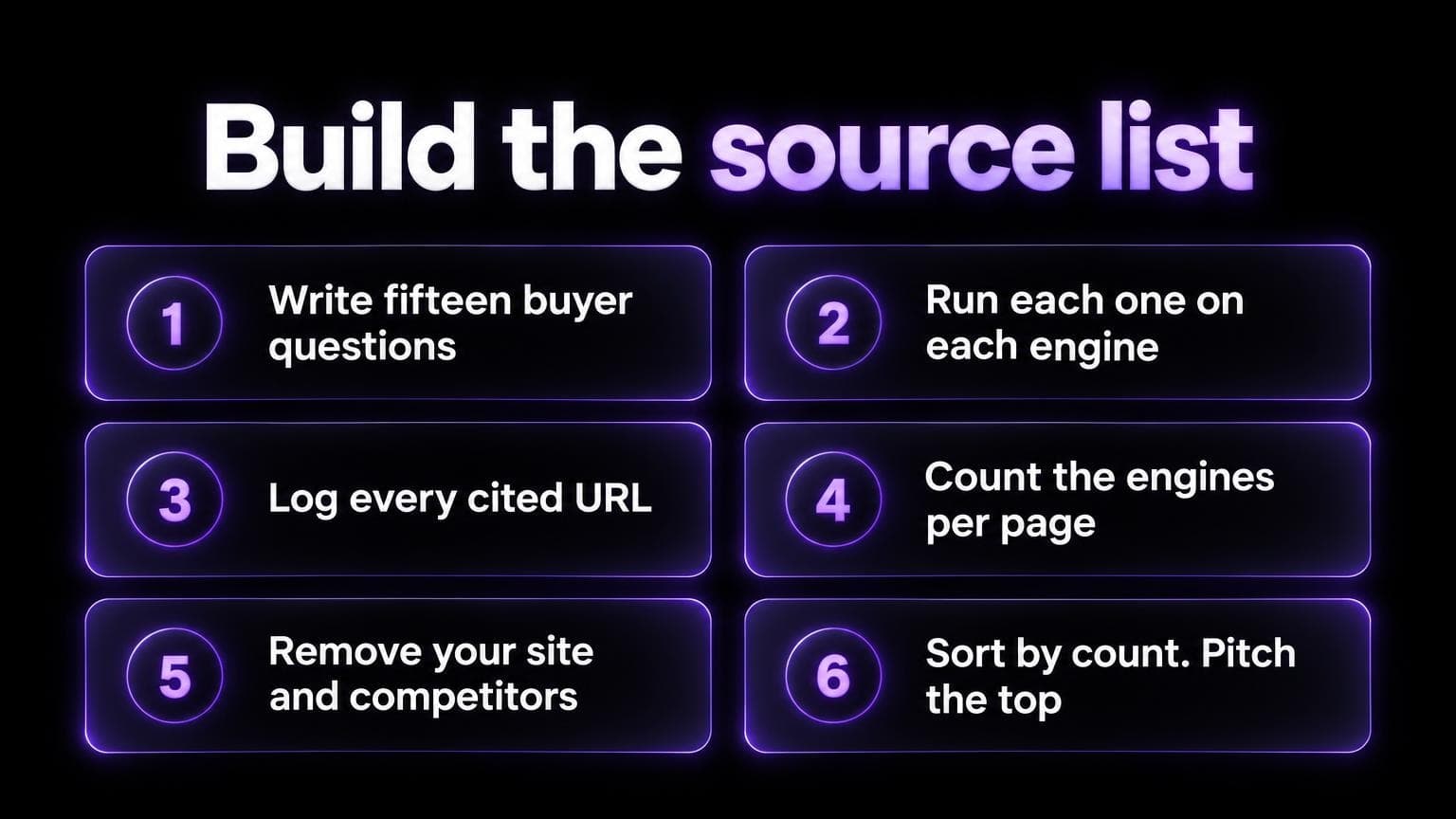
This method adapts cloro's outreach method:
- Write 15 questions your buyers ask.
- Run each one on each engine.
- Log every cited URL.
- Count how many engines cite each page.
- Remove your own domain and your competitors'.
- Sort by count. The top of the list is your outreach list.
Across 20 brands, cloro found that presence on more of the most-retrieved third-party pages tracked with higher brand visibility (r=0.88).
That is one corpus. And a correlation.
Worked example for best calendar app
The leaderboard scan of "best calendar app" (23 September 2026) cited 20 pages.
Seven were cited by two or more engines:
| Page | Cited by | Domain Rating |
|---|---|---|
| zapier.com/blog/best-calendar-apps | ChatGPT, Perplexity, Gemini, AI Overviews | 91 |
| learn.g2.com/best-calendar-app | Perplexity, Gemini, Copilot | 91 |
| techradar.com/best/best-calendar-apps | ChatGPT, Perplexity | 90 |
| niftypm.com/blog/best-calendar-apps | Perplexity, Gemini | 76 |
| lindy.ai/blog/calendar-apps | Gemini, AI Overviews | 72 |
| toolfinder.com/best/calendar-apps | Perplexity, AI Overviews | 60 |
| 2sync.com/blog/best-calendar-apps | ChatGPT, Perplexity | 41 |
That list of seven is the outreach list for a calendar app maker.
Three observations. Each checkable on the pages.
1. Tool makers' own lists get cited.
Three of the seven are on the blogs of tool makers.
- Nifty's list ranks Nifty first of 13.
- Lindy's list ranks Lindy sixth of six.
- 2sync's list does not pick 2sync. It pitches its own sync tool to Notion users.
The other four are Zapier, G2, TechRadar and Tool Finder.
2. Four of the seven share a structure.
Zapier, Lindy, 2sync and Nifty were checked.
Each has a criteria or method section ("How I tested", "How we chose", "How we evaluate and test apps" or "What makes the best calendar app?"). And one block per item.
Zapier, Lindy and 2sync also open with an "at a glance" table.
3. Freshness is visible.
- Lindy: published on 18 September 2026. Five days before the scan.
- 2sync: updated on 22 September 2026. The day before.
- Zapier: last modified on 26 November 2025.
These are the dates the pages declare.
Start the pitches with the page that four engines cite: Zapier's.
Should you publish your own list?
Ahrefs checked 250 "best X software" results pages (Ahrefs, 4 December 2025).
In 169 of them (67.6%), the company writing the list ranked itself first.
When ChatGPT recommended the publisher, a self-promotional blog list showed up in more than a third of its software responses.
Ahrefs advises SaaS firms and agencies to publish such lists. It also warns that many are overly self-promotional or do not link out to the alternatives they recommend.
My rule: publish yours only if you add criteria an engine can repeat. Who each option is for. A real price. A disqualifier.
Get in AI visibility listicles covers the pitch.
And video?
YouTube is 27.0% of what AI Overviews cited in this set.
A video transcript that states what you are, who it is for and one limit is a citable section.
No captions, or the video is hosted off YouTube? Put the transcript on the page next to it. Scribiz makes one from a link or a file, with timestamps. I built it. The free version needs no account and reads videos up to 15 minutes.
LLM SEO takes the same view: follow the citations you already see.

Does AI name you?
See if AI mentions your brand. Then get the pages to fix.
Write each section as a quotable answer
An engine retrieves candidate pages. It cites some of them.
So build each section so it can be lifted on its own.
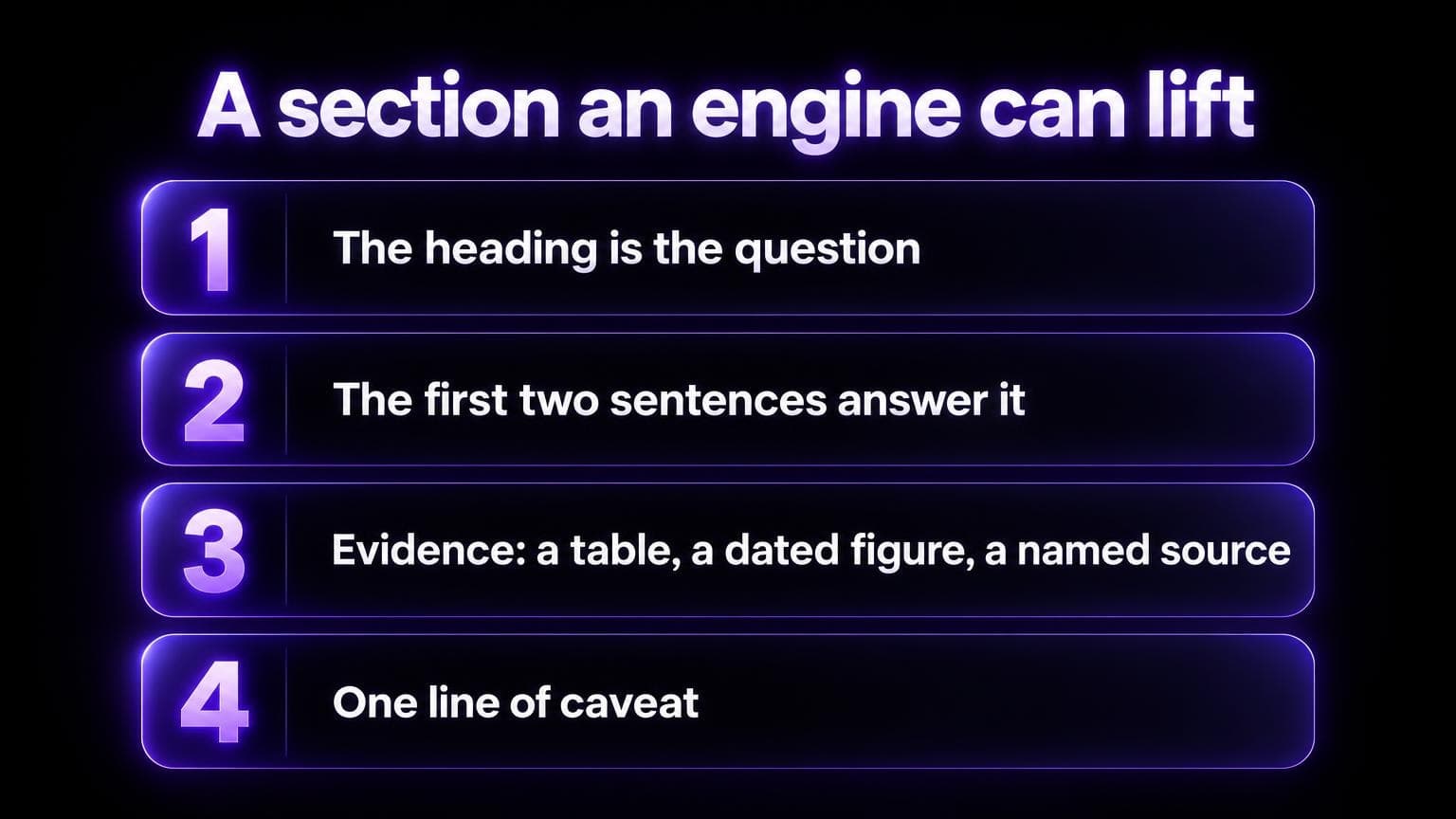
- Heading = the question. Use the words a buyer types.
- The first two sentences answer it. Name the entities you want repeated.
- Evidence. A table, a numbered procedure, a dated figure or a named source.
- One-line caveat when the answer depends on plan, region or date.
Two hundred to four hundred words per H2 is a rule of thumb. Not a measured limit.
Markdown for agents makes a section cheaper to parse. It does not add authority.
ChatGPT first sees a title, a URL and sometimes a snippet.
In Ahrefs' study of 1.4 million ChatGPT prompts (Ahrefs, 15 April 2026), ChatGPT retrieved dozens of URLs per question and cited about half.
- Titles: cited pages had titles closer in meaning to the prompt than non-cited pages. Similarity 0.60 against 0.48. And 0.66 to the closest of ChatGPT's own sub-questions.
- URLs: in the search channel, pages with natural-language URL slugs were cited 89.78% of the time. Against 81.11% without.
Two caveats. Ahrefs measured meaning with open-source embeddings, not ChatGPT's own rule. And 67.8% of non-cited URLs were Reddit, which skews the comparison.
Read it as a direction: put the question in the title and the slug.
Checkable facts helped in a lab test.
The GEO paper (Aggarwal et al., KDD 2024) rewrote pages in several ways (arXiv).
Adding citations, quotations and statistics raised source visibility by over 40% across various queries. And by up to 37% on Perplexity.ai.
Keyword stuffing was in its non-performing group.
The test ran on GPT-3.5 Turbo and Perplexity.ai. Not on today's engines.
Freshness: keep it honest.
Many cited titles in the leaderboard contain "2026" (see the first table). That describes the set. It does not prove a cause.
Ahrefs found that 79.1% of 1,100 "best X" lists were updated in 2025.
In a separate study, the median cited ChatGPT search page was about 500 days old. And within one retrieval set, relevance did the heavy lifting.
So update a page when the facts change.
Do not move a date without changing a fact.
Make the page fetchable
An engine cannot cite a page it cannot fetch.
Do this once. Then stop.
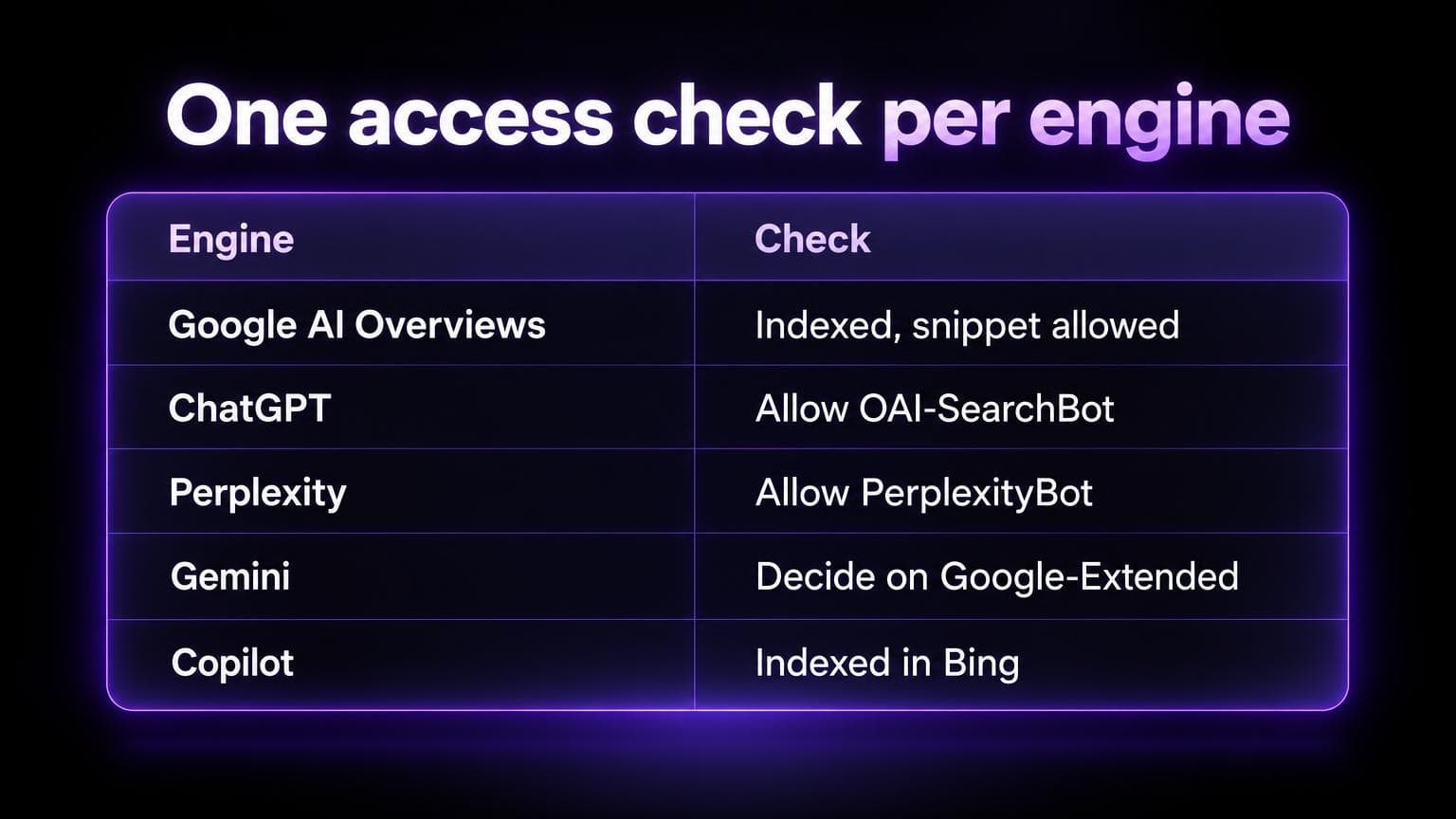
- Google AI Overviews and AI Mode. The page must be indexed and eligible to show in Google Search with a snippet. Google lists no additional technical requirements (Search Central, last updated 10 December 2025).
- ChatGPT. Allow OAI-SearchBot in robots.txt. Make sure your host or CDN allows OpenAI's published searchbot IP addresses. A site that opts out is not shown in ChatGPT search answers. A robots.txt change can take about 24 hours. GPTBot is a separate setting for training (OpenAI).
- Perplexity. Allow PerplexityBot. It surfaces and links sites in Perplexity search and is not used to train foundation models. Perplexity-User may fetch a page when a user asks a question (Perplexity docs).
- Gemini. Google-Extended controls whether Google may use your content for Gemini training and for grounding in Gemini Apps. Google says it does not affect inclusion in Google Search, so blocking it does not remove you from AI Overviews (Google crawlers).
- Copilot and Bing. Use Bing Webmaster Tools. Its AI Performance report, announced in public preview on 10 February 2026, shows citations across Microsoft Copilot, AI summaries in Bing and select partner integrations (Bing Webmaster Blog).
- Every engine. Keep pages indexable (no stray
noindex, no login wall) and keepdatePublishedanddateModifiedhonest. The Page Inspector shows the clean text it can extract from a public URL (what ChatGPT reads on your website).
What does not move the needle
No engine publishes a citation formula.
Four common tips have weak or no evidence.
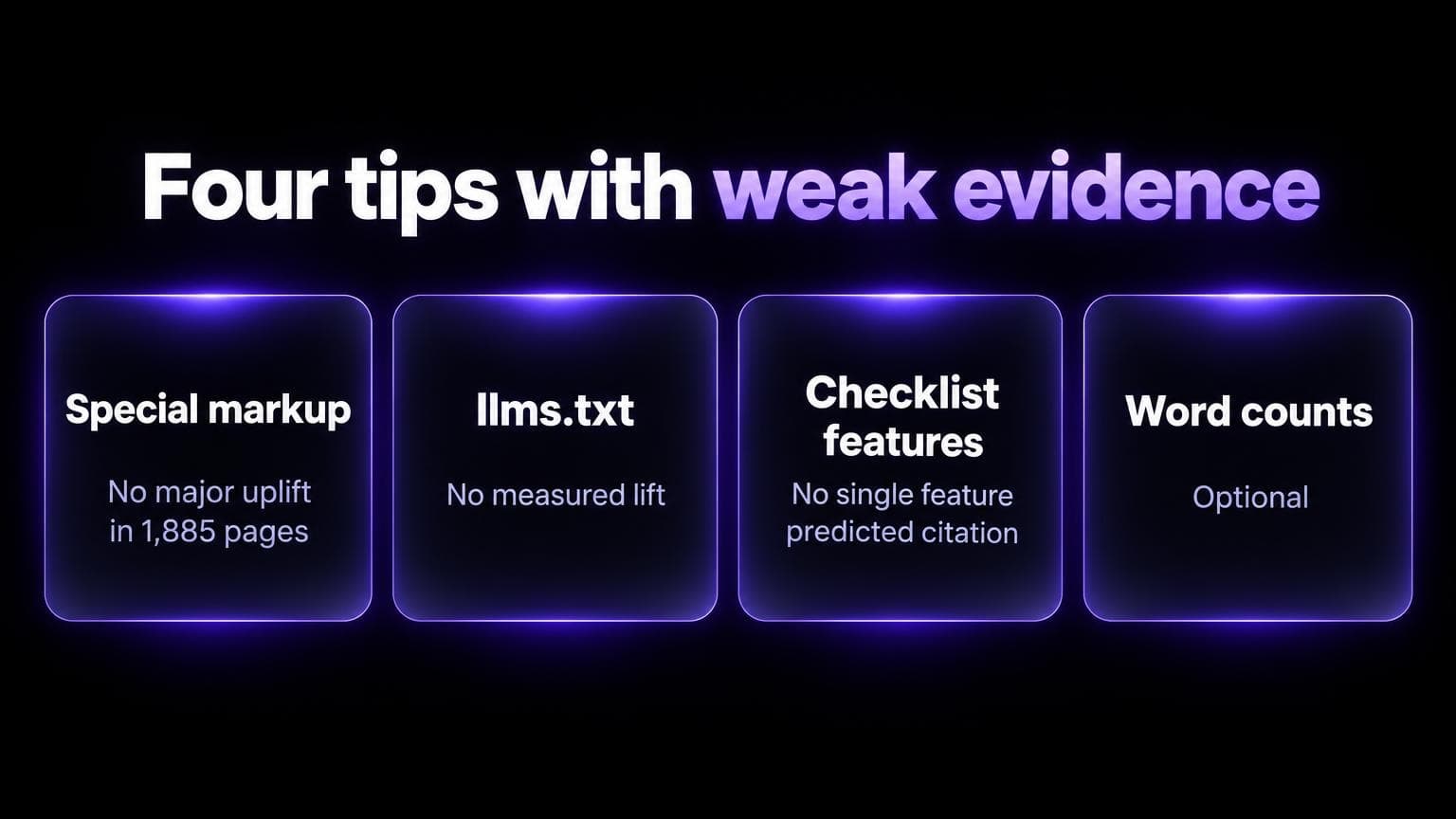
- Special markup. Google says AI features need no special schema.org markup. Ahrefs tracked 1,885 pages that added JSON-LD against 4,000 control pages. It saw no major citation uplift in AI Overviews, AI Mode or ChatGPT (Ahrefs, 11 May 2026). Limit: each page already had 100 or more AI Overview citations, so the test says nothing about pages with none. Schema is a label, not a switch.
- llms.txt. Google says you need no AI text files to appear in its AI features. cloro found no measured lift from llms.txt or schema in its data.
- Checklist features. cloro scored 249 of its own pages on 27 on-page features, including FAQ sections and takeaway blocks. No single feature predicted citation. Concrete prices and named competitors separated retrieved pages from ignored ones (one corpus). cloro treats such blocks as hygiene that makes a page liftable once retrieved. They do not get it retrieved.
- Word counts. A 40 to 60 word answer box is optional. If the first two sentences answer the heading, you are done.
Check whether it worked
Do not use one screenshot as proof.
Freeze 15 prompts. For each prompt and engine, log:
- Named (Y/N)
- Cited (Y/N)
- The cited URL: yours, a competitor's or an aggregator's
- Whether the citation supports the sentence (OpenAI tells users to open a cited source and check)
Track mentions and citations as two columns. How to measure brand visibility in AI has the metrics.
Citation rate is answers with a relevant URL divided by answers scanned.
Count it per engine. Only 13.2% of the leaderboard's cited pages were cited by more than one engine.
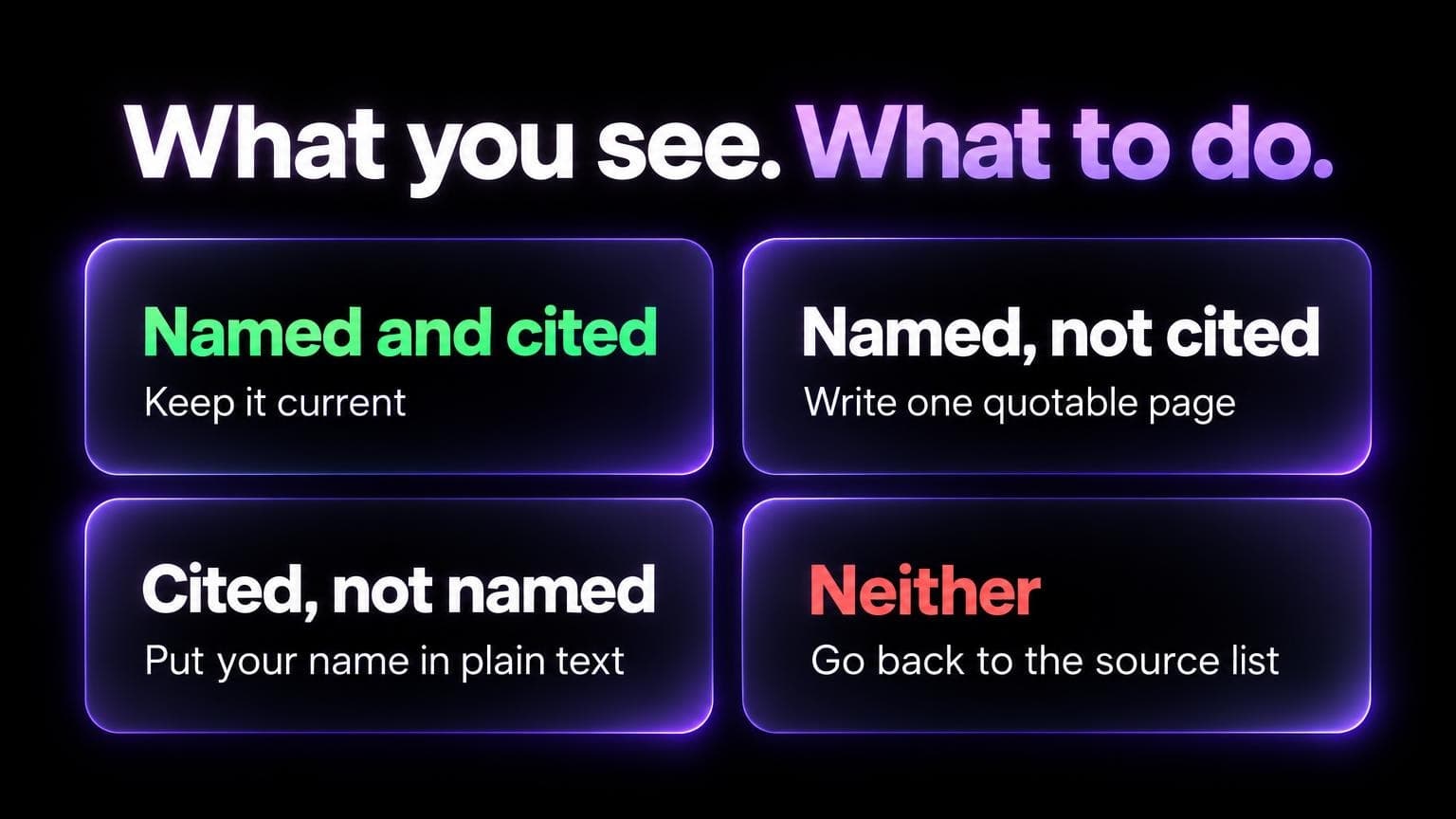
| What you see | What it means | What to do |
|---|---|---|
| Named and cited | The page works. | Keep it current. |
| Named, not cited | The engine knows you but does not use your page. | Write one quotable page for that question. Check access. |
| Cited, not named | Your page is evidence for someone else's answer. | Put your name and what you do in plain text. |
| Neither | You are not in the set. | Go back to the source list. |
Two places to look:
- The Bing AI Performance report. It covers Copilot, Bing's AI summaries and partners that Microsoft does not name.
- The leaderboard. It shows the output for 343 questions.
AI search monitoring tools compares tools that run the prompts for you.
My product. So weigh this one accordingly.
The $49 AI SEO Tracker report scans up to 50 prompts, written from your site and confirmed by you. On ChatGPT, Perplexity, Gemini, Copilot and Google AI Overviews. Daily for 7 days. For one brand.
You get mentions, citations, position in the answer, competitor gaps and the sources each engine cited.
From $79/mo to keep the set running.
It does not scan Google AI Mode, Claude, Grok, DeepSeek or Meta AI.
An agent can read the same report over MCP.
A seven-day routine.
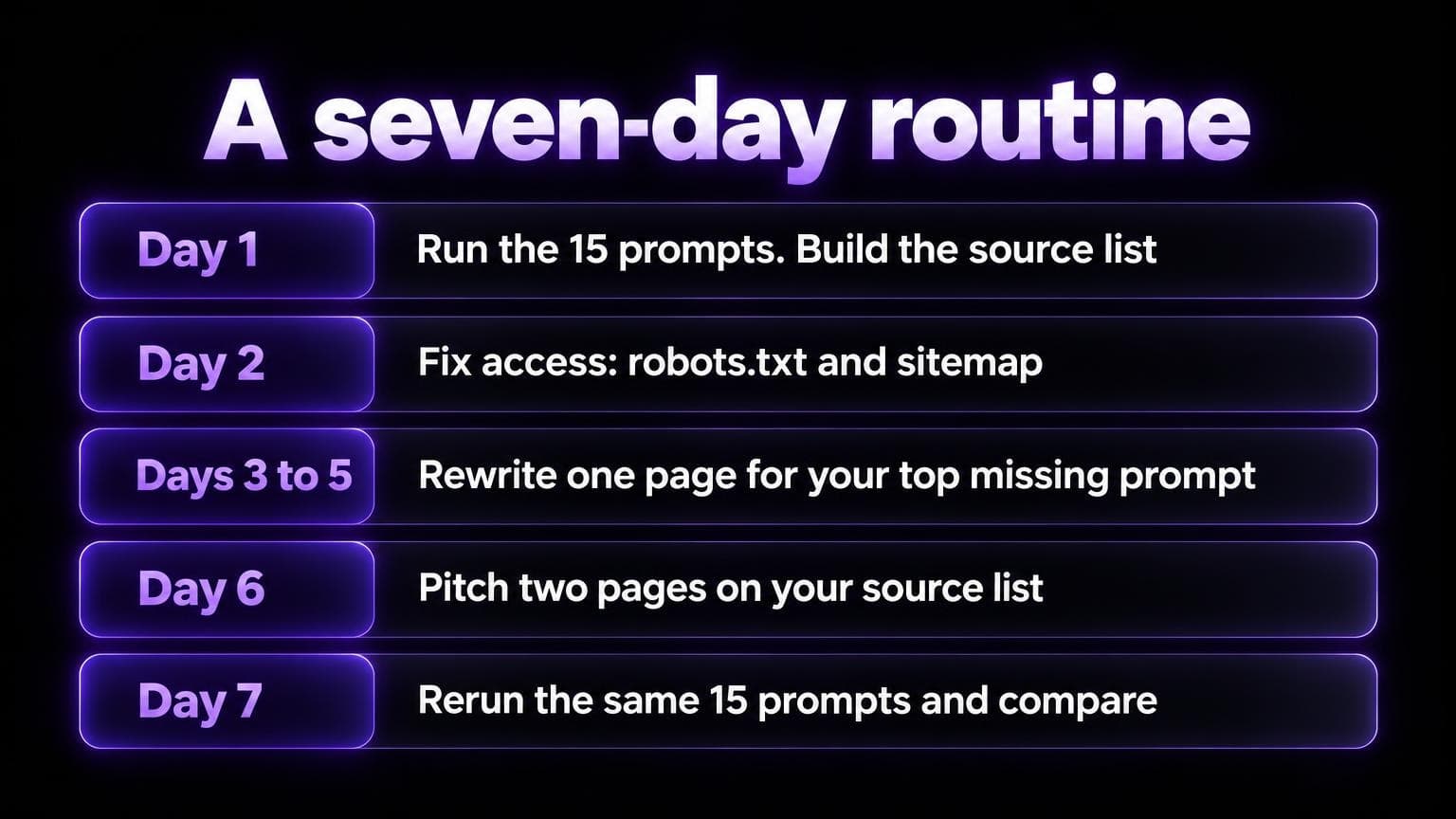
- Day 1. Run the 15 prompts. Build the source list.
- Day 2. Fix access: robots.txt and sitemap.
- Days 3 to 5. Rewrite the one page for your top missing prompt: a question heading, the answer in the first two sentences, one table.
- Day 6. Pitch two pages on your source list.
- Day 7. Rerun the same 15 prompts and compare.
Nothing moved? You probably rewrote a page the engine was not retrieving.
Go back to the list.
FAQ
Does schema get me cited?
Not on the evidence so far.
Google asks for no special markup. Ahrefs saw no lift in 1,885 pages (details above).
Use schema where it matches the visible page.
Are homepages good citation targets?
A deeper page usually does the work for category questions.
In Ahrefs' study of ChatGPT software recommendations (Ahrefs):
- A landing page on the brand's own site: in 37.2% of responses.
- A blog list: in 34%.
Ahrefs says a landing page was more likely to appear than the homepage.
A homepage answers "what is [brand]". If that prompt fails, fix the homepage.
For category prompts, fix the deeper page.
Is this the same as citing ChatGPT in an essay?
No. Here, the AI cites your page.
For the other meaning, cite the AI as your style guide or school tells you.
Can a small site get cited?
Yes. But it is rare on these questions.
Only 4.0% of the cited pages with a Domain Rating were below 50. (11.2% for the 36 software questions.)
2sync.com (Domain Rating 41) was cited by ChatGPT and Perplexity for "best calendar app".
What if the model cites a competitor's roundup that includes me?
That is a mention on their URL. And a citation for them.
Make your own page citable for the same prompt.
Then get onto a second list you do not own. So the citation does not rest on one competitor.