



TL;DR
- What it is: Getting your brand named, and your pages cited, in AI answers.
- Google's view: it's "still SEO". And you can skip llms.txt, chunking and special schema.
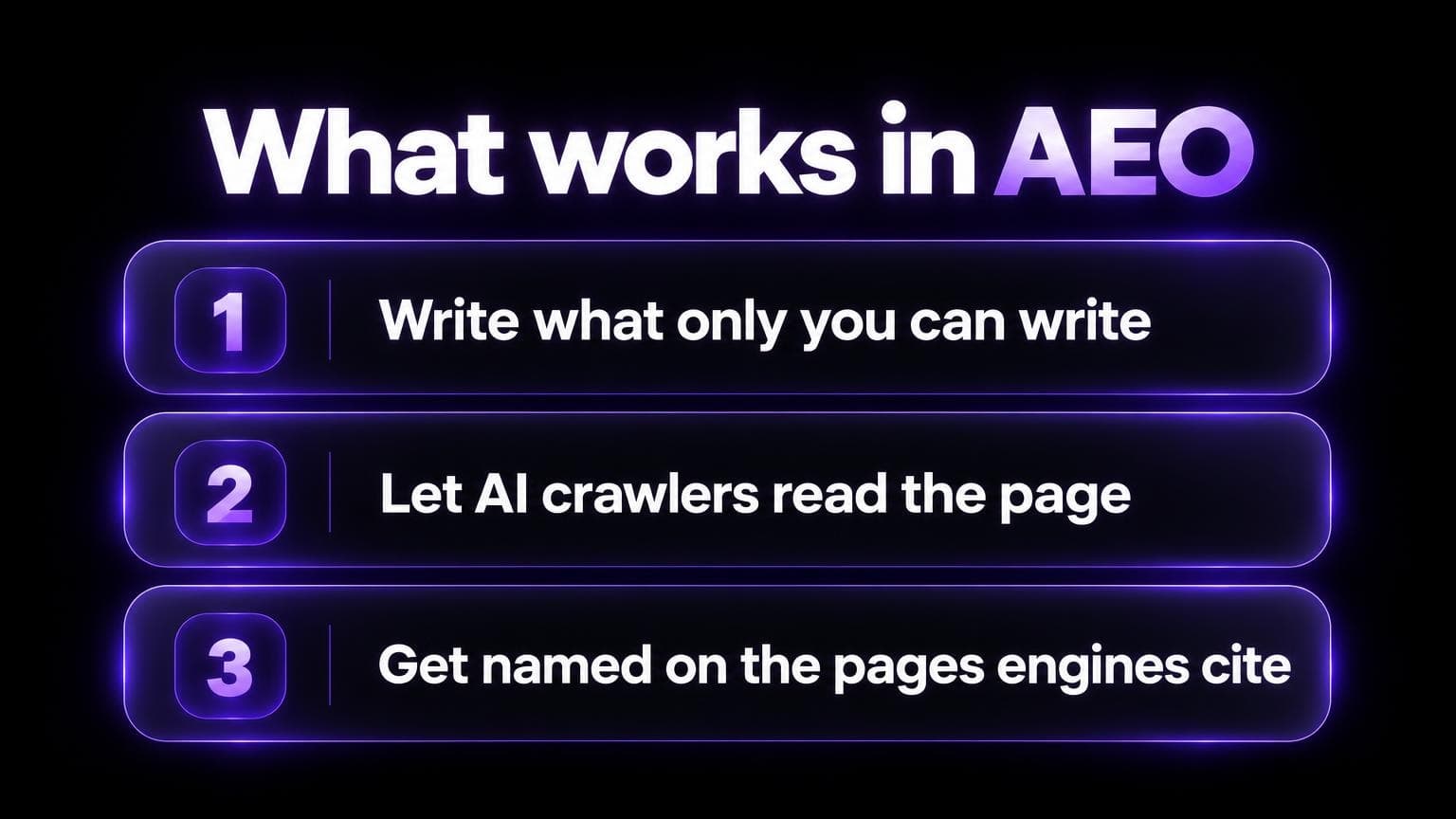
- What works: three things. Pages only you could write. Pages AI can read. Mentions on the pages engines cite.
- How to check: Run 10 to 20 buyer prompts. More than once.
- The limit: Nobody knows how the engines choose. The studies disagree.
Does AI name your brand? Check your site.
Answer engine optimization is one job.
Get your brand named, and your pages cited, in AI answers.
ChatGPT. Perplexity. Gemini. Copilot. Google AI Overviews.
You're not chasing a rank. You're chasing a place in the answer.
Why bother? Because AI answers take clicks.
- 8% click a result when Google shows an AI summary. 15% when it doesn't. (Pew, 900 US adults, March 2025.)
- 38% of the URLs cited in AI Overviews also rank in the top 10. In July 2025 it was about 76%. (Ahrefs, March 2026.)
Google says AEO is still SEO. Fine. But ranking alone doesn't get you cited anymore.
Here's what works, what to skip, and how to check your own numbers.
What is answer engine optimization
Make your brand easy for an AI to name. Make your pages easy to cite.
That's AEO.
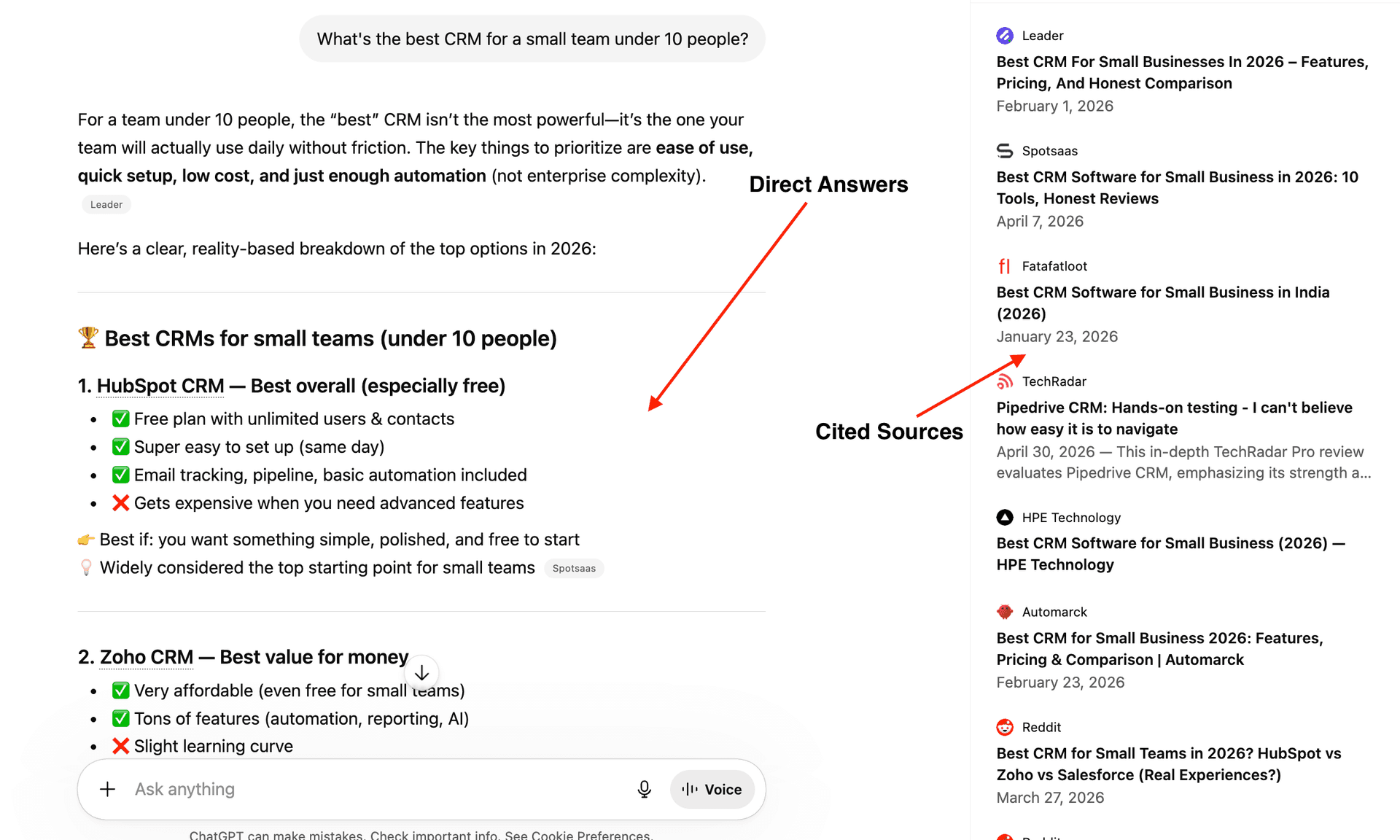
Look at the screenshot. Brands on the left. Sources on the right. You want to be in both.
The word has two meanings.
- The older one: direct answers in classic search. Featured snippets. People Also Ask. Answer boxes. Voice assistants like Siri and Alexa. Coursera's explainer defines it this way, then adds ChatGPT, AI Overviews and Copilot.
- The newer one: being a source inside an AI-written answer.
This page covers the newer one.
Google's own guide names both AEO and GEO. Its verdict: from Google Search's perspective, optimizing for generative AI search is still SEO.
How answer engines pick what to cite
Google names two techniques behind its AI answers:
- Retrieval-augmented generation (RAG). The system pulls relevant, current pages from the Search index. Then writes a response with links to the pages that support it.
- Query fan-out. The model creates related queries at the same time. And fetches results for each one.
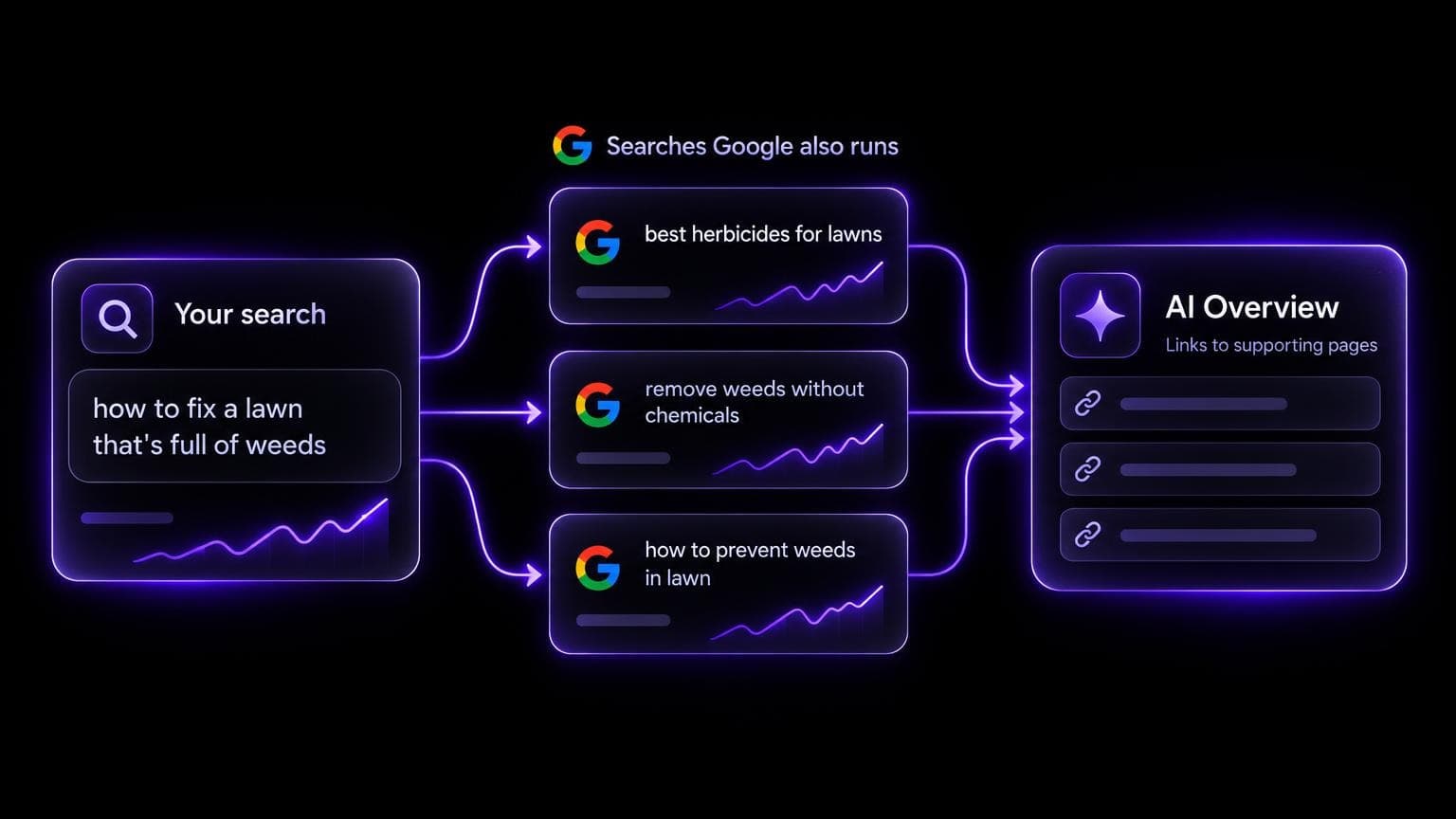
Google's example. You search "how to fix a lawn that's full of weeds". It also runs:
- "best herbicides for lawns"
- "remove weeds without chemicals"
- "how to prevent weeds in lawn"
So you compete for a set of related questions. Not for one.
And to appear at all, a page must be indexed and able to show a snippet.
That's Google. What about the others?
Nobody knows for sure. Content Science notes that answer engine companies have not fully disclosed how they choose content.
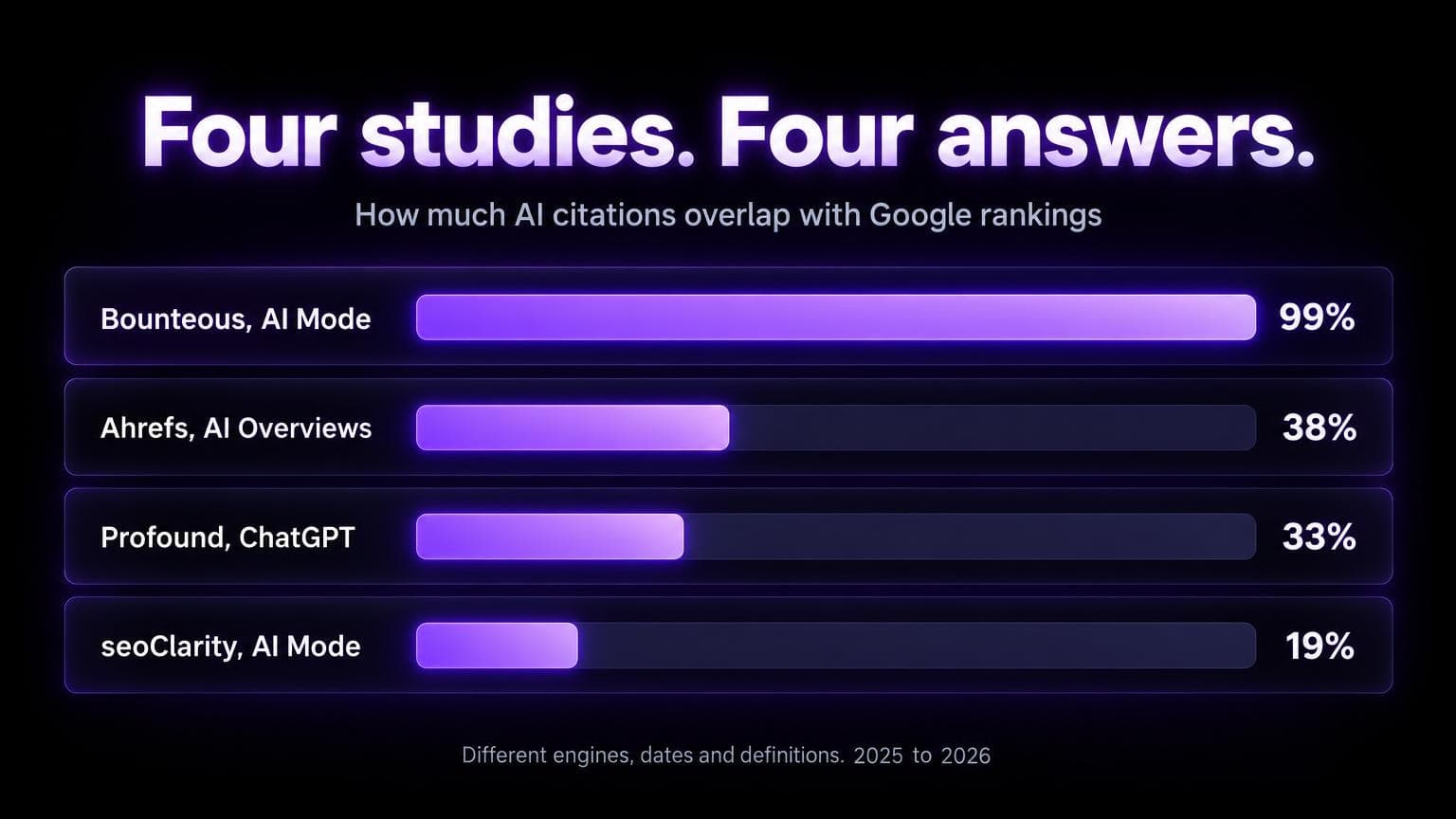
So we have studies. And the studies disagree:
| Study and date | What it counted | Result |
|---|---|---|
| Bounteous, Jul 2025 | URLs shown in AI Mode that also appear in Google's top 20 organic results | 99% |
| seoClarity, Sep 2025 | Share of 12,011 AI Mode citations, for 1,000 US transactional queries, that came from the top 20 | 19% |
| Ahrefs, Mar 2026 | Share of 4M cited AI Overview URLs that also rank in the top 10 | 38% (about 76% in Jul 2025) |
| Profound, Aug 2025 | Share of ChatGPT citations that match Google's results | 12% in Apr 2025, 33% in Jul 2025 |
Why so different? They counted different things. On different dates. In different engines.
Ahrefs thinks its own drop, from about 76% to 38%, reflects more weight on fan-out searches.
So treat "rank well and you get cited" as a weak prior. Not a rule.
For Google, ranking still feeds retrieval. But the cited list is wider than the top 10.
Another engine: how Perplexity picks sources.
AEO and SEO side by side
The basics overlap. The aim and the checks differ.
| SEO | AEO | |
|---|---|---|
| Goal | Rank a page in the results | Be named in the answer or cited as a source |
| What they type | Short queries. An AI summary showed on 8% of one or two word searches (Pew) | Full questions. An AI summary showed on 53% of searches with 10 or more words (Pew) |
| How sources are picked | Ranking systems | Retrieval plus fan-out searches. The cited list changes between runs |
| Where you check | Search Console | Prompt tests. Google's AI report covers Google only |
One more difference. AI visitors may be worth more.
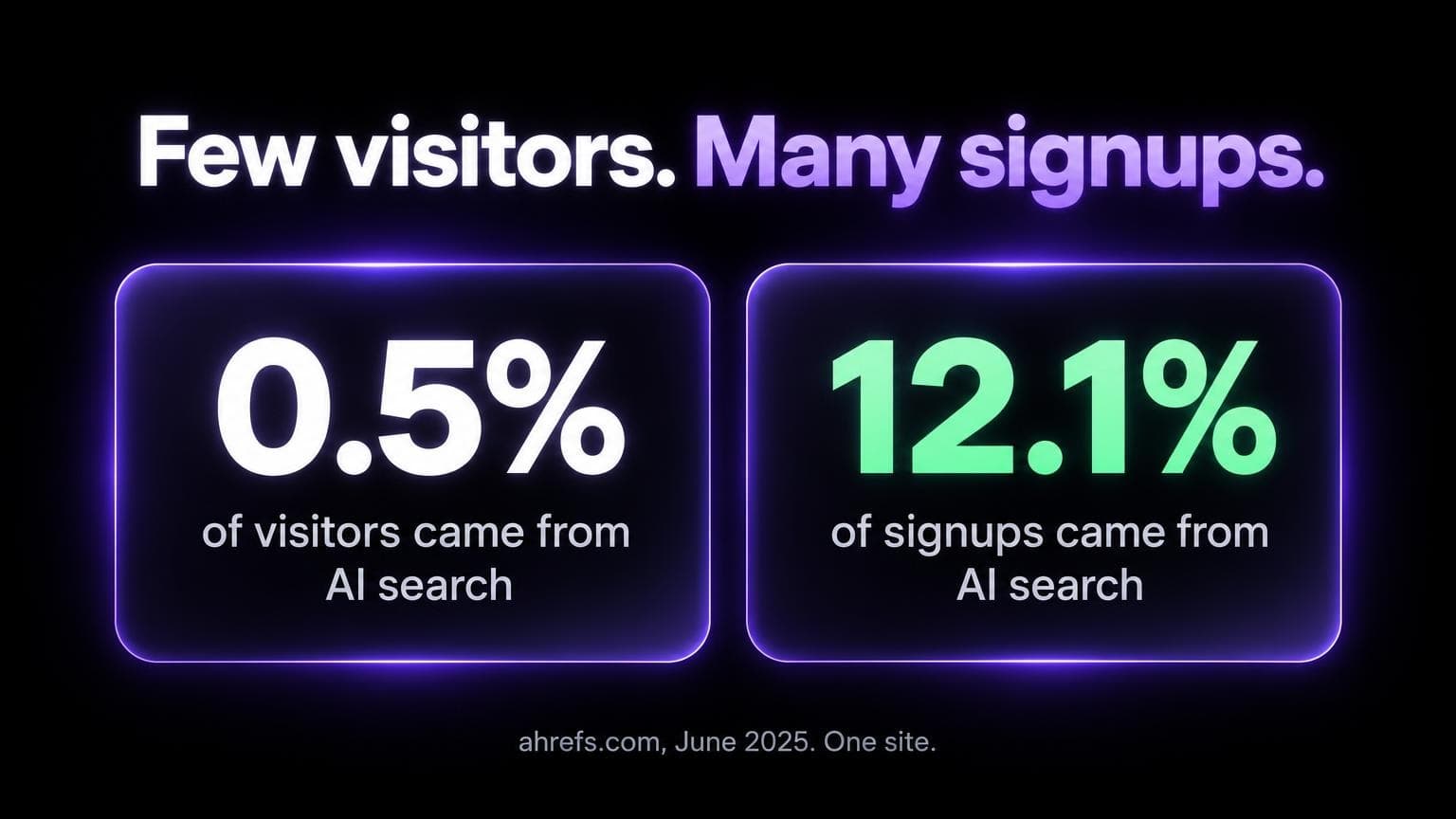
For ahrefs.com in the 30 days before its 16 June 2025 post:
- AI search was 0.5% of visitors.
- And 12.1% of signups.
That's a conversion rate 23x that of traditional organic search.
One site. Don't assume it holds for yours.
What works in AEO
Three things have a primary source or a test behind them.
Write what only you can write
Google's guide says it plainly. Unique, non-commodity content will likely shape your presence in generative AI search more, in the long run, than any other suggestion in it.
What's "commodity"? Google's Danny Sullivan showed a slide at Search Central Live in Toronto, April 2026:
- Commodity: "Top 10 Things to Consider When Buying Running Shoes".
- Not commodity: a video on why one customer's shoes collapsed after 400 miles.
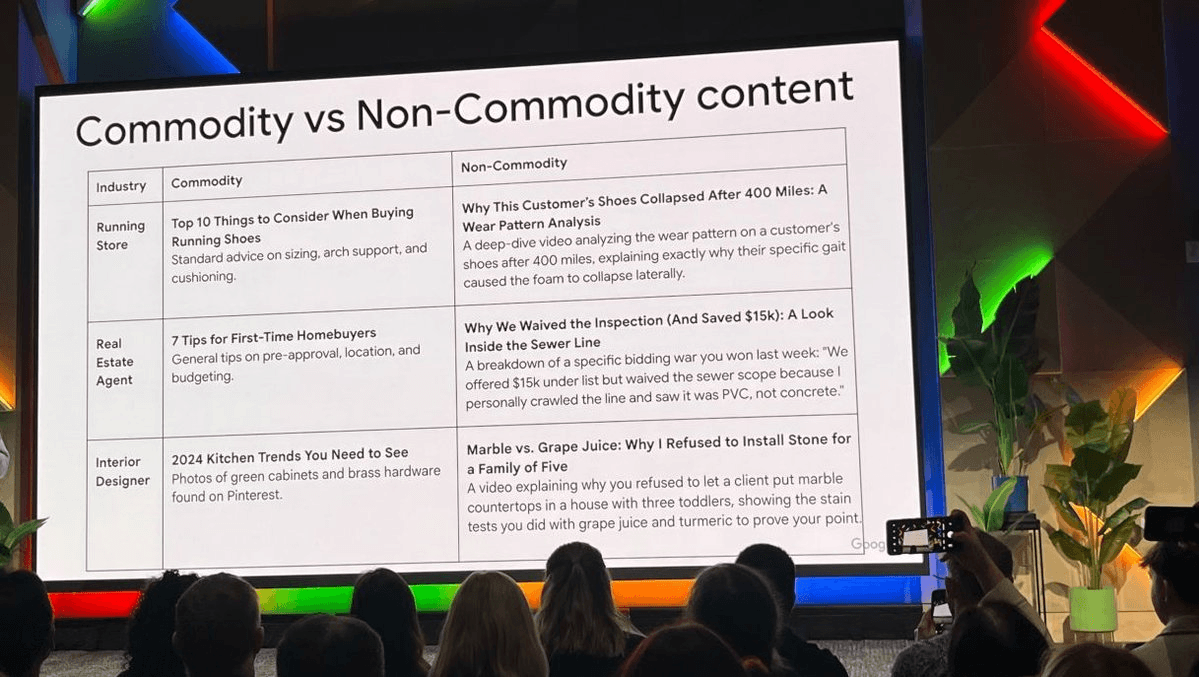
(Search Engine Roundtable has the write-up.)
The best-known study points the same way. The GEO paper (KDD 2024), from Princeton and IIT Delhi, tested nine methods:
- Adding citations, quotations or statistics: 30 to 40% more visibility on the paper's word-count metric. 15 to 30% on its subjective score.
- Keyword stuffing: no help. On Perplexity.ai its word-count score came out 10% worse than doing nothing.
Two caveats. The metric is how much of an answer draws on your page. Not clicks. And the test is from 2024.
Where do original ideas come from? Forbes contributor Lutz Finger says to look at your site search queries, sales team scripts and support chats.
Let AI crawlers read the page
Most AI crawlers don't run JavaScript.
Vercel's December 2024 analysis found that none of the major AI crawlers it studied render JavaScript. OpenAI, Anthropic, Meta, ByteDance and Perplexity.
Gemini and Applebot were the exceptions. Gemini uses Googlebot's infrastructure. Applebot renders pages with a browser-based crawler.
(The study is old. Check your own logs.)
So if your price or key facts load through JavaScript, those crawlers may see an empty page.
HubSpot hit exactly this with its pricing page. The result is below.
How to check. View the source of your page. Search for the fact that matters.
A client-rendered page often looks like this:
<body>
  <div id="root"></div>
  <script src="/app.js"></script>
</body>
That's all you see? Then a crawler that doesn't run JavaScript sees the same.
Page Inspector shows the title, description, headings and copy it can extract from a public URL. One catch: it runs scripts before it reads. So use view source or curl for the JavaScript test.
More: what ChatGPT sees on a page.
Get named on the pages engines cite
Engines cite pages about brands. Not only the brands' own pages.
So read the sources they cite:
- Pick a buyer prompt. Like "best CRM for a small team under 10 people".
- Run it in each engine. List the pages cited.
- Sort the pages by type. Pick a move for each type.
Here's the sort for our CRM scan (covered in the examples below). 24 cited pages.
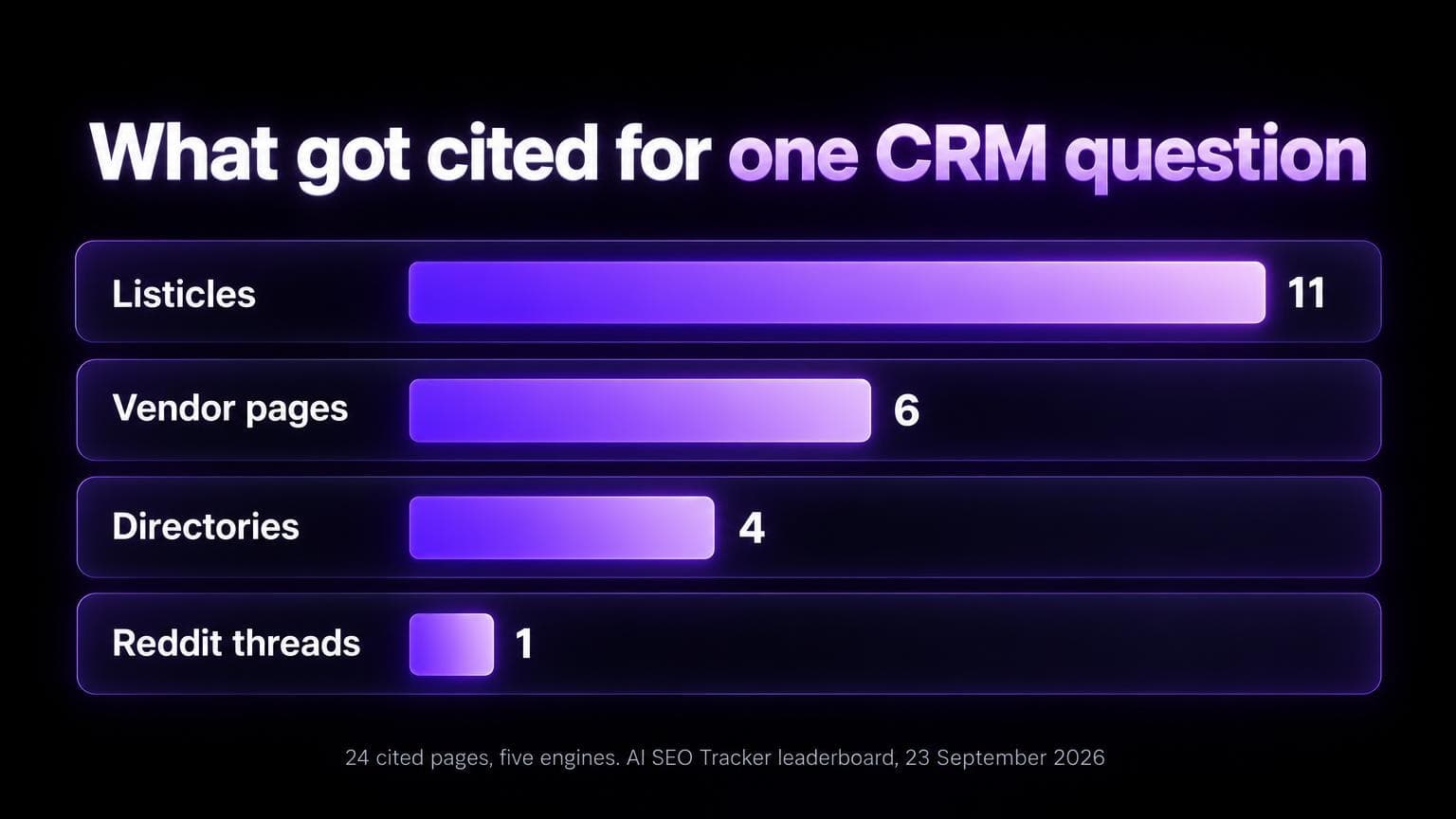
| Cited page type | Seen in the CRM scan | Your move |
|---|---|---|
| Listicle | 11 of 24 pages, 3 of them YouTube videos | Pitch the author something quotable: a number, a test, a price |
| Directory | 4 pages (G2 twice, Capterra, Software Advice) | Claim your profile. Ask real customers for reviews |
| Vendor page | All 6 pages that ChatGPT cited, on HubSpot, Pipedrive, Salesforce and Zoho | Make your own pricing and comparison pages plain HTML |
| Reddit thread | 1 page, cited by AI Overviews | Answer in the thread as yourself, and say who you are |
Which types win depends on the question. And the engine.
- Our leaderboard, 343 "best X" rankings: 77% of cited pages are listicles. 10% vendor pages. 2% Reddit threads.
- Ahrefs Brand Radar, AI Overviews, all topics, US, September 2026: YouTube is first with 22.9% of the citations earned by the 50 most-cited sites. Then Reddit with 18.5%.
So "get on Reddit" isn't the answer for every question. Test your own prompts.
And earn the mention. Google says seeking inauthentic mentions is not as helpful as it seems.
What to skip in AEO
Google's guide lists what you don't need to do. For Google Search.
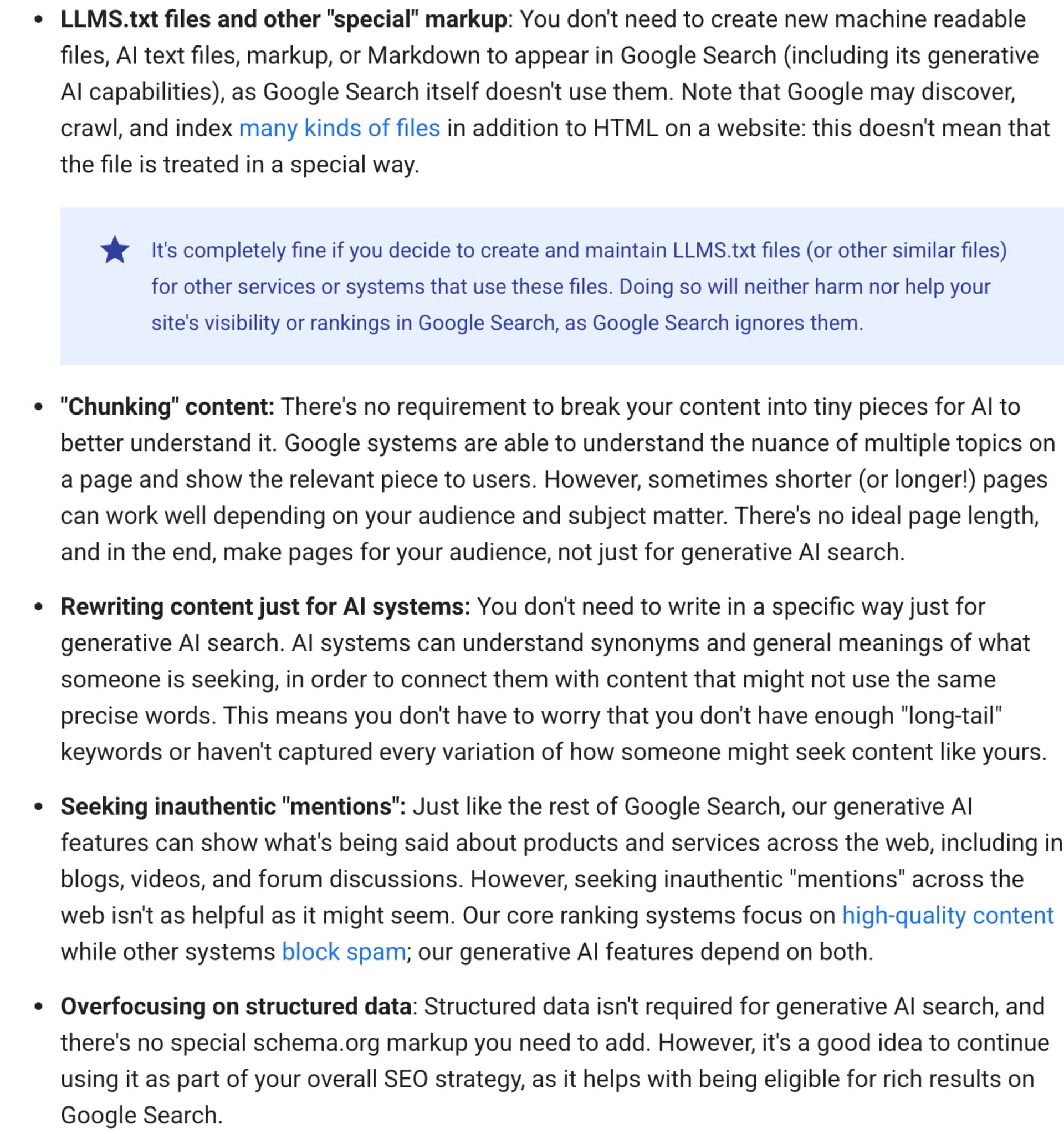
- llms.txt and other "special" markup. Google Search ignores them. They neither help nor harm there.
- "Chunking" content into tiny pieces for AI.
- Rewriting content just for AI systems.
- Seeking inauthentic mentions.
- Overfocusing on structured data. No special schema.org markup is needed. (It still helps with rich results.)
Tests back this up:
- Schema: Ahrefs tracked 1,885 pages that added JSON-LD between August 2025 and March 2026, against 4,000 matched control pages. Citations in AI Overviews fell 4.6% relative to the controls. AI Mode (plus 2.4%) and ChatGPT (plus 2.2%) were not distinguishable from zero.
- llms.txt: HubSpot's team put markers in an llms.txt file and watched its server logs. No bot visits. Nothing after submitting the file to Bingbot and Googlebot either. Aja Frost also cites an Ahrefs analysis: 97% of llms.txt files get zero requests.
Each is one test. And Google's guide speaks about Google Search. Not ChatGPT.
One open question: page volume.
- HubSpot published 141 AI-written industry and use-case pages. And reports gains.
- Google warns that separate pages for every query or fan-out variation, made to manipulate answers, can break its scaled content abuse policy.
- Frost says HubSpot's early batches were full of hallucinations. The team logged every fix.
Read that as a warning about quality. Not a recipe.

Does AI name you?
See if AI mentions your brand. Then get the pages to fix.
Examples of AEO work and what happened
Few AEO guides show a result. Here are some.
HubSpot
From Aja Frost's write-up for Growth Unhinged (16 September 2026). Her account. Not independent results.
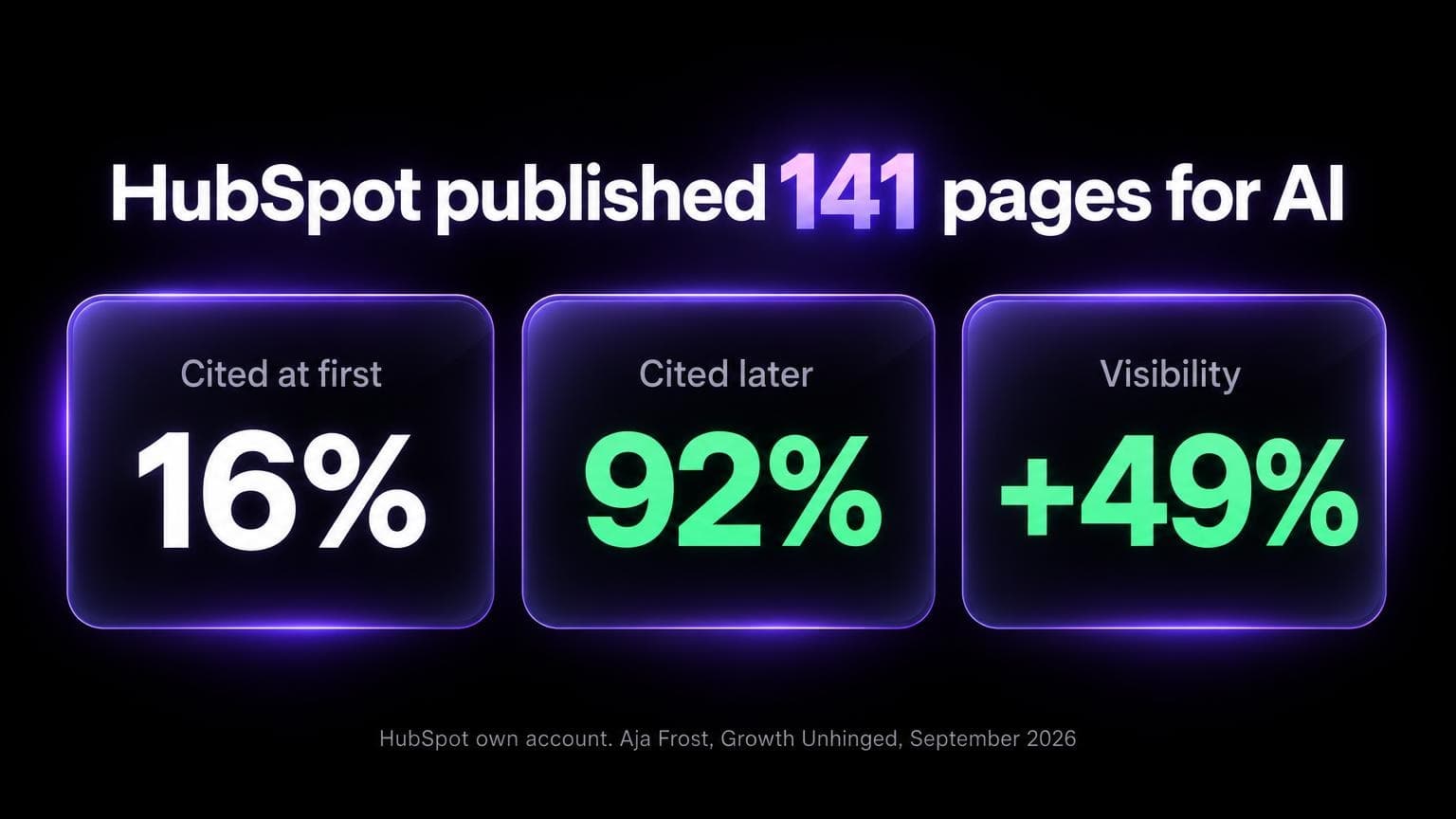
141 industry pages:
- ChatGPT's bot crawled them 15K times in a few weeks. Citations hovered around 16%.
- Then citations rose. 92% were cited.
- Visibility went up 49%.
Her lesson: crawls come first, then citations, then visibility.
Pricing:
- HubSpot's pricing pages are rendered with JavaScript. AI bots couldn't read them.
- So the bots took prices from outdated third-party sites.
- The team wrote plain blog posts about each product's pricing.
- Two months later, accuracy improved for five of six products.
- Sales Hub got worse. Until the team corrected its prices on third-party sites.
llms.txt: tested. Found nothing. (See above.)
Her year-end claim, which HubSpot reports about itself: the most visible CRM in AI search. And qualified leads from AI up 1,850%.
A scan you can check yourself
"Best CRM Software" on our leaderboard. Five engines. Data synced 23 September 2026.
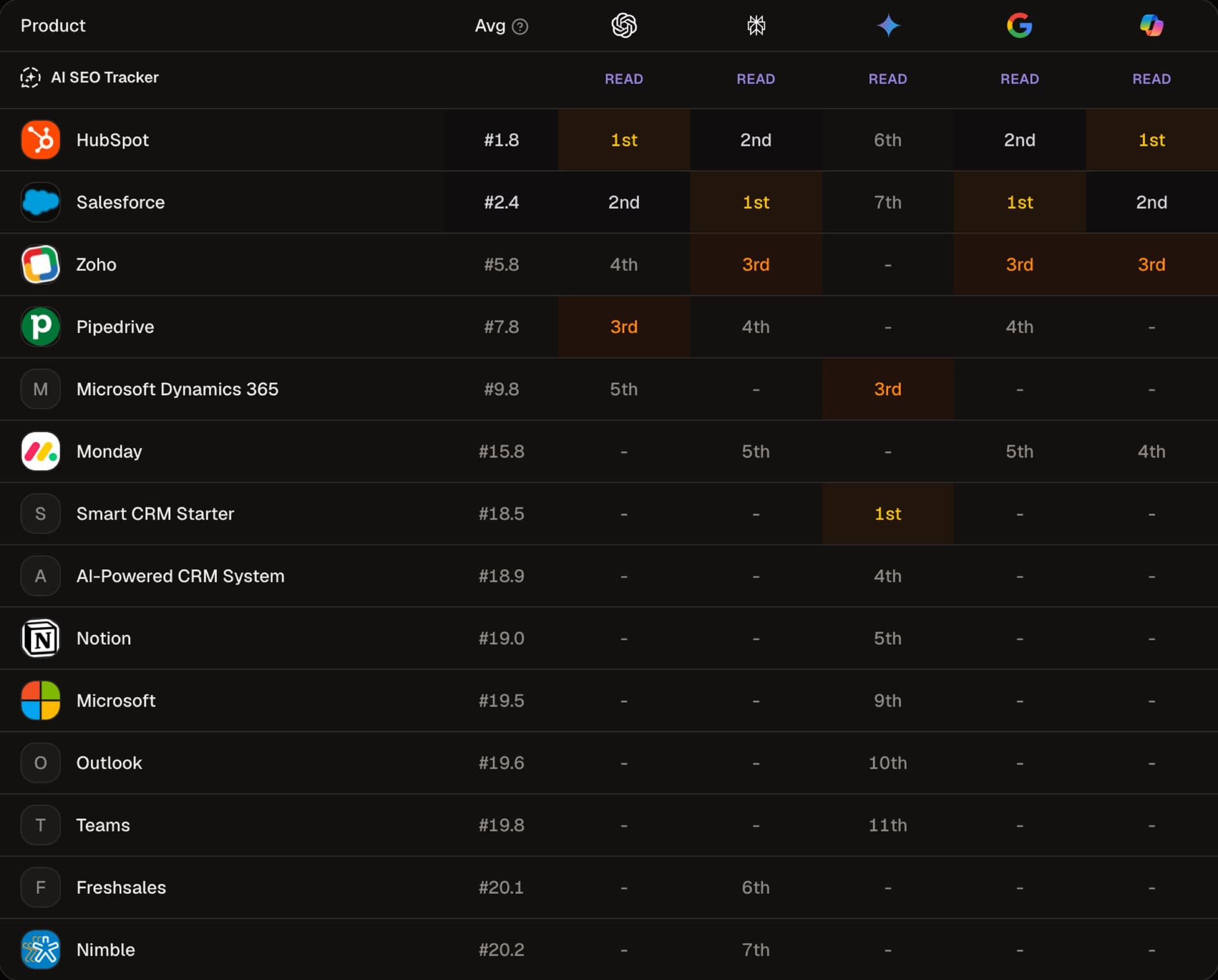
Read it in three lines:
- The engines disagree. HubSpot is 1st in ChatGPT and Copilot. 2nd in Perplexity and AI Overviews. 6th in Gemini. Salesforce is 1st in Perplexity and AI Overviews. 7th in Gemini.
- Gemini has its own pick. Its number one is "Smart CRM Starter". No other engine lists it.
- The sources differ by engine. ChatGPT cited six vendor pages. Perplexity cited ten reviews, listicles, directories and news pages.
How to measure AEO
Start by hand. For a first look, check one question in ChatGPT with the free AI Visibility Checker.
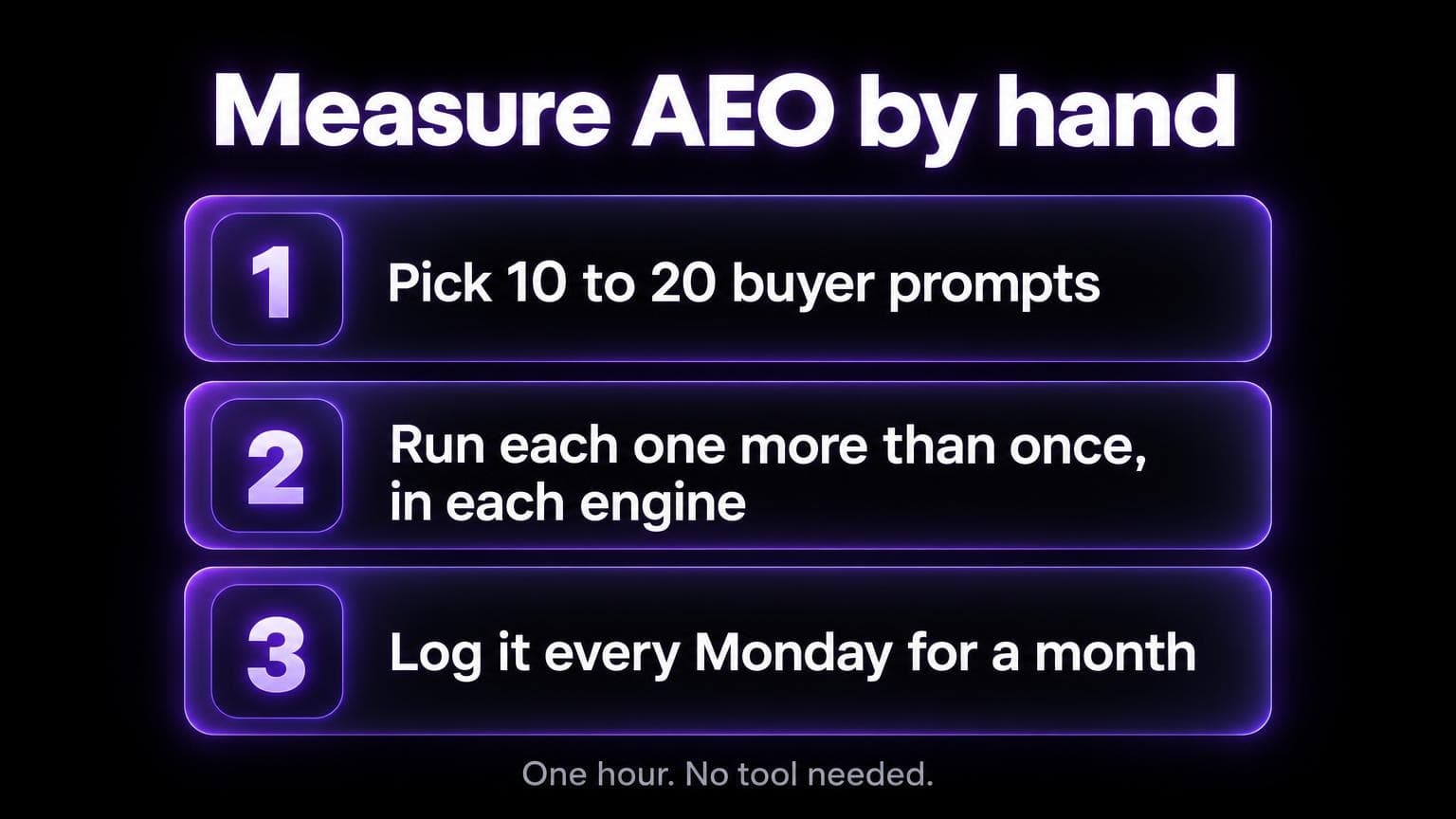
- Pick 10 to 20 prompts. Buyer questions. Mix branded ("is Acme worth it") and non-branded ("best CRM for agencies").
- Run each prompt more than once, in each engine. Why? Ahrefs followed 43,000 keywords for a month. An AI Overview changed 70% of the time between observations. And on average, 45.5% of cited sources were new from one check to the next.
- Log it. Date, engine, prompt. Were you mentioned? Were you cited? Who else was named? Repeat every Monday for a month.
Then read Google's own data.
The generative AI performance report in Search Console is open to all sites since 31 August 2026.
- It shows impressions. Only impressions. In AI Overviews and AI Mode.
- By page, country, device and date.
- It may not appear if your site has too few.
- It doesn't cover ChatGPT, Perplexity or Copilot.
Clicks from AI features are counted in the main Performance report. Mixed in with other web traffic.
Add AI referrals in your analytics as a second signal. Finger argues that watching the traffic from ChatGPT, Gemini and Perplexity is cheaper and more reliable than a dashboard.
By hand, or a tool?
| Test by hand | Use a tool | |
|---|---|---|
| Engines | Any you can open, including Claude and Google AI Mode | A fixed list. AI SEO Tracker scans ChatGPT, Perplexity, Gemini, Copilot and Google AI Overviews. It does not scan AI Mode, Claude, Grok, DeepSeek or Meta AI. HubSpot AEO names ChatGPT, Perplexity and Gemini as examples |
| Repeat runs | You repeat each prompt yourself | Scheduled. AI SEO Tracker scans daily for 7 days |
| Cost | Your time | AI SEO Tracker: $49 once, up to 50 prompts written from your site, one brand. HubSpot AEO: $50 a month |
| Limit | Gets messy past about 20 prompts | A tool is also a sample. Google says no third-party tool has access to its internal ranking or AI systems |
My advice: do the work first. Buy the dashboard second.
Ten prompts and one hour will show you where you stand.
More: AEO metrics, best AI visibility tools, and for Google's box alone, how to track AI Overviews.
What nobody knows yet
Three honest gaps.
- How engines choose. Their makers haven't fully disclosed it. The table above shows four answers to one question. Content Science says the field runs on observed patterns.
- What transfers. Ahrefs' 12.1% of signups is one site. HubSpot's results are one company's account.
- What each person sees. Finger argues that models remember past chats. So no dashboard sees every user's answer. Treat any tracker, ours included, as a sample. Pair it with your traffic.
FAQ
Is AEO real? Google says optimizing for AI search is SEO under another name. The studies show the cited pages are not only the top-ranking ones. Both are true. The basics are the same. The places you need to be seen are wider.
What is AEO vs SEO? SEO ranks a page in a list of results. AEO gets your brand named, or your page cited, in an AI-written answer. See the table.
How do you do answer engine optimization? Test 10 to 20 buyer prompts by hand for a baseline. Then write what only you can write, let AI crawlers read the page, and get named on the pages engines cite. Test again.
What is the best answer engine optimization tool? Depends on what you need to see. Test by hand first. A tool helps when you pass about 20 prompts or want repeat runs. See the tool comparison.
How long does AEO take? No one publishes a reliable number. HubSpot saw crawls first, then citations, then visibility. Its pricing fix took two months.
Will AEO show up in Search Console? Partly. For Google only. See how to measure AEO. Citations from ChatGPT, Perplexity and Copilot don't show up at all.
What is the difference between AEO, GEO, and AIO? People use the labels loosely. Google treats AEO and GEO as SEO. For the GEO label: generative engine optimization. The full comparison: AI SEO vs LLM SEO vs GEO vs LEO.