

 ChatGPT
 Perplexity
 Claude
 Grok
GrokAsk ten marketers what LLM SEO is and you'll get two different answers.
One camp says it's just SEO with a new label. The other says it's an entirely new game with new rules and new tools.
Both are partly right. That's exactly why so many people are confused.
So let's clear it up. LLM SEO is the practice of getting ChatGPT, Perplexity, Gemini, Copilot, and AI Overviews to mention your brand when they answer a question.
You're still competing for visibility in Google. But now you're also trying to become the brand AI systems cite directly in their answers.
I've tested this across multiple client brands. Here's what actually moves the needle, what's just short-term hype, and how to measure whether any of it is working.

Does AI name you?
See if AI mentions your brand. Then get the pages to fix.
What is LLM SEO? Recommended, not ranked
Most people think about LLM SEO the same way they think about Google. Ten results, a battle for the top spot, and a click if you win.
That's not how it works.
LLMs don't rank a list. They recommend a handful of brands within a single answer. Ask ChatGPT for the best project management tool and it'll name three or four options. It doesn't give you 10 links to sort through.
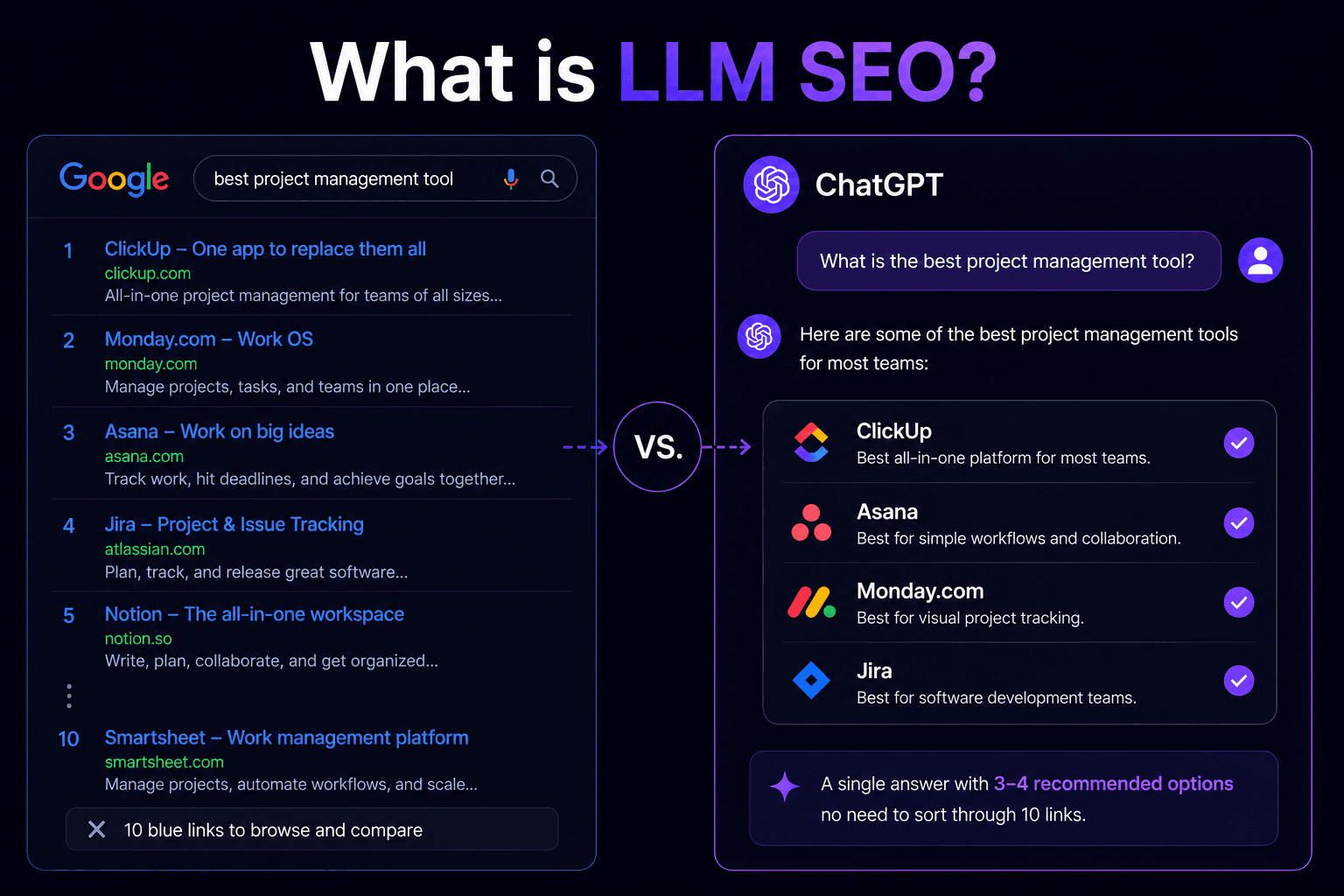
So the goal changes. You're not trying to hold position #4. You're trying to become one of the brands the model mentions by name.
There's a second shift too. On Google, people often search once and click. With an LLM, they keep the conversation going. They ask a question, follow up, and then narrow down their options. The entire experience is interactive.
That means you're optimizing for a conversation, not a single query. Your content needs to answer the first question and the three that follow.
Here's the mental model to keep in mind for the rest of this article:
LLMs only know what the internet knows about you.
They pull from information available across the web. If there's more useful, trustworthy information about your brand than your competitors, you're more likely to be recommended. So give them more to work with.
LLM SEO vs Traditional SEO
This is where most people get it wrong. They assume strong Google rankings automatically translate into visibility in ChatGPT.
The data suggests otherwise.
Ahrefs analyzed 15,000 prompts across ChatGPT, Gemini, and Copilot. On average, only 12% of the URLs these AI assistants cited also ranked in Google's top 10 results for the same query. Put differently, nearly 90% of AI citations came from pages that weren't ranking in the top 10 at all.
Google's AI Overviews used to tell a different story. Early on, they relied heavily on pages that already ranked well in traditional search. But that's changing fast.
According to Ahrefs' Q1 2026 benchmark, just 37.9% of pages cited in AI Overviews also ranked in Google's top 10 results. In their July 2025 study, that figure was roughly 76%.
In other words, AI Overviews are becoming less dependent on traditional rankings and more willing to surface information from outside the original search results. The most likely reason is Google's growing use of fan-out queries, which we'll cover next.
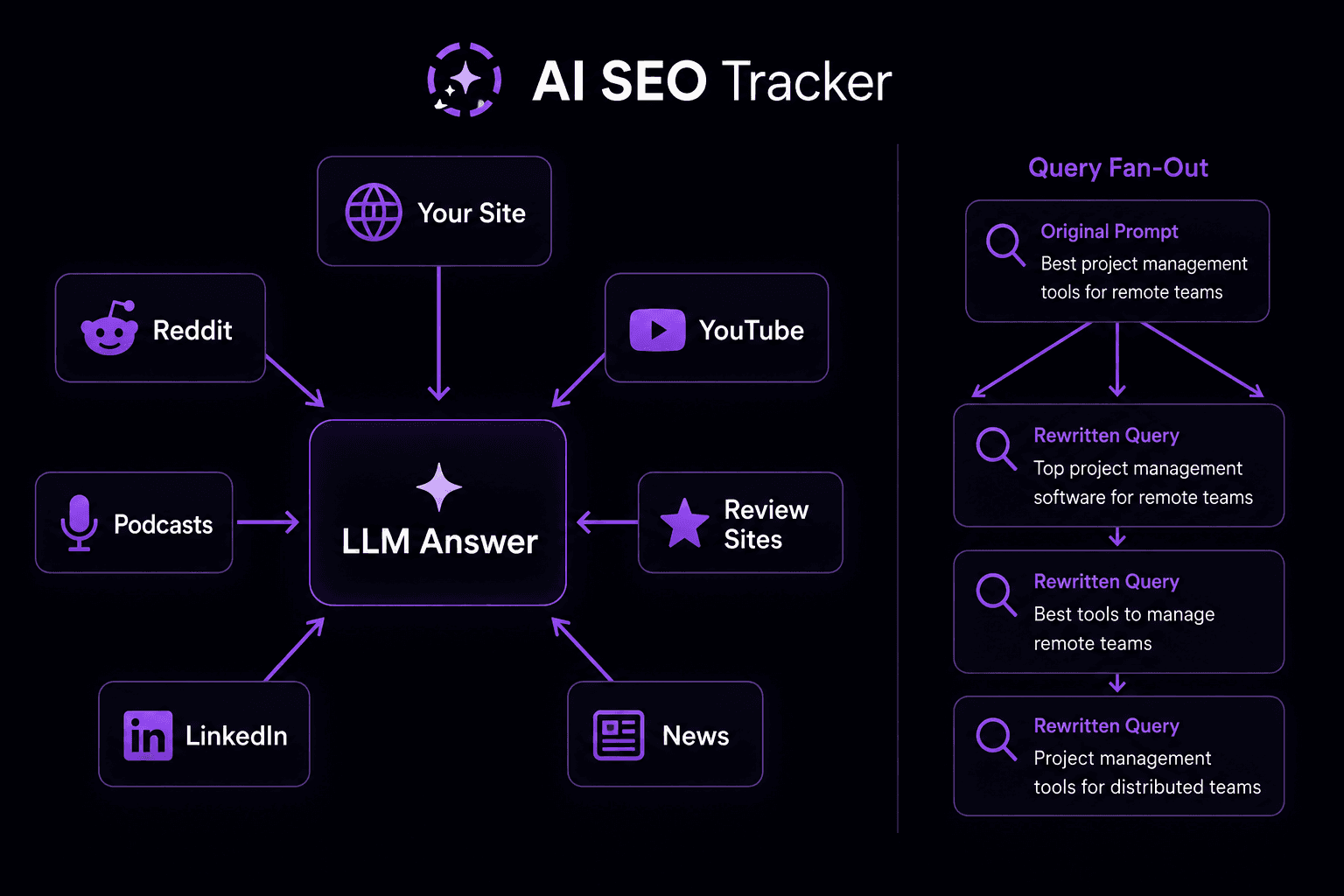
So the work splits in two.
Strong SEO still helps you show up in Google's AI features. But visibility in ChatGPT, Perplexity, and other LLMs is driven by something broader: your brand's presence across the web: Reddit, YouTube, reviews, forums, and third-party mentions.
You can't win with rankings alone. You need both search visibility and brand visibility.
| Traditional SEO | LLM SEO | |
|---|---|---|
| Goal | Rank your page on a SERP | Get named in the answer or cited as a source |
| What the user sees | 10 blue links | One written answer with a few cited sources |
| What the user types | A keyword ("best CRM") | A full prompt ("best CRM for a 5-person team") |
| Trust signal | Backlinks, domain authority | Backlinks plus brand mentions across the web |
| Where you show up | One Google SERP | ChatGPT, Perplexity, Gemini, Copilot, AI Overviews |
| How you check it | Google Search Console | An LLM SEO tool |
| What you measure | Position, clicks, impressions | Mention rate, citation share, sentiment |
| Time to results | 6 to 12 months | 2 to 4 months, but more volatile |
The takeaway is simple: keep investing in SEO. Just don't expect rankings alone to win in AI search.
The cheapest win in LLM SEO: Consistency
If you change one thing after reading this article, make it this:
Describe your brand the same way everywhere.
Your website. LinkedIn. X. Directory listings. Press releases. Pick one description and repeat it consistently.
If you're an "SEO consultant for lawyers," use that phrase everywhere. Don't become a "legal search visibility expert" on one profile and a "growth partner for law firms" on another. Every variation creates another signal the model has to interpret.
When the language stays consistent, the model stops guessing who you are. It starts associating your brand with one clear category. When it doesn't, you're no longer one strong entity. You're several weaker versions of the same thing.
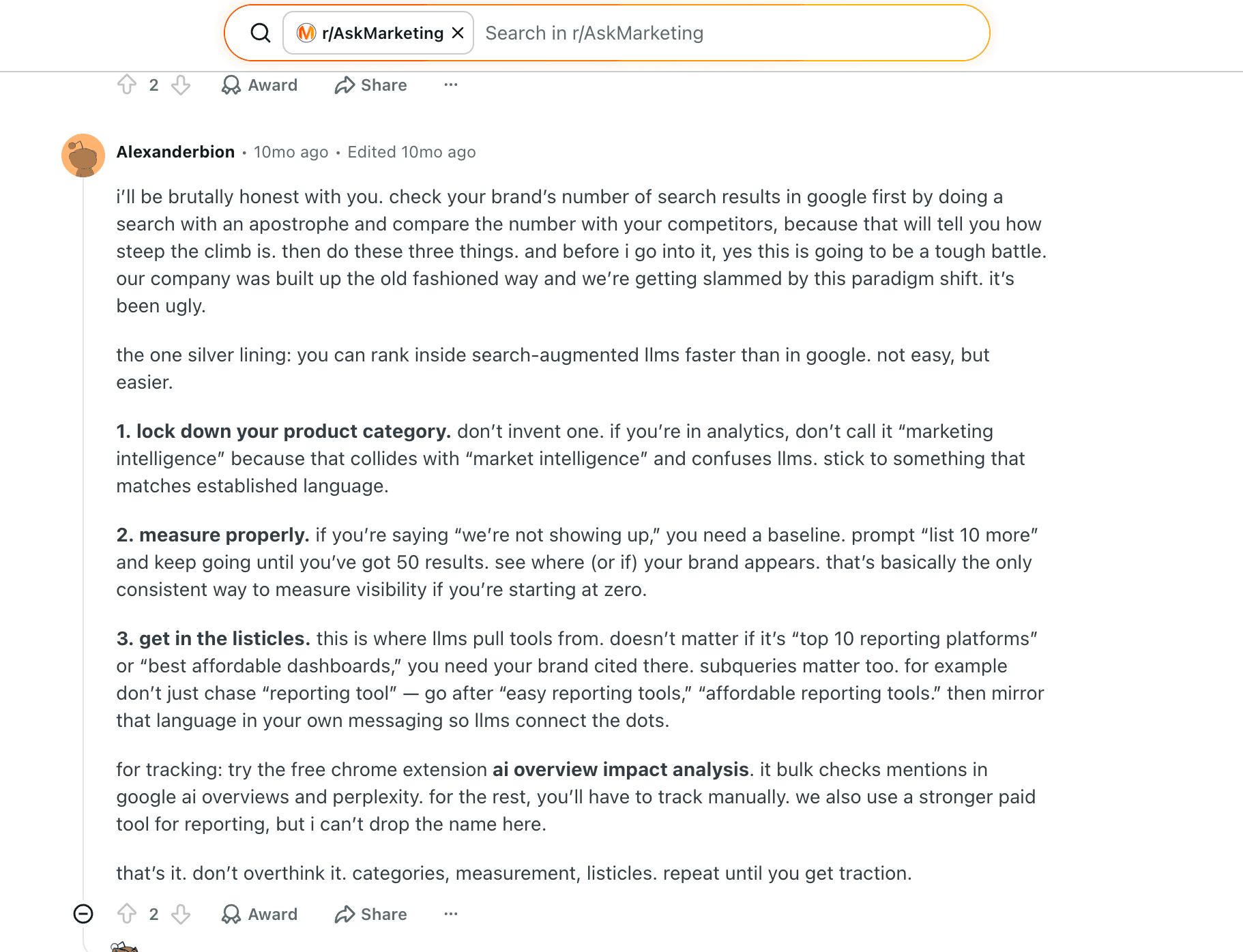
This is something practitioners see repeatedly. In one discussion about LLM visibility, a marketer summed it up well: lock down your category, don't invent one. If you're in market intelligence, call it market intelligence. Don't rebrand it as "marketing intelligence" because it sounds different.
The goal isn't originality. It's recognition.
The payoff is often fastest for smaller brands: freelancers, consultants, and indie founders. When your footprint is small, a handful of consistent mentions can change what an LLM says about you in days, not months.
Consistency applies to your facts, too. If your website says $10 per month and a directory says $5, you're feeding the model conflicting signals. The same goes for features, positioning, and product descriptions.
Make it easy for the model. Keep everything aligned everywhere.
Boring work. Big payoff.
Optimize for Prompts, not Keywords
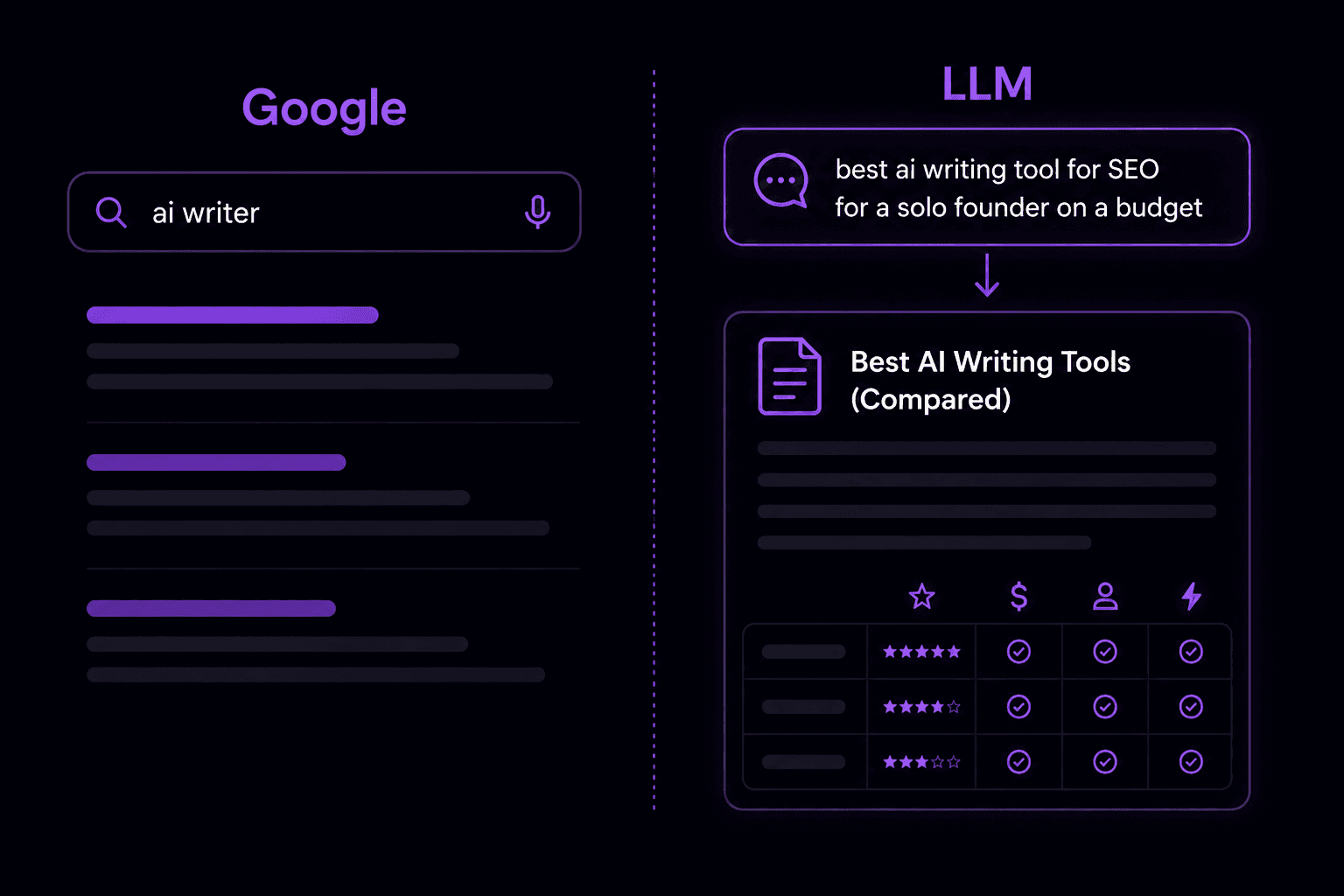
On Google, people type fragments. "AI writer." "Best CRM." Three words, maybe a few more, then a search button.
On an LLM, they type the whole thought. "What's the best AI writing tool for SEO if I'm a solo founder on a tight budget?"
That difference changes what you build.
Chasing the bare keyword isn't enough anymore. You want content that answers the full prompt, with all its context. The budget. The use case. The type of buyer.
So write for the long version. "Best X for Y" pages. Comparison pages. Alternatives pages. The questions people actually ask, phrased the way they ask them.
Why listicles work
The data backs this up.
In the Ahrefs Q1 2026 benchmark, blog-style lists made up 43.8% of every source URL ChatGPT cited for top-of-funnel "best" queries.
Listicles are where the models shop.
Operators have noticed. In that r/AskMarketing thread, one marketer's advice was blunt: get in the listicles, that's where LLMs pull tools from. And don't just chase "reporting tool." Go after "easy reporting tools" and "affordable reporting tools" too, then mirror that language in your own copy.
Own the list. Get on the list.
So try both kinds and see what works for you.
Publishing a "best [your category]" post on your own site, with yourself in the mix, works. I've ranked this way myself and it still pulls citations.
Keep doing it.
Just don't lean too hard on self-heavy lists alone. Your AI visibility is still tied to your Google health, and that can change.
The move that compounds is getting on lists you don't own. Independent publications. Review sites like G2. Third-party roundups in your category.
A listicle someone else publishes with you on it carries trust your own post can't fake.
Run both in parallel and watch which one moves your mentions.
One more source: YouTube
One more lever. LLMs can read YouTube transcripts now.
A single thorough video explaining what your product does can feed your recommendations, even without a blog post.
Build presence where your buyers actually research
Earlier I said LLMs pull from across the web. Here's the important part: they don't all pull from the same places.
Each model leans on different sources. That means your job isn't to be everywhere.
It's to be visible in the places that influence the model your buyers use.
Right now, the patterns look something like this:
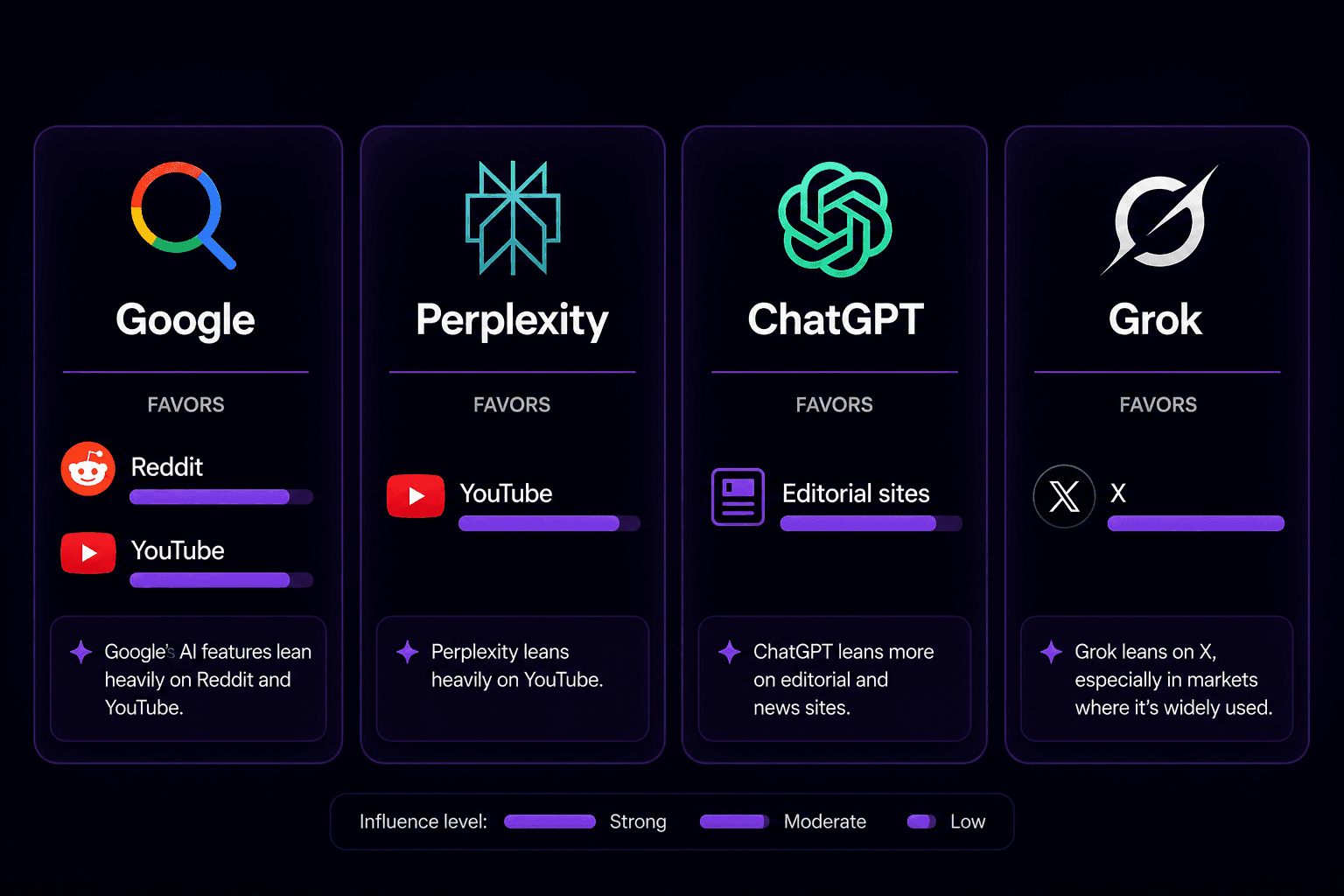
- Google's AI features lean heavily on Reddit and YouTube.
- Perplexity leans heavily on YouTube.
- ChatGPT leans more on editorial and news sites.
- Grok leans on X, especially in markets where it's widely used.
Why YouTube matters more than most SEOs think
One finding from the Ahrefs Q1 2026 benchmark stands out.
Across 75,000 brands, YouTube mentions correlated with AI visibility more strongly than any other factor they measured. Stronger than backlinks. Stronger than domain rating. Stronger than branded search volume.
Sit with that for a second.
A channel most SEOs barely think about outperformed the signals they spend years optimizing.
Third-party mentions matter more than you think
The same benchmark found that link volume barely correlated with AI visibility at all.
That doesn't mean backlinks are dead. They still matter for Google.
But if your goal is getting recommended inside AI answers, third-party mentions appear to carry far more weight than most marketers realize.
The Reddit discussion pointed in the same direction. The consensus was simple: third-party mentions matter, and user-generated content carries disproportionate influence.
One marketer summed up their entire approach in a single sentence:
Treat LLM visibility like PR, not SEO.
Follow the citations
This leads to a simple workflow.
Type your buyers' prompts into the models they use. Look at which sources appear in the answers. Then focus your efforts there.
If a subreddit keeps showing up, participate there.
If editorial publications dominate the citations, invest in digital PR, partnerships, or guest contributions.
If YouTube keeps surfacing, make the video.
Don't guess where the models look. Check where they're already looking.
One final caution
These source preferences change with every major model update, so treat the list above as a snapshot, not a rule.
What stays consistent is the habit underneath.
Every model relies on a set of trusted sources when forming an answer. Find out which sources matter today, then make sure your brand shows up there, positively.
Two myths you can skip
A lot of LLM SEO advice sounds useful but creates very little impact.
These two tactics get far more attention than they deserve.
The llms.txt file
The idea is simple: add a text file to your website telling AI models what they should know about your business, and they'll use that information when generating answers.
That's not how it works.
Companies that use llms.txt today mostly use it for developer documentation and API references, not as a ranking or recommendation signal. No major LLM provider has publicly confirmed using it to decide which brands to cite or recommend.
In practice, it looks a lot like the old meta keywords tag: a signal website owners completely control, which makes it easy to manipulate and difficult to trust.
Google's position is straightforward. You don't need a special AI file to appear in AI Overviews or other AI-powered search features.
Niche schema markup
Another common claim is that you need increasingly complex schema markup to appear in AI-generated answers.
The evidence isn't very convincing.
Pages that get cited often have more schema. But they also tend to have stronger content, more authority, and more visibility overall. Correlation doesn't tell you which factor actually caused the result.
That doesn't mean schema is useless. It just means most websites don't need a custom schema project to improve AI visibility.
Use the structured data your CMS already supports. Add schema when it genuinely matches your content. Skip the expensive markup exercises built around speculative benefits.
One marketer in that Reddit discussion put it bluntly:
Schema doesn't matter. The copy does.
Focus on what moves the needle
Every hour spent debating llms.txt or custom schema is an hour not spent improving your positioning, building third-party mentions, publishing useful content, or creating a stronger brand footprint across the web.
The highest-leverage work hasn't changed.
Be easier to understand. Be easier to find. Give the models more trustworthy information to work with.
How to measure LLM SEO
Google Search Console won't show you a single ChatGPT mention. The moment an answer happens inside an LLM, your usual reporting goes blind.
So you need an LLM SEO tool built for it.
The core job is tracking where your brand gets mentioned across ChatGPT, Perplexity, Gemini, Copilot, and AI Overviews. A useful one goes further and reports four things: your citation share, your average position in the answer, the sentiment around your brand, and which sources each model cited.
The sources matter most, because they tell you what to fix. Editorial sites dominating the citations points you toward PR. A competitor's own pages getting cited points to a content gap. A subreddit appearing again and again points to where you should be active.
Then there are competitor gaps: the prompts that mention your rivals but not you. That list is your roadmap.
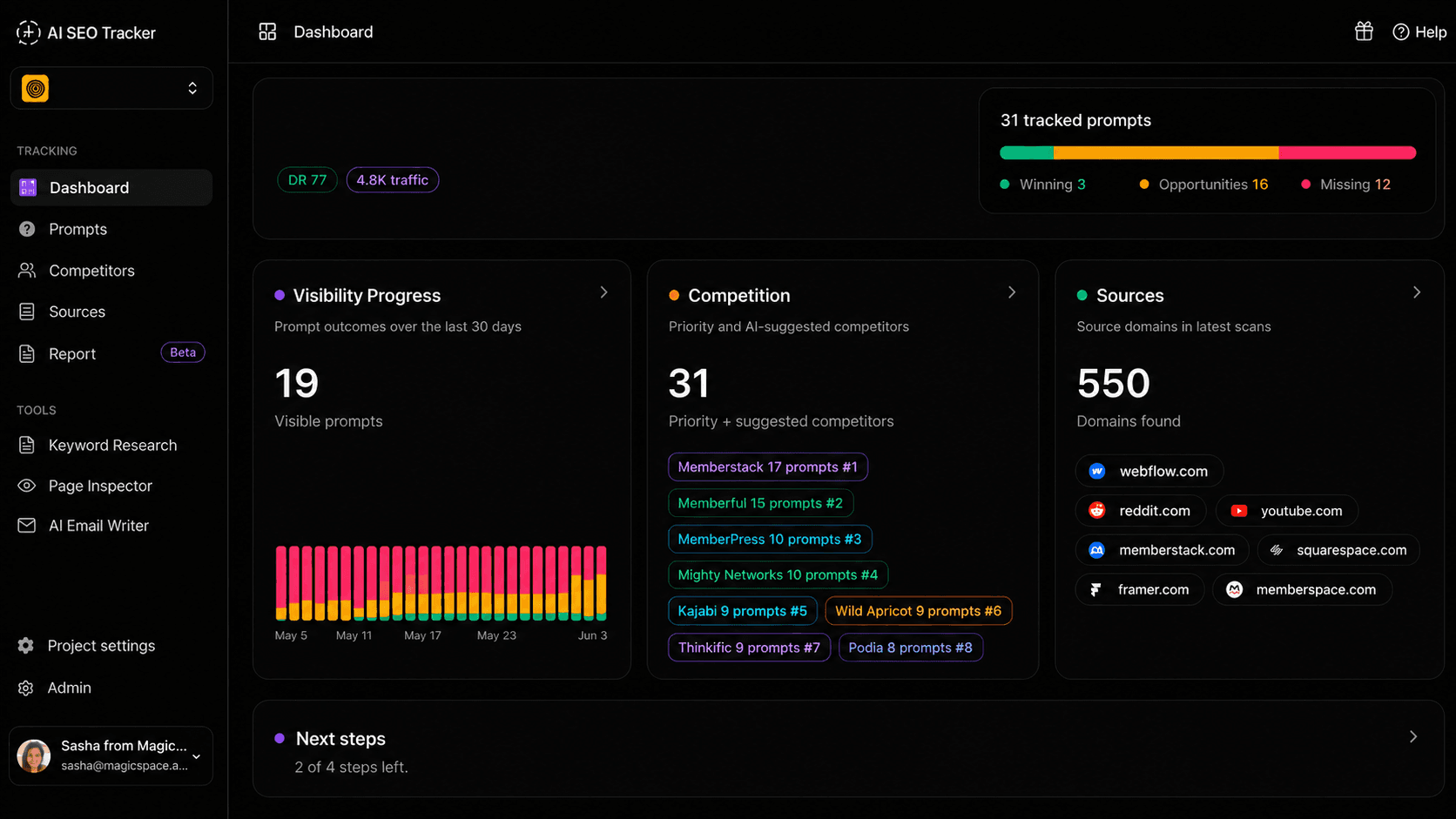
We built AI SEO Tracker for this. You enter your URL, get a visibility report across the major engines, and see your mentions, citation sources, and competitor gaps in one place.
Your LLM SEO checklist
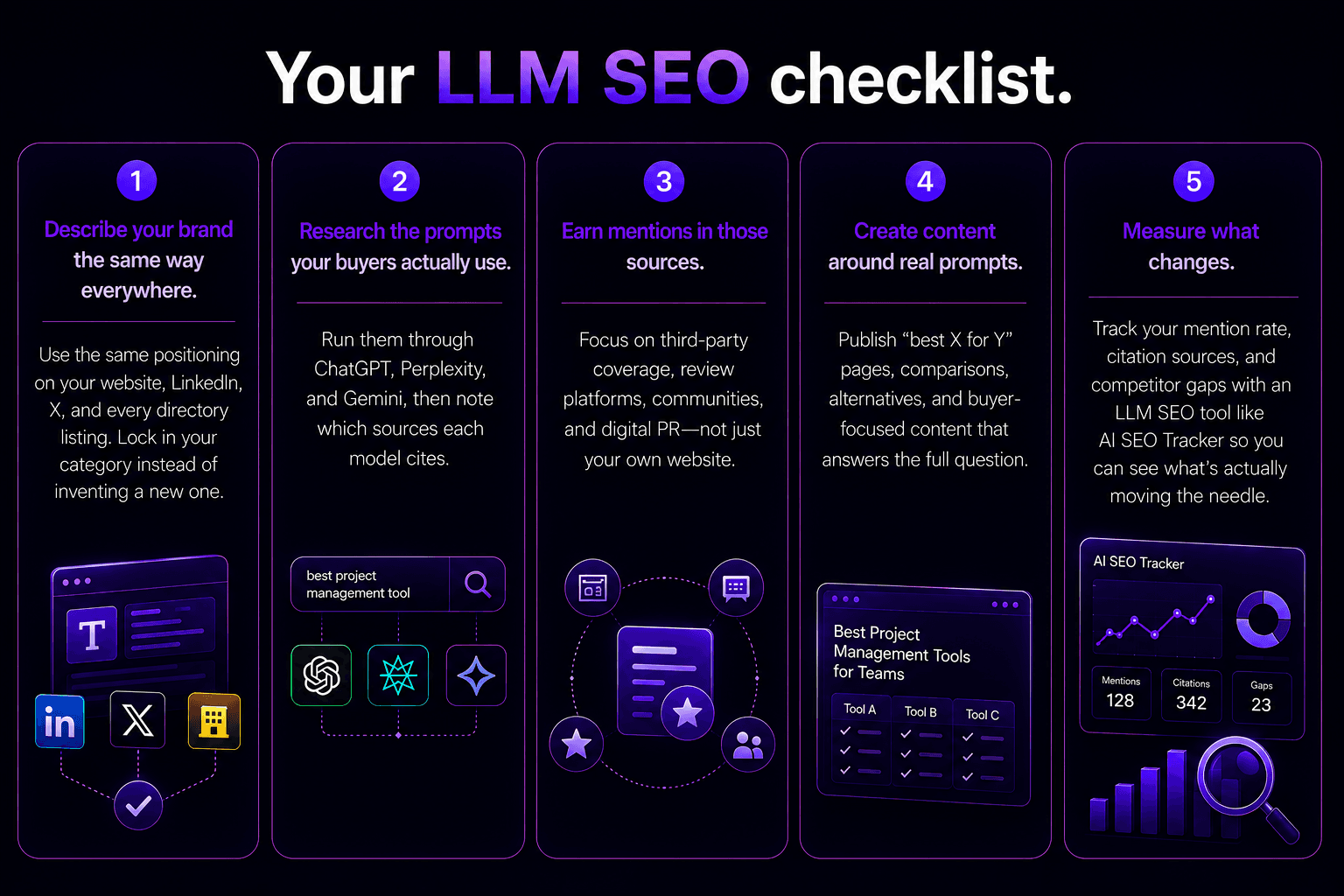
Here's the entire playbook in five steps you can start this week.
- Describe your brand the same way everywhere. Use the same positioning on your website, LinkedIn, X, and every directory listing. Lock in your category instead of inventing a new one.
- Research the prompts your buyers actually use. Run them through ChatGPT, Perplexity, and Gemini, then note which sources each model cites.
- Earn mentions in those sources. Focus on third-party coverage, review platforms, communities, and digital PR, not just your own website.
- Create content around real prompts. Publish "best X for Y" pages, comparisons, alternatives, and buyer-focused content that answers the full question.
- Measure what changes. Track your mention rate, citation sources, and competitor gaps with an LLM SEO tool like AI SEO Tracker so you can see what's actually moving the needle.
None of this is a shortcut.
It's brand-building for engines that read, compare, and synthesize information from across the web.
Which brings us back to the idea underneath all of it:
LLMs only have the information you give them to work with.
So give them more. Give it to them consistently. And make sure it shows up in places they trust.
Do that, and your brand becomes one the AI reaches for instead of one it overlooks.