



TL;DR
- Report six metrics: mention rate, citation URL rate, share of voice, engine split, AI referral sessions and Google AI impressions. Formulas for each.
- Keep mentions and citations apart: a name in the answer is a mention. A link to your domain is a citation URL. Count them separately.
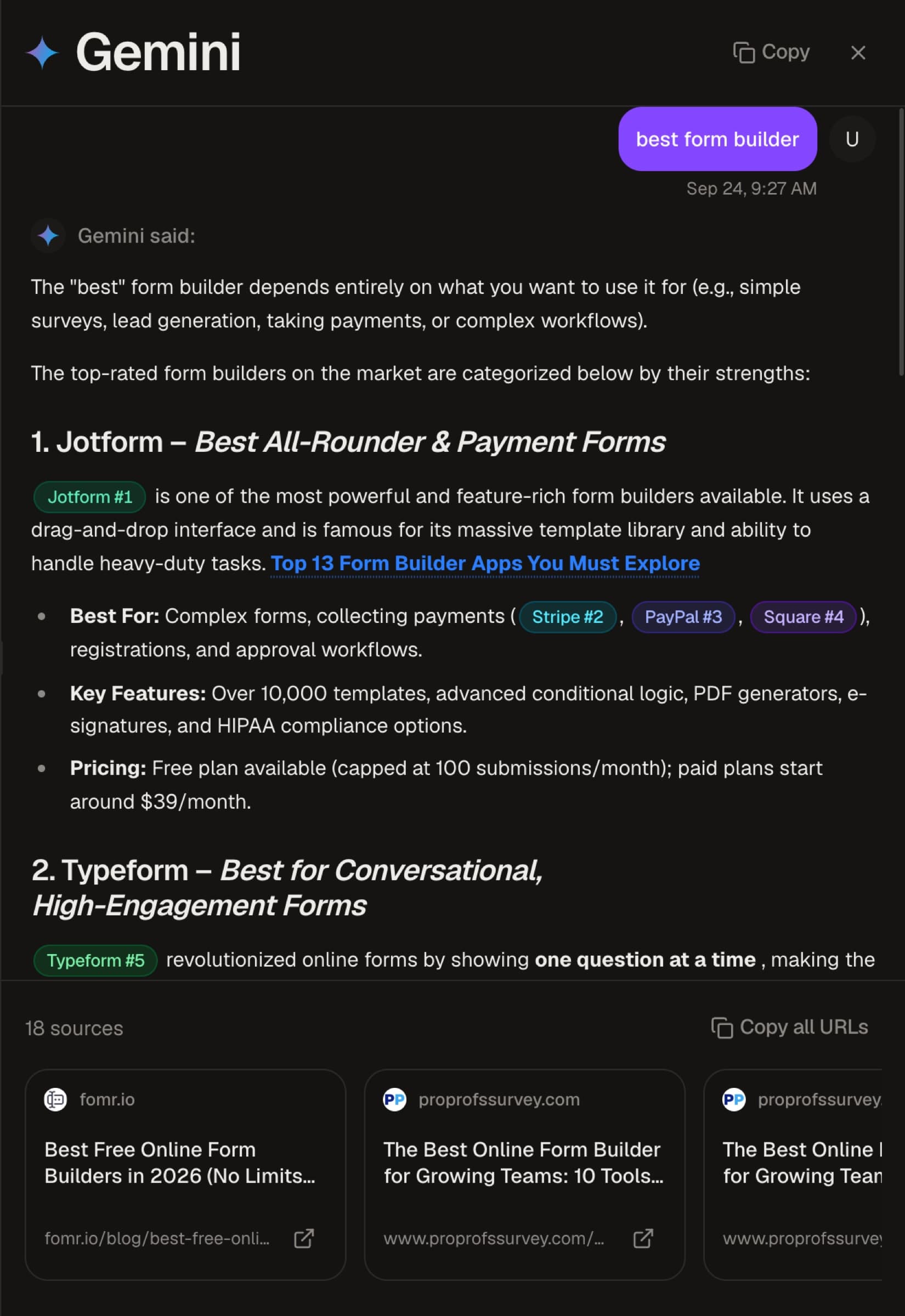
- A name is not a recommendation: in Gemini's answer for "best form builder", Stripe, PayPal and Square appear only in Jotform's payments line. A string match counts all three.
- Read the noise first: one run of 25 prompts puts a 16% mention rate anywhere from 6% to 35%. A rise must reach about 44% to beat chance.
- Leave two things off the slide: an average position and a lone 0 to 100 score.
Does AI name your brand? Check your site.
AEO metrics are the numbers that show whether AI answer engines name your brand, cite your pages and send you visits. Six are worth reporting: mention rate, citation URL rate, share of voice, the split by engine, AI referral sessions, and AI impressions in Google Search Console.
Each one is a rate on a small sample, so each one is noisy. If every answer has a 15% chance of naming you, two runs of the same 25 prompts on one engine differ by 12 points or more about one time in three, with no real change. Do not report that swing as a win.
Below: the formulas, real answers from the AI SEO Tracker leaderboard, and a noise table that shows how many prompts a change needs. New to AEO? Start with answer engine optimization.
The six AEO metrics and their formulas
Four metrics come from prompt scans. Two come from your own data and Google.
| Metric | Formula | The question it answers |
|---|---|---|
| Mention rate | Answers that name your brand / answers scanned | Do the engines put you on the list? |
| Citation URL rate | Answers that show a URL from your domain as a source / answers scanned | Do they use your pages as proof? |
| Share of voice | Your brand names / all tracked-brand names | How much of the shortlist is yours? |
| Engine split | Mention rate per engine, and how many engines name you per prompt | Which engines skip you? |
| AI referral sessions | Sessions with an AI referrer or an AI utm_source | Do answers send visits? |
| AI impressions | Impressions of your links in Google AI Overviews and AI Mode | How often did Google show your links? |
Each has a blind spot. Mention rate misses recommendation, citation URL rate misses clicks, referral sessions miss every answer nobody clicks, and AI impressions cover Google only. Write the numerator, the denominator and the prompt count beside every rate.
One number many names
Vendors give the same count different names. Check the definition before you compare dashboards.
| Term you will see | Who uses it | What it counts |
|---|---|---|
| Citation rate | Discovered Labs | How often you appear in answers. Mention rate |
| Visibility, brand mention rate | Peec, Profound, Yes Optimist | Answers that name your brand. Mention rate |
| Citation rate, citation score | Yes Optimist, Profound | Links to your pages or domain. Citation URL rate |
Mention rate vs citation URL
Start with two counts. Do not blend them.
Mention rate = answers that name your brand / answers you sampled.
The brand string (or an alias) appears in the answer. There may be no link. Peec's docs call this Visibility. Discovered Labs calls the same count "citation rate". I will not do that. Appearance without a URL is a mention. A URL is a citation.
Citation URL rate = answers that show a URL from your domain as a source / answers you sampled.
If you count only names, you miss pages used as evidence. If you count only URLs, you miss the shortlist that never links out. Peec says you can have one without the other:
- Named, never cited: AI may tie your brand to the topic without using your content as a source.
- Cited, never named: AI finds your content useful without tying it to your brand.
Write both on the slide. Never one.
How to compute mention rate without cheating
Denominator = prompts in the frozen set × engines × runs you keep. For one engine, drop the engines term.
Numerator = those answers where an alias matches.
Rules:
- Use unbranded prompts for the headline rate. Branded prompts inflate it. Discovered Labs audited five client prompt sets, and all five had this inflation. In the worst one, a reported 10.8% fell to 1.9% without brand-anchored prompts (Discovered Labs).
- Count an answer once. Pronouns after the first name are not extra mentions.
- Store the answer. If you cannot reopen it, you cannot defend the count.
- Keep a written alias list. Misspellings count if a human would still see you.
A 20-prompt, one-run, one-engine "rate" is a sketch. To build the prompt set, see how to measure brand visibility in AI.
A mention is not a recommendation
A mention counts the name, not what the answer does with it.
AI SEO Tracker's best form builder leaderboard stores each engine's answer (scan of 24 September 2026). Gemini's answer has six numbered picks: Jotform, Typeform, Google Forms, Paperform, Microsoft Forms and a pair of WordPress plugins. The leaderboard records 15 names for it. Eight are not picks.
Stripe, PayPal and Square sit inside Jotform's "Best For" line, as payment options. Google Sheets, Microsoft 365, Excel, Teams and Power Automate sit in feature and ecosystem lines. The leaderboard numbers names in order of appearance, so it tags Stripe second and Typeform, the second pick, fifth. A counter that matches strings gives Stripe the same credit as Typeform.
Brainlabs calls the missing piece Share of Recommendations. In its 13-week test on one anonymized B2B brand, 42 mentions across 33 prompts produced four recommendations, where the brand was presented as the answer, the lead choice or an explicit suggestion. By my arithmetic that is 12.1% of prompts (4 of 33) and 9.5% of mentions (4 of 42).
Define "recommended" once, in writing, and apply it the same way every week. For a list like Gemini's, "one of the numbered picks" is a rule you can check.
Engine split, the metric people skip
ChatGPT, Perplexity, Gemini, Copilot and AI Overviews do not give the same answer. Averaging them hides a dead engine.
In the same form builder scan, the five engines name 21 products. Three appear in all five answers: Jotform, Typeform and Google Forms. Sixteen appear in one engine only. Names per engine: Gemini 15, ChatGPT 7, Copilot 6, AI Overviews 5, Perplexity 3. One scan is one sample.
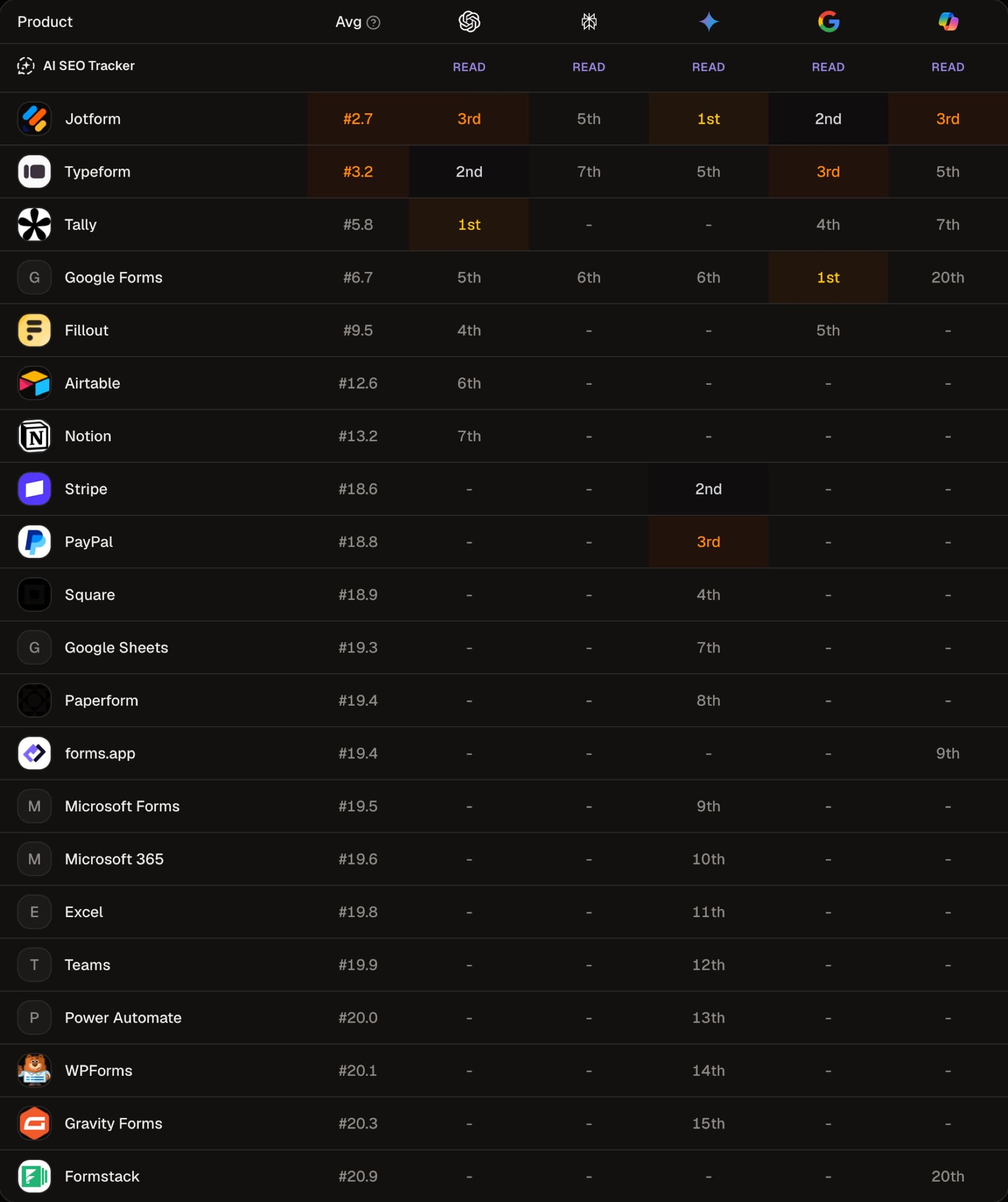
Brainlabs' Consensus Position counts, for each prompt, how many platforms name the brand. In its 13-week test (33 prompts, four platforms), 18 prompts showed the brand on none, six on all four and nine on one to three. A simple average (about 1.3 platforms per prompt) hides that.
That is the report I want: a row for each prompt, a column for each engine. Three strategies fall out:
- Zero engines: no consensus. You need third-party mentions and a page that answers the prompt early. See LLM SEO.
- One or two engines: close the gap. A source or format is missing on the engines that skipped you. For one of them, read how Perplexity picks sources.
- All engines: defend it. Do not "optimize" a winning prompt into a different article.
A single "AI visibility %" is a compromise for people who will not read a table. Do not let it be the only line in the deck.
Share of voice without the vanity
AI share of voice = your mentions (or citations) / all tracked-brand mentions (or citations) in the same answer set. Peec defines it the same way.
Two versions, keep them separate:
| Flavor | Formula | What it is good for |
|---|---|---|
| Mention SoV | Your names / all tracked names | Shortlist share |
| Citation SoV | Your URLs / all cited URLs | Source authority |
Here is the denominator problem with real data. In the form builder scan, the five engines produce 36 name slots (7, 3, 15, 5 and 6). Jotform is in all five answers: 5 of 36 is 13.9% of all names. Against five chosen rivals (Jotform, Typeform, Google Forms, Tally and Fillout, 20 slots in all), it is 5 of 20, or 25%. Same answers, 13.9% or 25%. Say who is in the denominator. The 36 also includes Gemini's eight non-picks.
Do not compare your share in tool A with a rival's screenshot from tool B. Prompt sets, engines and match rules differ. For the media version of this metric, see how to calculate share of voice. Share of voice measurement covers the AI version.

Does AI name you?
See if AI mentions your brand. Then get the pages to fix.
AI referrals and Google AI impressions
Prompt scans show what the engines say. Your own data shows what reaches you.
AI referral sessions. In GA4, add a custom channel group for AI sources: clone the default group and add a channel with a regex condition on source (Cairrot, Discovered Labs). A starting regex, built from their lists and the tags below:
chatgpt|openai|perplexity|gemini|claude|copilot|edgeservices
Discovered Labs says ChatGPT Search adds utm_source=chatgpt.com to outbound links. In the sources stored for five leaderboard questions (scans of 23 and 24 September 2026), all 39 ChatGPT links carry it, and all 59 Gemini links carry utm_source=gemini. None of the 40 Perplexity, 54 AI Overviews or 58 Copilot links carry a utm_source. So filter on utm_source as well as on referrer. The sample is small: five questions, one scan each, four for Perplexity. A visit with no tag and no referrer lands in direct, so the count is a floor. A "How did you hear about us?" field with an AI option on lead forms catches some of the rest.
Google AI impressions. Google says its Search generative AI performance report reached all websites worldwide on 31 August 2026 (Google Search Central). The help page says it counts impressions of links to your site in AI Overviews and AI Mode, by page, country, date and device. The page lists no clicks and no queries. The report covers Google only, and sites with too few impressions may not see it. AI SEO Tracker scans AI Overviews but not AI Mode. For query patterns, see ChatGPT in Google Search Console.
Branded search. Google's branded queries filter splits Performance report queries into branded and non-branded. Yes Optimist and semai suggest watching branded search as AI visibility grows. A rise there is correlation, not proof.
How noisy each number is
Two things add noise. First, the same prompt on the same engine returns a different answer on each run. In SparkToro's study (600 volunteers, 12 prompts, 2,961 runs), the chance of the same list of brands in any two ChatGPT or Google AI responses was under 1 in 100, and about 1 in 1,000 for the same order (SparkToro). Second, your prompt list is only a sample of what buyers ask.
The arithmetic below is mine. It treats every answer as an independent draw with the same chance of naming you, which makes it a ceiling for week-to-week noise on a frozen set. It is per engine. Five engines on 25 prompts are 125 answers but five different rates, so do not pool them.
| Prompts, one engine, one run | 95% range around a 16% rate | A rise from 16% must reach |
|---|---|---|
| 25 (4 mentions) | 6% to 35% | 44% |
| 50 (8 mentions) | 8% to 29% | 34% |
| 100 (16 mentions) | 10% to 24% | 28% |
| 250 (40 mentions) | 12% to 21% | 23% |
| 500 (80 mentions) | 13% to 19% | 21% |
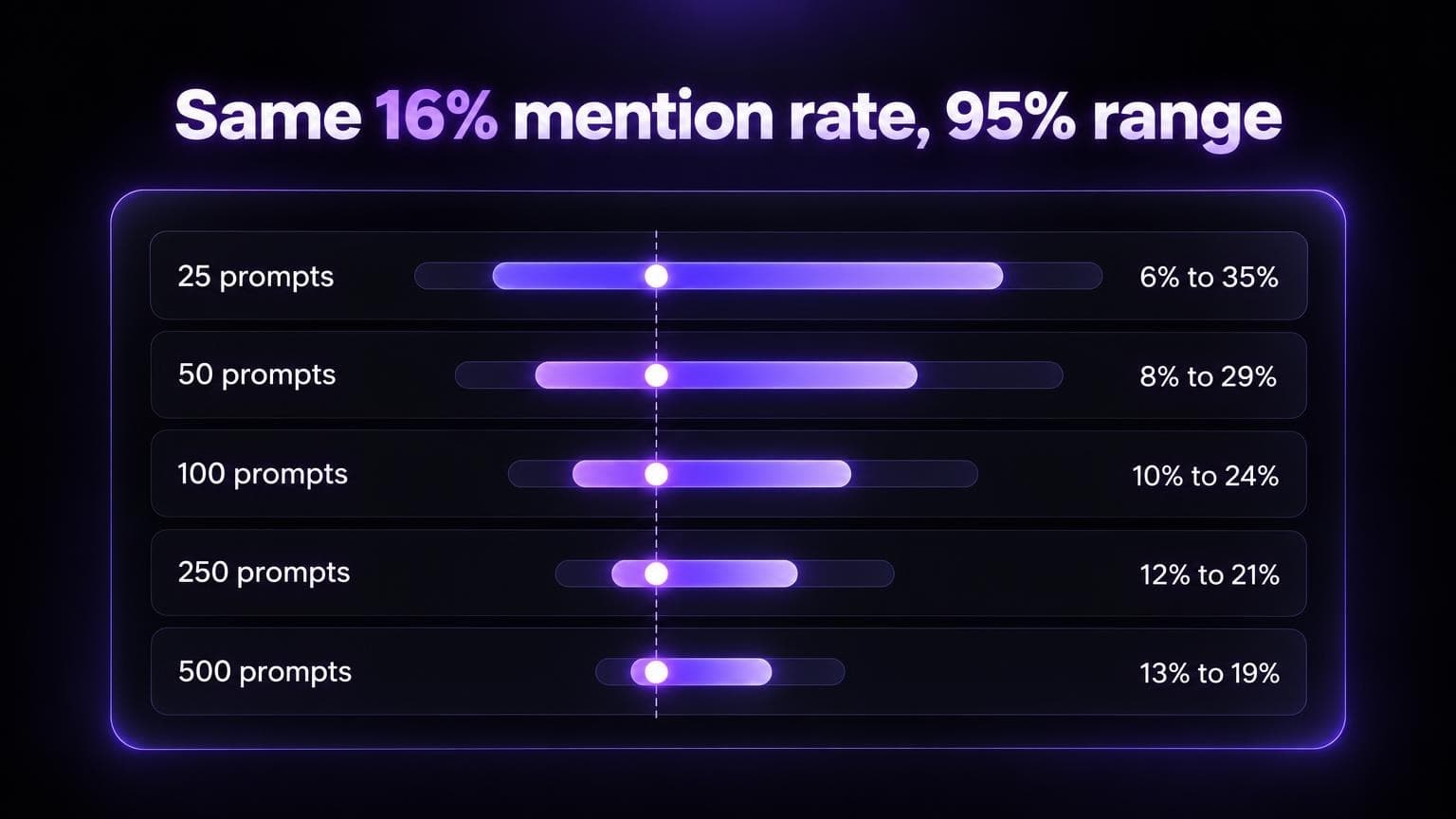
The range is a 95% Wilson interval. The last column is the lowest second-run rate that a pooled two-proportion test at 95% calls more than chance, for two runs of the same size. A fall from 16% on 25 prompts shows only if the rate drops to 0%.
If nothing changes and the true rate is 15%, two runs of 25 prompts differ by 12 points or more 31.7% of the time.
Guides start small: Yes Optimist suggests 20 to 50 buyer prompts, and Acquia 10 to 15 queries. Those sizes find gaps and prove only big moves. Discovered Labs says most production benches run 500 to 2,000 prompts to see a 1 to 2 point shift (test-bed post).
Weekly is the default for a tracked trend. We run weekly scans in AI SEO Tracker for that reason. Daily feels productive. Weekly is closer to a shift you can act on. The $49 report runs your prompts daily for 7 days, so the same prompt on the same engine shows how often the answer flips. That spread is your noise floor.
When a metric moves
A move smaller than the last column above is noise. For a larger one, look for the cause:
| Move | Likely cause | First check |
|---|---|---|
| Mentions up, citations flat | Name recognition, no quotable page | What an AI crawler can read on the page (Page Inspector) |
| Citations up, mentions flat | A guide got retrieved, brand still weak | Entity consistency, third-party listicles |
| One engine jumps, others flat | That engine's index or a source it likes | The citation URLs on that engine only |
| All engines drop together | Prompt set change, alias bug, category rewrite | Did we edit prompts? Did a legal name change? |
What to leave off the dashboard
Four numbers to treat with care:
| Metric | Verdict | Why |
|---|---|---|
| Average position in the answer | Leave off | SparkToro saw the same order about 1 time in 1,000. In the stored Gemini answer, the position tag is the order of appearance (Stripe is second). At most, log whether you were named first |
| One 0 to 100 score | Leave off | Brainlabs argues against one master score. HubSpot's free grader publishes its weights: share of voice is up to 10 of 100 points |
| Sentiment score | Trend only | In a vendor preprint from Ranqo, framing flips about 6.7 times more often than whether a brand is mentioned. Fix 5 to 8 positioning attributes first (Brainlabs) |
| Citation half-life | Watch after 8 or more weeks | In Brainlabs' test, 76% of cited URLs appeared for one week and never again. It calls 13 weeks too short for a benchmark |
A report that fits on one slide
One slide, five lines, and the engine table in the appendix.
- Mention rate (unbranded), this week and last, per engine, with the prompt count
- Citation URL rate, same window
- Share of voice against the three rivals you lose deals to
- Top cited domains in the answers you lost, so PR and content have a list
- Monthly: AI referral sessions and Google AI impressions
Run lines 1 to 4 weekly, line 5 monthly, and pipeline quarterly (the cadence Yes Optimist uses).
If you need a monitor that already stores mention rate, citation URL, and engine split, that is the job AI SEO Tracker was built for. $49 for the first audit. From $79/mo if the weekly trend is worth paying for.
AEO is not a new religion. It is a measurement problem with sloppy denominators. Fix the denominator, split the engines, keep mentions and URLs on different rows.
FAQ
What is a good AEO score
There is no settled benchmark. In the Ranqo vendor preprint, global household names appeared in 73% of relevant answers on a first run, established mid-market brands in 44% and niche brands in 11%. Compare yourself with your own earlier scans and with rivals on the same prompts.
How often should I measure AEO
Weekly for the prompt scan, monthly for referral sessions and Google AI impressions, quarterly for pipeline. Run daily only after a major change.
Can Google Search Console track AEO
Partly, for Google only. The generative AI performance report counts impressions of your links in AI Overviews and AI Mode. It does not show ChatGPT, Perplexity, Copilot or Gemini. See ChatGPT in Google Search Console.
AEO metrics vs SEO metrics
SEO metrics come from a results page everyone sees. AEO metrics come from sampled answers that change on each run, so they are rates with a denominator. See AI SEO vs traditional SEO.