



TL;DR
- Answer: Run a fixed set of buyer prompts on each AI engine, save every answer, and count how often your brand is named and cited. A Google rank does not measure this.
- Five metrics: Mention rate, share of voice, citations vs mentions, scanned vs missing prompts and the per-engine split. Show the denominator every time.
- Real scan: On the "best SEO tool" scan of 24 September 2026, Ahrefs is first on ChatGPT and sixth on Gemini.
- Free data first: Search Console, Bing Webmaster Tools and ChatGPT referral tags cover Google, Microsoft and the clicks.
- Start: Freeze 25 prompts, add 3 to 5 competitors, rerun weekly. One answer is one sample, so count many runs.
Does AI name your brand? Check your site.
To measure brand visibility in AI search, run the same buyer questions on each AI engine, save every answer, and count how often your brand is named and cited. Report the counts with their denominators, not a score.
Clicks are the part analytics can see, and referral metrics measure only that last step (Search Engine Land). On our own site that part is small. Between 1 July and 30 September 2026, ChatGPT, Claude and Perplexity together sent 37 of 5,375 visitors to aiseotracker.com (0.7%, from our DataFast referrer report). A buyer can read an answer that names three brands and click none. If you were not named, no report shows the loss.
This guide covers the five metrics, a worked example from a real scan, how many runs make a rate, and free data from Google, Bing and ChatGPT.
Why rank tracking is the wrong scoreboard
Classic SEO reports a position that everyone sees. AI answers do not work that way. SparkToro had 600 volunteers run 12 prompts through ChatGPT, Claude and Google's AI, 2,961 runs in total. There was under a 1 in 100 chance that ChatGPT or Google's AI gave the same list of brands in any two responses to one prompt, and about 1 in 1,000 for the same order (SparkToro, January 2026). Its author calls tracking position in an answer foolhardy, and the share of runs that name a brand "probably" a reasonable measure. A co-researcher works at a tracking vendor, Gumshoe.ai, and the post says so.
A Google rank tells you little too. Profound, another vendor, says ChatGPT's sources overlap only 39% with Google's (Profound). Search Console's new AI report (details below) covers only Google, so you need a prompt-level scoreboard next to it.
The five metrics that actually travel
Vendors rename these. The counts underneath do not change. These five are our working set, not an industry standard. For each one, print the numerator and the denominator, and count an answer once even if it names you three times (Editorialge). More definitions are in AEO metrics, and the concepts are in AI search visibility.
1. Mention rate
Mention rate is the share of scanned answers where your brand name appears.
Mention rate = (answers that name you ÷ answers scanned) × 100
If you scan 40 prompts across 5 engines (200 answers) and you appear in 50, your mention rate is 25% for that set.
Brainlabs calls the volume version "AI visibility volume", and Discovered Labs calls a close formula "citation rate". Pick one name and keep the denominator.
State the set: which prompts, which engines, which dates. A 40% mention rate on 8 branded prompts is not the same as 40% on 40 discovery prompts.
2. Share of voice
Share of voice is your mentions relative to the competitive set in the same answers.
Share of voice = (your brand mentions ÷ all tracked-brand mentions) × 100
Mention rate says whether you show up. Share of voice says whether you own the category or only sneak in. You can appear in 20% of answers and still lose if three competitors appear in 50%. Use a fixed competitor list, because a rival added mid-quarter breaks the trend. The classic formula is in how to calculate share of voice.
3. Citations vs mentions
HubSpot defines a mention as a brand reference in an AI answer without a linked source, and a citation as an attributed source reference or a linked URL (HubSpot).
A mention without a citation still puts you on the shortlist. A citation without a mention can send a click while the recommendation goes to someone else. AirOps, a vendor, found that brands with both are 40% more likely to resurface across consecutive runs than citation-only brands (AirOps). Semrush is the real case: first on three engines, yet no page of its own is cited.
4. Scanned vs missing prompts
This is the operational metric a single score hides. The unit here is the prompt, not the answer.
- Scanned: a prompt you ran this period, with a stored answer.
- Mentioned: a scanned prompt where at least one stored answer names you.
- Missing: a scanned prompt where you do not appear.
- Unscanned: a prompt in the library that did not run (quota, engine error, or not yet scheduled).
"Missing" is the work list. A blended 22% does not tell a writer which five questions to fix. The missing-prompt table does.
Do not count unscanned as missing. Missing means you looked and were absent. Unscanned means you do not know. Example: 50 prompts, with 12 mentioned, 31 missing and 7 unscanned. The mention rate is 12 of 43 scanned prompts, or 28%. Count the 7 as missing and it reads 24%, and a writer goes after seven prompts that never ran.

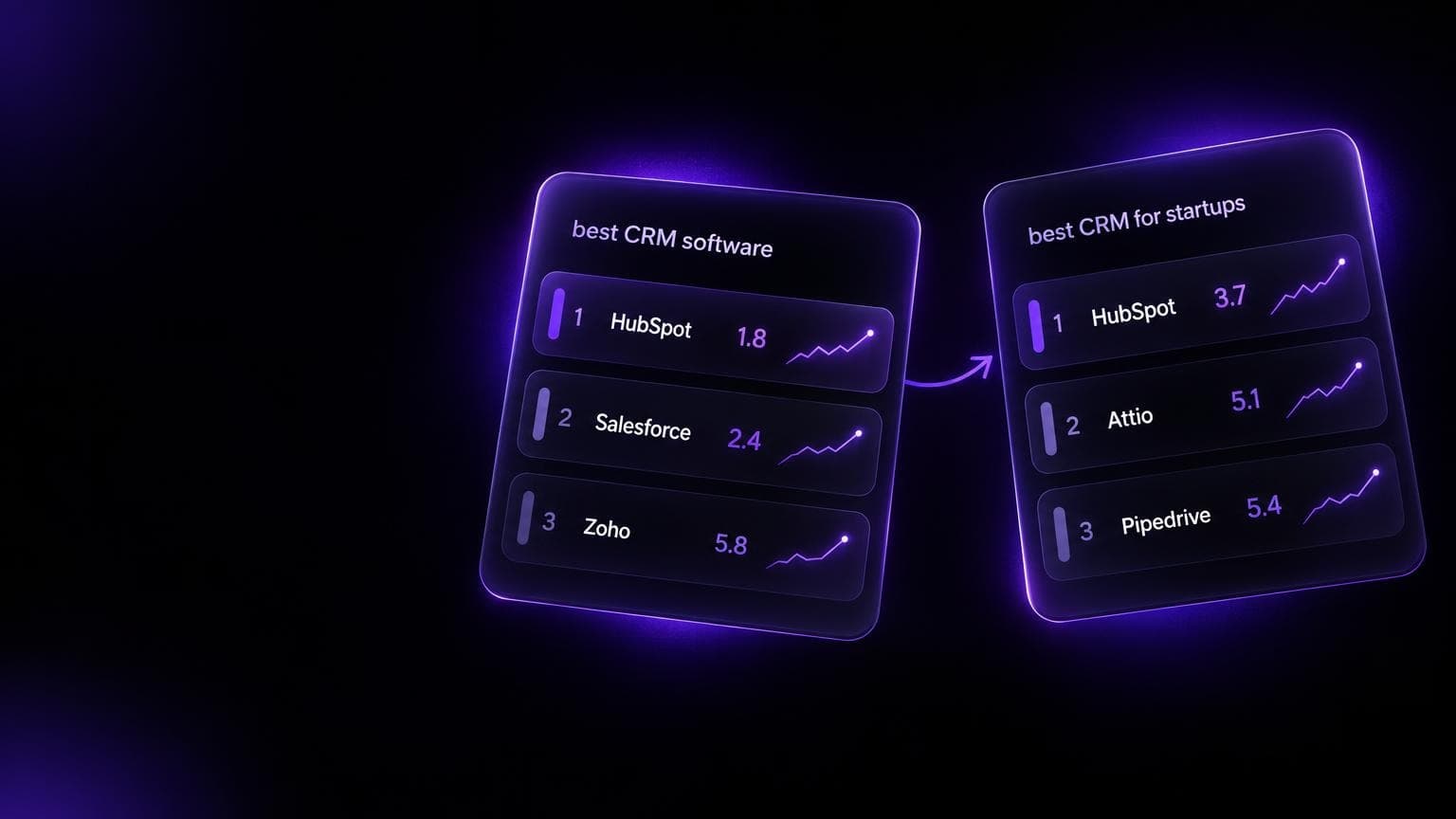
A real case: the leaderboard page for best CRM for startups has four engine columns and no Perplexity column. It shows no Perplexity reading, so nobody on it can be called missing from Perplexity.
5. Per-engine split
One blended number hides the real story. On our best SEO tool scan, Ahrefs is first on ChatGPT and sixth on Gemini. Report mention rate and share of voice per engine, then a rollup. A brand that wins ChatGPT and loses Perplexity needs different sources, not a generic "AI SEO" rewrite. LLM SEO covers how source preferences differ by model.
Position in the answer is the noisiest count (SparkToro saw the same order about 1 time in 1,000), so report it as an average over many answers, never one run's rank. Accuracy and sentiment need a person to read the branded answers and log each wrong claim.
A worked example from a real scan
The AI SEO Tracker leaderboard publishes how each AI engine ranks the products it names for a buyer question. One dated scan from our own product: best SEO tool, 24 September 2026, on five engines.
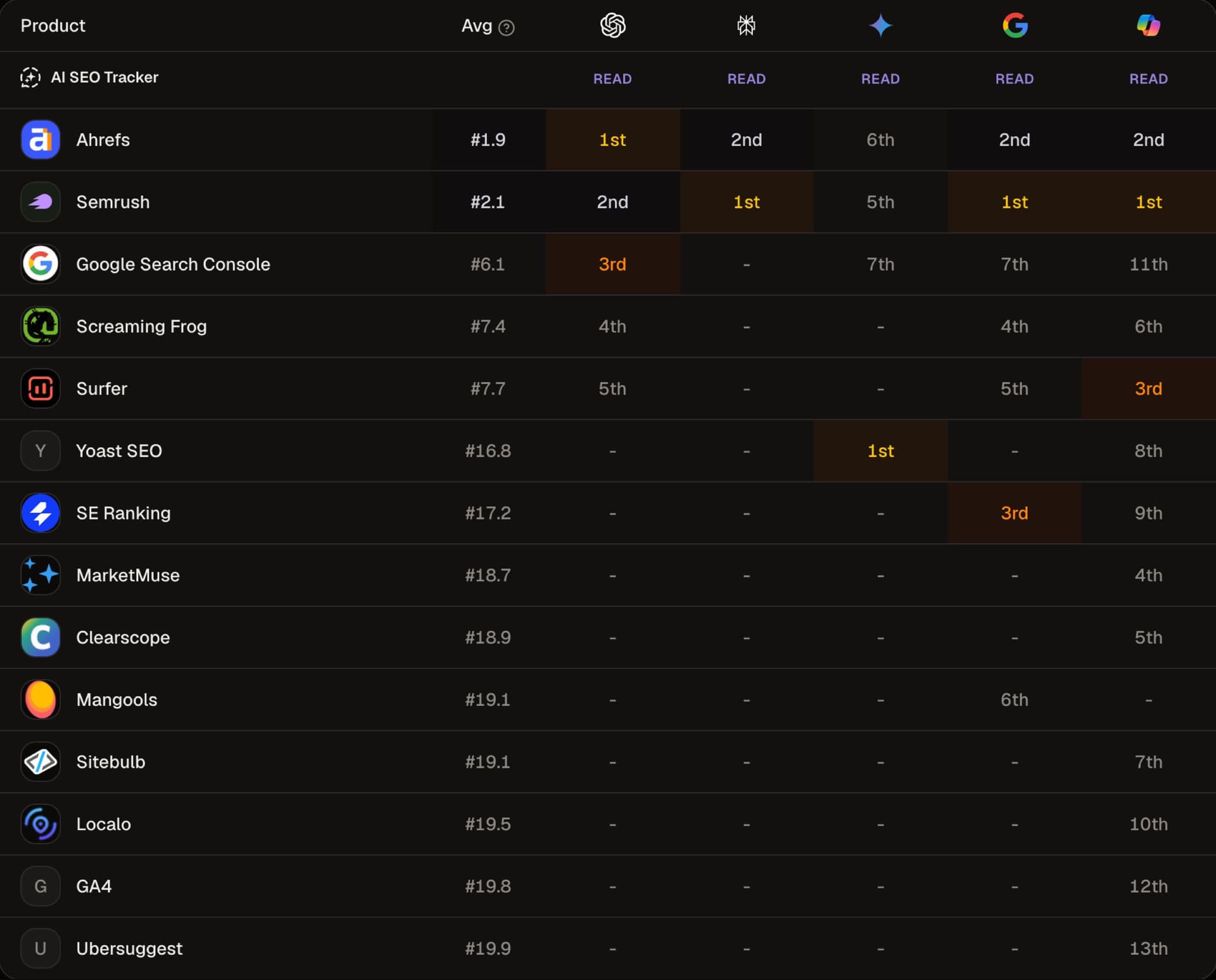
- Engines disagree. Ahrefs is first on ChatGPT and sixth on Gemini. Yoast SEO is first on Gemini and is not listed on ChatGPT, Perplexity or AI Overviews. One blended rate would hide both.
- Named is not cited. Semrush is first on Perplexity, AI Overviews and Copilot. Yet none of the 24 cited pages is on semrush.com. Ahrefs has one: its own tools page, cited by ChatGPT.
- The sources are other people's lists. Fourteen of the 24 pages are labelled listicles and 3 are comparisons. Only 3 of the 24 are cited by more than one engine. Across the 343 questions on the leaderboard index (2 October 2026), the page labels 77% of cited pages as listicles and 2% as Reddit. Most of those questions are about consumer products.
- A scan is a sample. The page does not say how many runs make a scan, so read the ranks as one dated sample. Ranks are not always consecutive (Gemini shows 1st, 5th, 6th and 7th), so read a dash as "not listed on the page".

We are not ranked on that page either. The AI SEO Tracker row has no rank on any engine.

Does AI name you?
See if AI mentions your brand. Then get the pages to fix.
Build a prompt set, not a keyword dump
The prompt set is the sample. A bad sample makes every metric lie.
Start from buyer questions, not your homepage slogan. Profound's guide takes prompts from customers (ask how they found you through AI) and from sales, customer success and marketing staff. Sort them into six buckets, which are our own grouping and not a standard.
- Discovery. Best [category]. Top tools for [job].
- Use case. Best [category] for [industry / team size / stack].
- Comparison. [You] vs [rival]. [Rival] alternatives.
- Problem. How do I [job] without [pain]?
- Proof. Is [you] worth it? [You] reviews.
- Branded. What is [you]? [You] pricing.
Twenty to fifty prompts is a workable start (HubSpot's method also uses 20 to 50). Do not mix branded and category prompts in one mention-rate headline. Branded should be high. Category is the competitive number. A branded-only panel shows what the model says once you hand it your name, not whether buyers find you (Editorialge).
Phrase prompts the way people talk to chatbots. "Best CRM" is a keyword. "Best CRM for a 5-person agency that already uses Gmail" is a prompt. SparkToro's 142 headphone prompts, written by people, barely matched in wording (semantic similarity 0.081), yet Bose, Sony, Sennheiser and Apple appeared in 55 to 77% of 994 responses. Measure intents and sets of brands, not one phrase. Then keep the wording fixed: if you rewrite a prompt every week, you cannot tell whether the model changed or you did.
How many runs make a rate
One answer is one sample. SparkToro's author says to ask at least 60 to 100 times and average the results to see the set of brands for a prompt, and he lists how many runs are statistically sound as an open question. AirOps, a vendor, reports that only 30% of brands stay visible across back-to-back answers, and 20% across five consecutive runs (AirOps, December 2025).
The $49 report scans your prompts on five engines daily for 7 days. That is 7 runs per prompt and engine, and at most 1,750 stored answers for 50 prompts (50 × 5 × 7). The rest is our own arithmetic, not a source's:
- One prompt on one engine: a brand named in 4 of 7 runs has a 95% Wilson interval of 25% to 84%. That is a direction, not a rate.
- A whole prompt set: 50 named in 200 answers gives about 19.5% to 31.4%. Answers to one prompt are not independent, so treat this as the narrowest the range can be.
Report a rate for the set, never for one prompt.
Use the free data you already have
Three free sources cover parts of the problem. None replaces a prompt scan.
- Search Console, for Google AI Overviews and AI Mode. Google's generative AI performance report counts impressions in both, by page, country, date and device. Google says it rolled the report out to all sites on 31 August 2026 (Google), but its help page says you may not see it if your site has too few AI impressions. It lists impressions only, with no query and no clicks. Setup is in Search Console and AI and tracking AI Overviews.
- Bing Webmaster Tools, for Copilot and Bing. The AI Performance report shows total citations, average cited pages per day, a sample of grounding queries and citations by page. Microsoft says the numbers do not show placement, ranking or a page's role in an answer (Bing, February 2026).
- ChatGPT referral tags, for clicks. For publishers that allow OAI-SearchBot, ChatGPT adds
utm_source=chatgpt.comto referral URLs (OpenAI). In GA4, group the AI referrers in one custom channel. HubSpot lists chatgpt.com, chat.openai.com, perplexity.ai, bing.com (for Copilot sessions), claude.ai and gemini.google.com (HubSpot). This counts clicks only.
None of these pages lists a visibility report for Perplexity or Gemini. Those two need a prompt scan or a manual check.
Manual log, then automate
A spreadsheet works for a first baseline. Columns: date, engine and mode, signed in or out, exact prompt, mentioned (Y/N), cited (Y/N), cited URL, competitors named, wrong claims about you, notes. Run each prompt on ChatGPT, Perplexity, Gemini, Copilot and Google (for AI Overviews) on a fixed weekday, and save the answer or a screenshot.
The limits: answers vary across runs, and results differ by model, location, language, account settings and search access (Editorialge).
Wix's roundup maps the dedicated trackers, and best AI SEO tools is our take.
AI SEO Tracker is built around that prompt list. See the AI visibility tracker page for engines, mentions, citations and competitor gaps. The report costs $49 once. It writes up to 50 prompts from your site (you confirm them) and scans ChatGPT, Perplexity, Gemini, Copilot and Google AI Overviews daily for 7 days, for one brand. You get mentions, citations, position in the answer, competitor visibility gaps, the sources each engine cited and a prioritized action plan, with read, print and export access. It gives counts you can check, not a mystery 0-100 score with no denominator. It does not scan Google AI Mode, Claude, Grok, DeepSeek or Meta AI, and there is no free scan.
Ongoing tracking starts at $79/mo. MCP lets an agent read the same prompt, snippet, competitor, and scan data you see in the UI (MCP docs).
Page Inspector, on Pro, shows how models read a URL. Use it after the report tells you which page should be winning a missing prompt.
How to read a week of numbers without fooling yourself
Separate branded from category. A low branded mention rate means the engines describe you badly or not at all, so read those answers for wrong or missing facts. A low category rate means you are not in the consideration set. Those are different projects.
Do not celebrate a blended uptick. Adding 10 easy branded prompts lifts the mention rate without any real win. Watch the missing prompts instead: moving 4 of 12 is a real change, and a 2-point wiggle on a small sample is noise.
Read sources before you rewrite. On the best SEO tool scan, 14 of the 24 cited pages are listicles on other people's sites. If most citations for "best X" look like that, a new post on your domain may not be the first lever. Getting onto the list may be. Generative engine optimization is the content half.
Map rates to something commercial only after they are stable. Brainlabs warns that branded search can rise because of a CTV campaign, a PR win or seasonal demand, so map it against your AI visibility metrics before you credit AI (Brainlabs).
Cadence and benchmarks have no standard. HubSpot says weekly works for most teams, and Editorialge says monthly for trends. Discovered Labs publishes working B2B SaaS targets of 10 to 15% on category queries, above 30% for market leaders and above 80% on branded queries (Discovered Labs). SE Ranking says there is no benchmark yet (SE Ranking). Trajectory on a frozen set beats copying someone else's percentage.
A one-hour measurement setup
- List 25 prompts in the six buckets above. Freeze the wording.
- Add 3 to 5 competitors you actually lose deals to, plus the listicle sites your first run shows being cited.
- Run a baseline across five engines. Save the answers.
- Compute mention rate, share of voice, citation rate and the missing-prompt list, split by engine. Write each as a count with its denominator, such as "named in 12 of 43 scanned prompts = 28%". Never write a bare percent.
- Pick five missing prompts. That is next week's content and outreach list.
- Schedule the same 25 prompts weekly. Do not change the set for 30 days.
Steps 1 and 2 fit in an hour. Before step 3, you can test one prompt with the free AI Visibility Checker. Step 3 is 125 checks by hand, so spread it over a few days, or let the $49 report on aiseotracker.com run it for 7 days.
FAQ
How do I measure brand visibility in AI answers without a paid tool?
Freeze 25 buyer prompts, log each answer in a sheet, and count mentions and citations per engine. Add the free reports. The one-hour setup has the steps.
Can I measure this in Google Search Console alone?
No. Its generative AI report covers Google's AI features only, not ChatGPT, Perplexity, Gemini chat or Copilot. Use Search Console for Google, Bing Webmaster Tools for Copilot citations, and a prompt scan for the rest.
How do I measure brand visibility in Google AI Mode or Perplexity?
For AI Mode, Google's help page lists AI Overviews and AI Mode in one report and offers no split by feature or by query. To see whether the answer names you, check the prompts by hand. AI SEO Tracker scans AI Overviews but not AI Mode.
For Perplexity, none of the first-party sources above covers it. Run a prompt scan or a manual check and log the sources it cites. AI SEO Tracker scans Perplexity. How it picks sources is in Perplexity citations.
How do I measure brand visibility in ChatGPT?
Run your prompts in ChatGPT and log mentions and citations. The utm_source=chatgpt.com tag in your analytics shows clicks only, not whether ChatGPT named you.
What if AI traffic is up but mention rate is flat?
You may be getting clicks from citations while the recommendation still names competitors. Read citations vs mentions, then the missing-prompt list.
Measure the prompts your buyers type, and show the denominator on every count. Everything else is a dashboard skin on those counts.