



TL;DR
- How to get cited: allow PerplexityBot, put a self-contained answer under a heading that matches the question, and get onto the third-party roundups it lists. The seven steps.
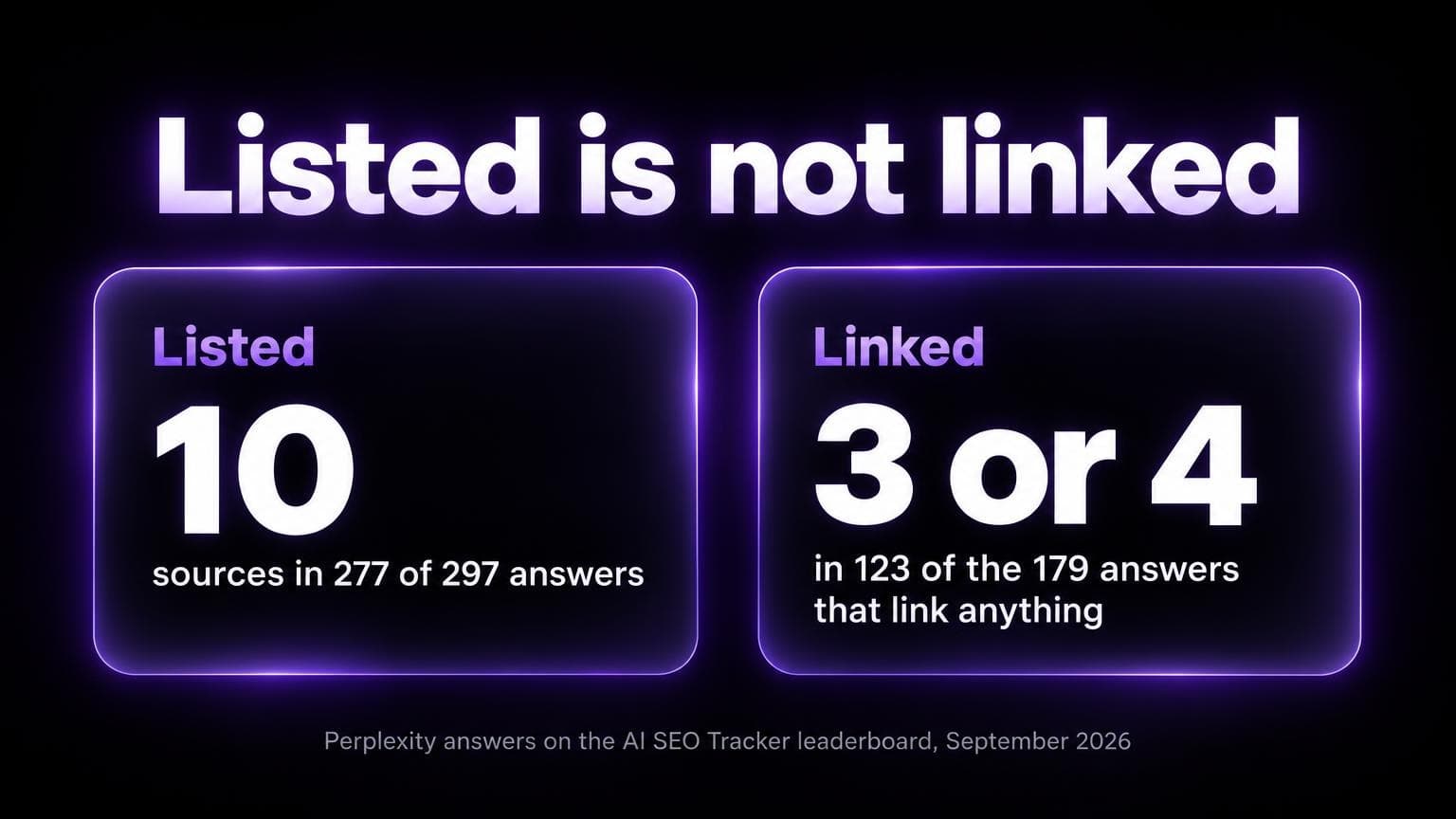
- What a citation is: Perplexity listed ten sources in 277 of 297 answers. Where the text linked sources, it most often linked three or four. Listed versus linked.
- What gets listed: 73.6% of the 3,067 listed pages were listicles. 2.4% were vendor pages. The data.
- How it picks: Perplexity describes hybrid search, a stale-content filter, and ranking at the level of page sections. It publishes no weights. Its own words.
- How to track: run a fixed prompt set, store the listed and linked URLs, re-check weekly. The Agent API now returns them in a
search_resultsitem. The method.
Does AI name your brand? Check your site.
Perplexity shows its sources on every answer.
So a citation there is visible. And countable.
I counted. 297 answers on our leaderboard.
To get cited by Perplexity, do three things:
- Let its crawler in.
- Put a self-contained answer under a heading that matches the question.
- Get onto the roundups it already lists.
For "best X" questions, roundups are most of the list. In our scans, 73.6% of the pages Perplexity listed were listicles.
This post covers:
- What Perplexity says about its own search stack
- What 297 answers on our leaderboard show
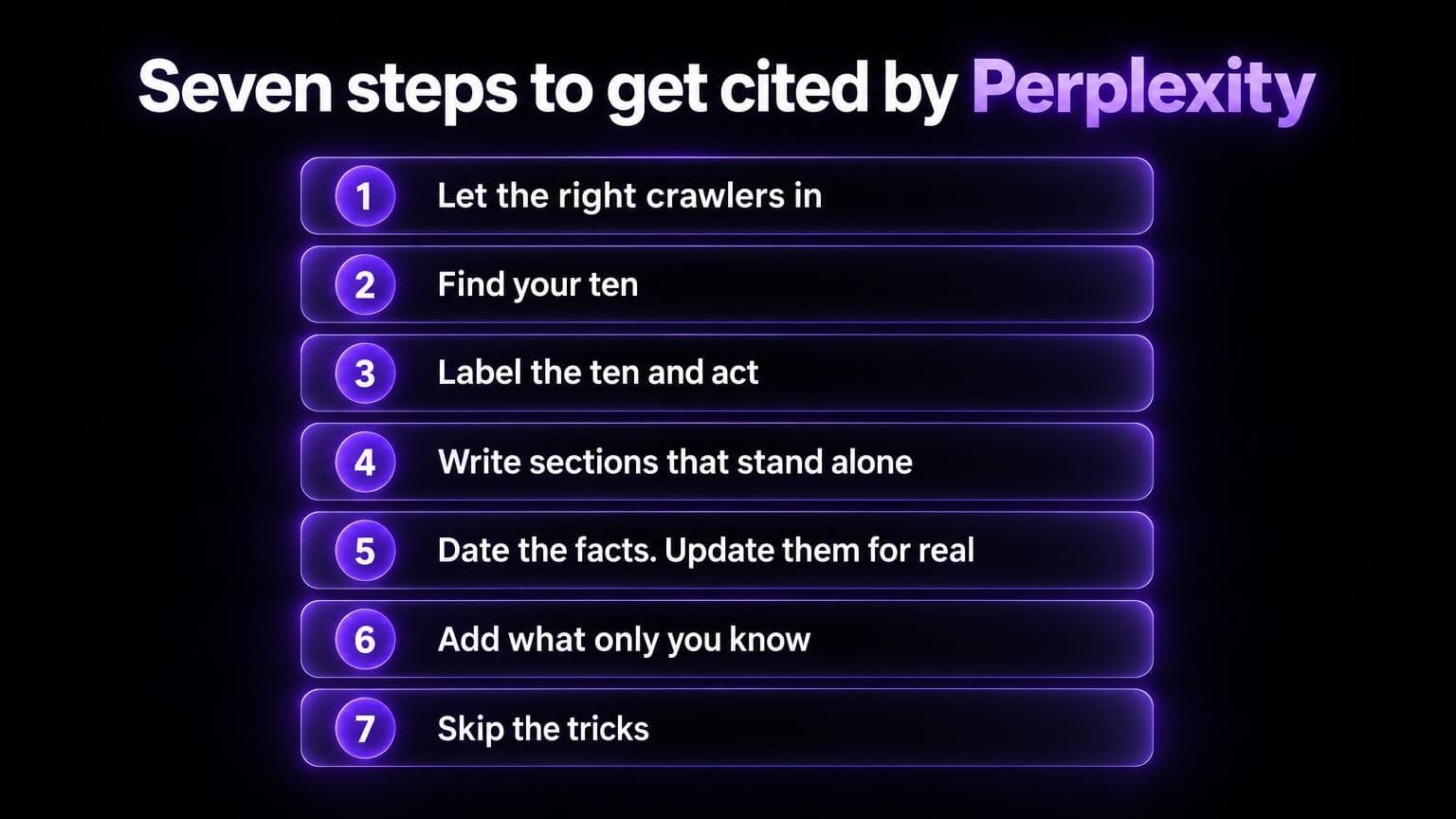
- Seven steps for a page
- How to track source URLs
- What nobody knows yet
I build AI SEO Tracker. So the scan data is ours.
What counts as a Perplexity citation
Perplexity's help center says each answer includes numbered citations that link to the original sources.
That makes a citation easy to count.
It also hides a split. And the split matters:
- Listed: a URL in the answer's source list.
- Linked: a URL tied to a sentence in the answer text by a numbered link.
On our leaderboard:
- Perplexity listed ten sources in 277 of 297 answers.
- 179 answers linked at least one URL in the text. Of those, 123 (69%) linked three or four distinct URLs.
- In 118 answers, the stored text had no linked URL.
A caveat on that last one. Some stored answers are plain bullet lists. So the count may include answers whose link markers were not kept.
One real case.
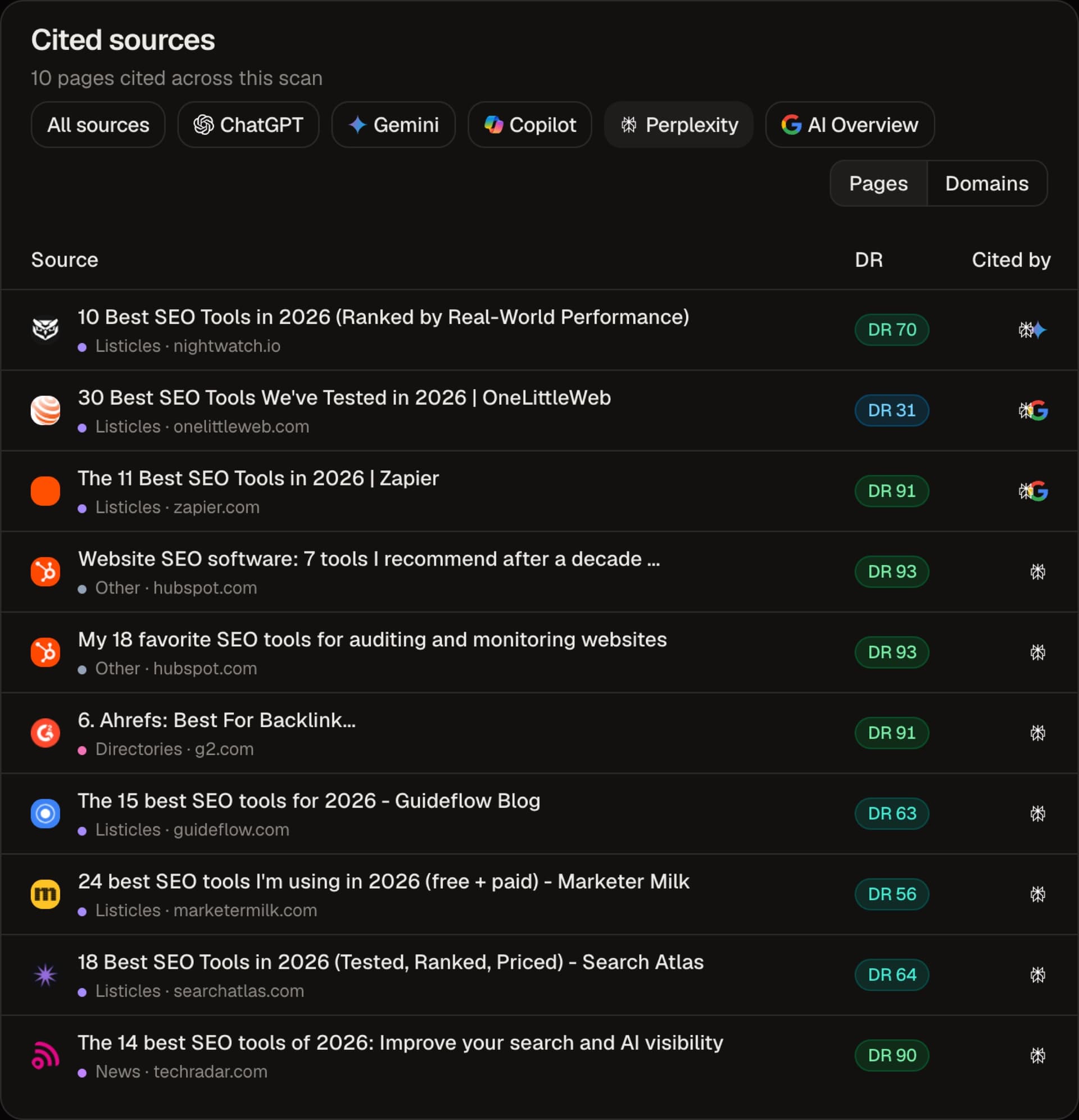
For best SEO tool, scanned on 24 September 2026, Perplexity listed ten pages.
The answer text named Semrush and Ahrefs. It linked two pages: TechRadar's "14 best SEO tools of 2026" and a HubSpot article on website SEO software.
Eight listed pages were not linked in the text.
A Perplexity citation is stricter than an AI citation in ChatGPT, where a brand mention with no link still counts as visibility.
So score three outcomes separately.
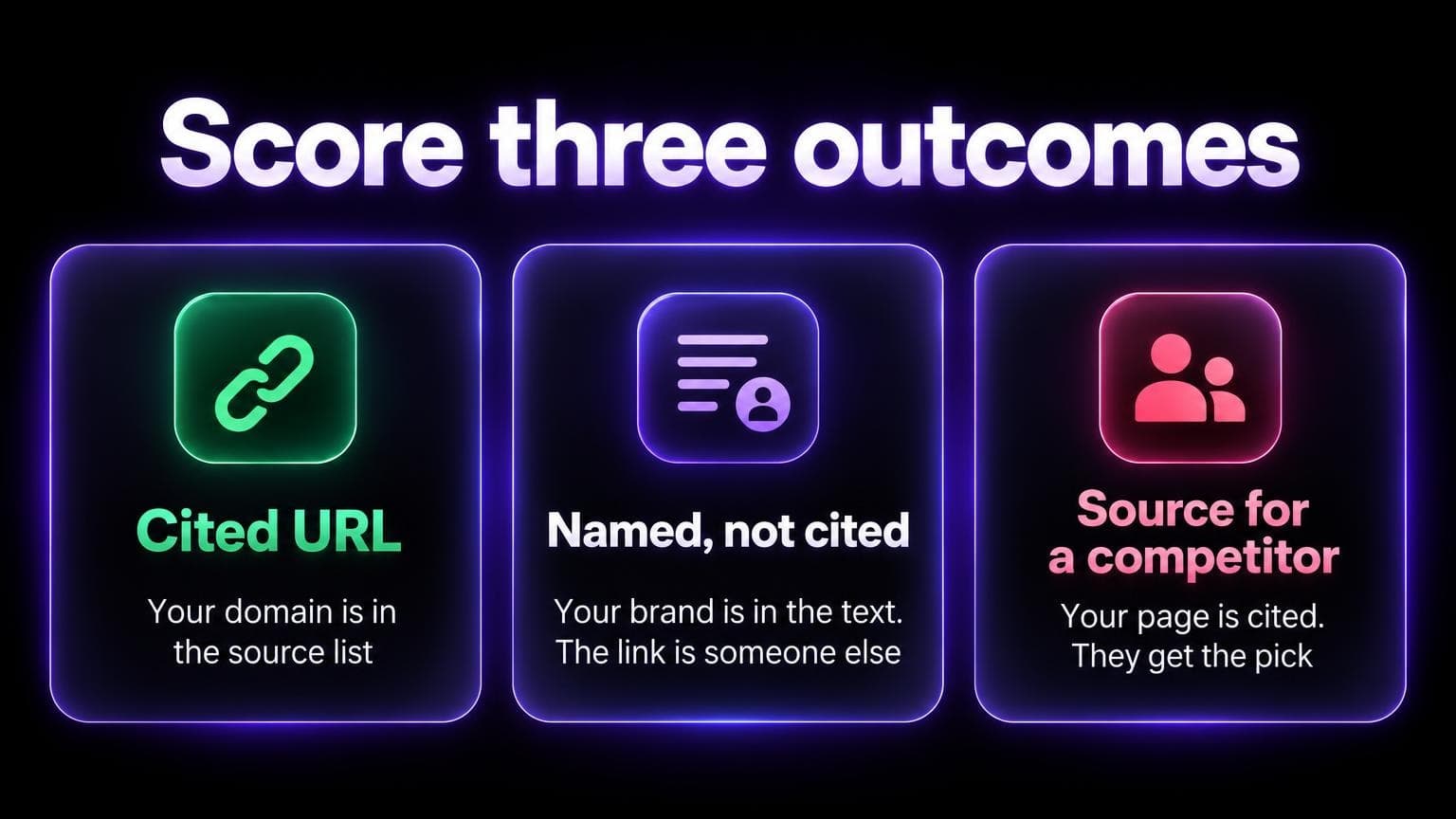
| Outcome | What you see | What it is worth |
|---|---|---|
| Cited URL | Your domain in the source list | Clickable, attributable, the AEO win |
| Named, not cited | Brand in the prose, someone else's URL in the cards | Entity recognition. You still lost the footnote. |
| Used as a source for a competitor | Your comparison page cited while the answer recommends them | Partial win. You are evidence, not the pick. |
How Perplexity picks its sources
Perplexity has not published a ranking formula.
Treat weights you see on random blogs as guesses.
I use what Perplexity makes observable: its docs, its engineering write-up, and our scan data.
The write-up is its Search API research post of 25 September 2025. It describes lexical and semantic retrieval, a filter for stale pages, and staged ranking that ends with cross-encoder rerankers.
It says the ranking stack is built together with Perplexity's products. It gives no weights and no number of sources.
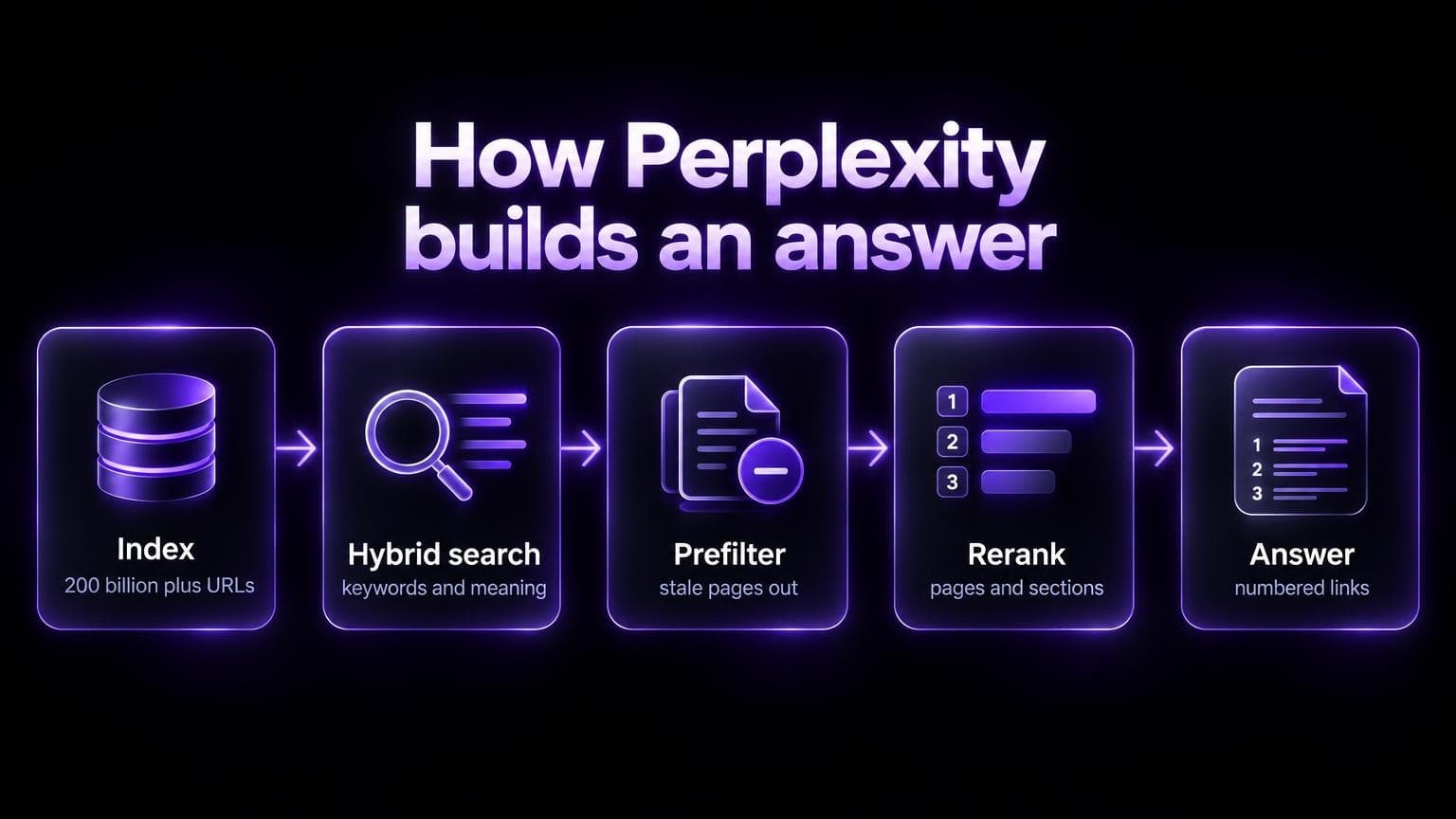
What it says:
- The index tracks over 200 billion unique URLs.
- Retrieval is hybrid. Lexical and semantic search are merged into one candidate set. At that stage, comprehensiveness matters more than precision.
- A prefilter removes clearly non-responsive or stale content.
- Ranking runs in several stages. The last stages use cross-encoder rerankers.
- Pages are split into self-contained spans. Each span can be retrieved and ranked on its own.
- Machine-learned models decide which URLs to re-index and when. Documents from authoritative domains and under-covered topics stay in hot storage.
Three of these change how you write a page:
- The stale filter
- The span-level ranking
- The way the index decides what to keep fresh
The steps below use them.
How many sources does one answer use?
The pages that rank for this topic disagree:
| Page | What it says about sources per answer | Matches our data as |
|---|---|---|
| 2POINT | Three to five | Linked |
| AI Labs Audit | About 10 pages visited, 3 to 4 cited | Both |
| Stackmatix | 5-10 inline citations | In between |
| Conbersa | Retrieves 10-20 pages | Listed or retrieved |
| geoclarity | 5-7 sources per response | In between |
| AuthorityTech | Perplexity's documentation leaves the count open | Open |
| Our leaderboard, 297 answers | Ten listed in 277 answers. Three or four linked in 123 of the 179 answers that link anything | Both |
They disagree because they count different things.
Listed is ten in our scans. Linked is three or four, when the text links anything.
The count also depends on the mode. The help center describes Pro Search and a Research mode. It says Deep Research performs dozens of searches and reads hundreds of sources.
Our scans are one snapshot per question.
Two crawlers matter.
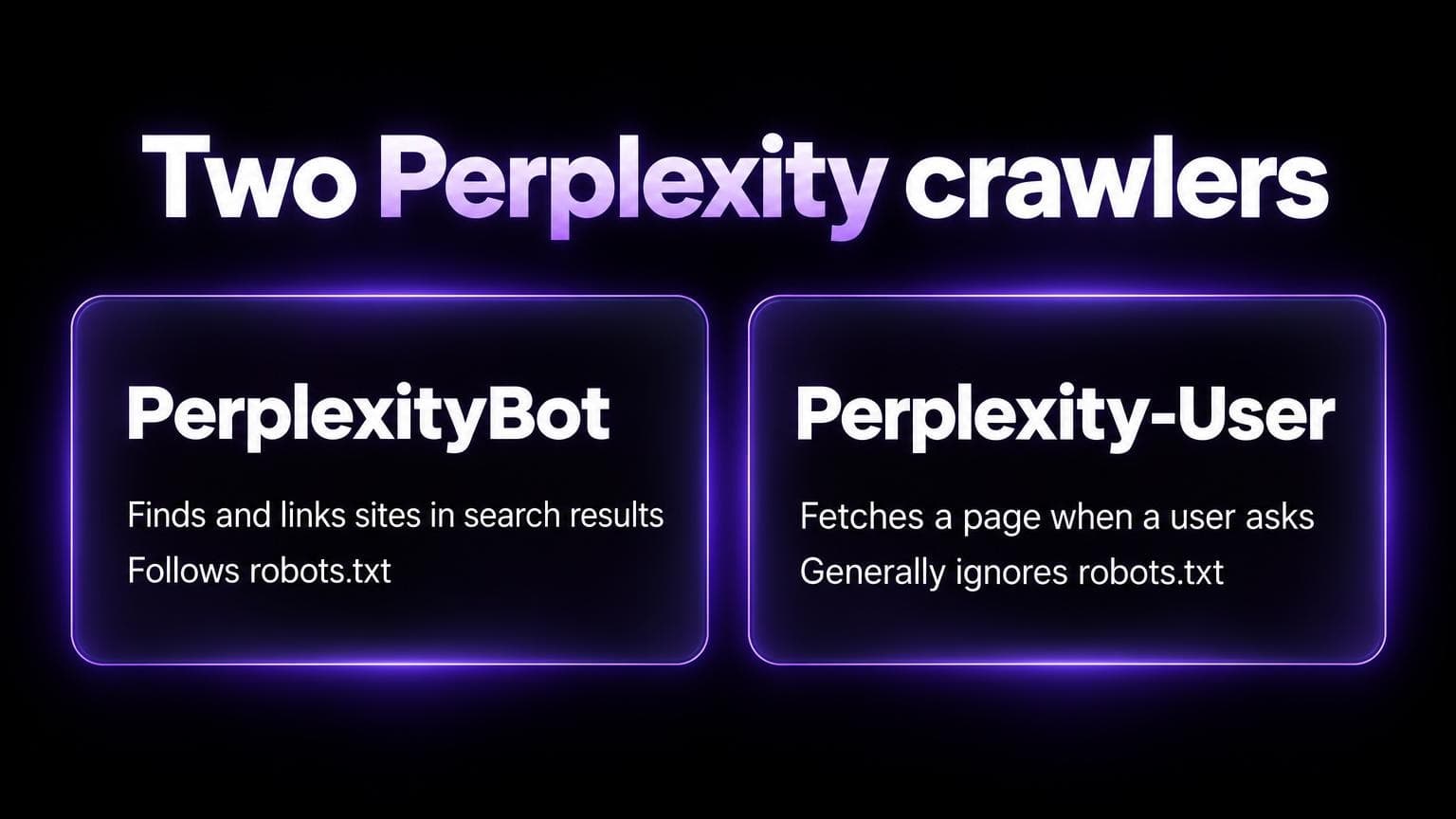
The crawler docs keep them apart.
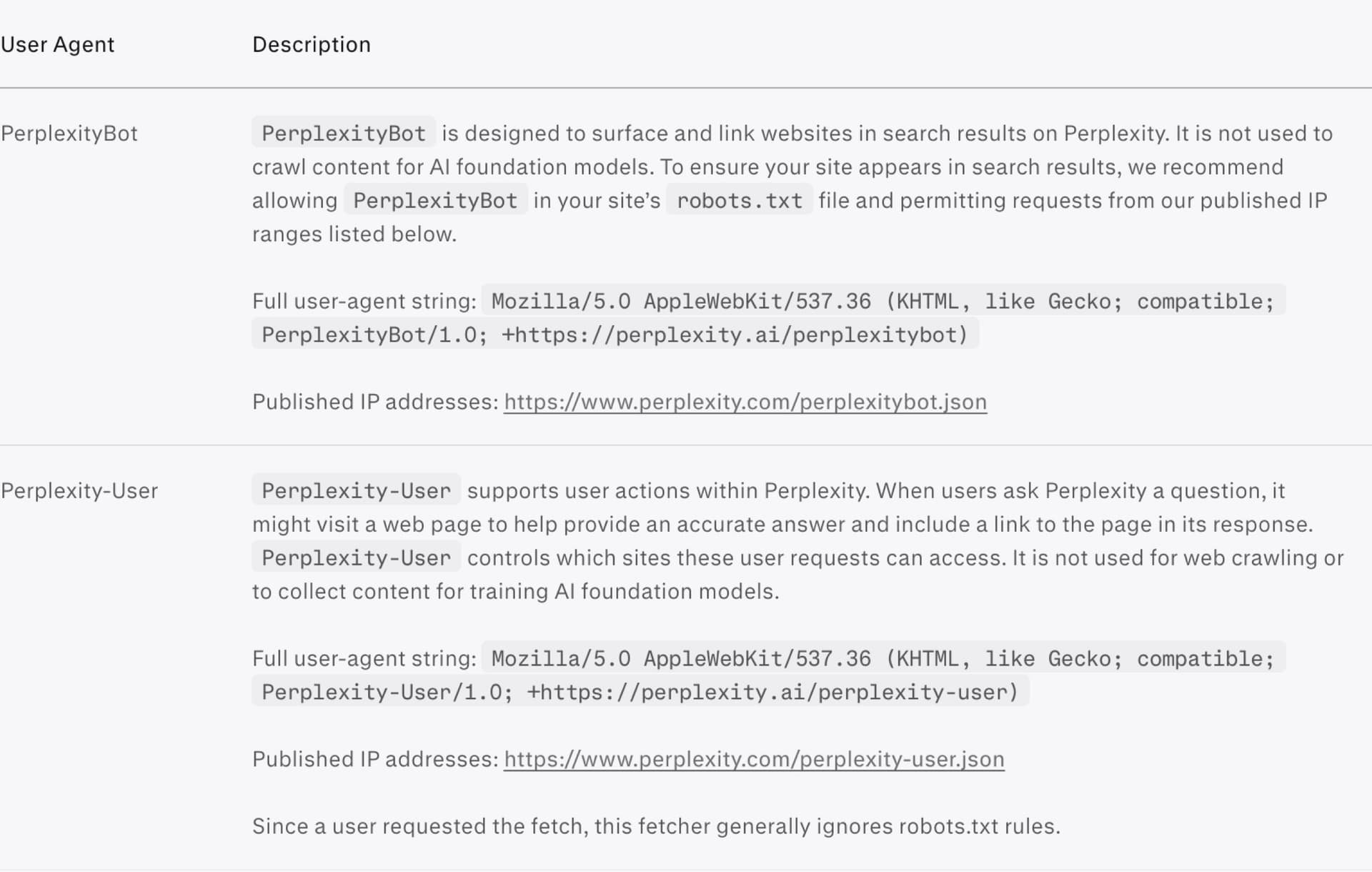
- PerplexityBot surfaces and links sites in Perplexity search results. Perplexity says it is not used to crawl content for AI foundation models. The research post says it follows explicit robots.txt limits.
- Perplexity-User supports user actions. It may visit a page to help answer a question and link to it. A user asked for that fetch, so Perplexity says the fetcher generally ignores robots.txt rules.
What 297 Perplexity answers show
The leaderboard scans "best X" questions on five engines. The data for this post comes from every public question page, read on 2 October 2026. That gave 343 questions, and 297 have a stored Perplexity answer. The scans date from 23 and 24 September 2026, with one from 5 September. Listed means a URL in the answer's source list. Linked means a distinct URL linked in the answer text. Page types and domain rating (DR) are the leaderboard's own labels. Only 36 of the 343 questions are in the Software and AI category. Most are consumer products: 106 are tech and gadgets, and 63 are home and appliances.
Perplexity lists about twice as many sources as the next engine.
And every answer has some.
| Engine | Median sources listed | Answers with none |
|---|---|---|
| Perplexity | 10 (297 answers) | 0 |
| Copilot | 5 (343 answers) | 10 |
| Google AI Overviews | 5 (343 answers) | 28 |
| ChatGPT | 4 (338 answers) | 6 |
| Gemini | 3 (343 answers) | 81 |
Most of those sources are roundups.
Of the 3,067 pages Perplexity listed:
- 73.6% listicles
- 11.7% news
- 7.2% other
- 2.4% vendor pages
- 1.9% guides
- 1.4% Reddit
- 1.4% comparison pages
- 0.4% directories
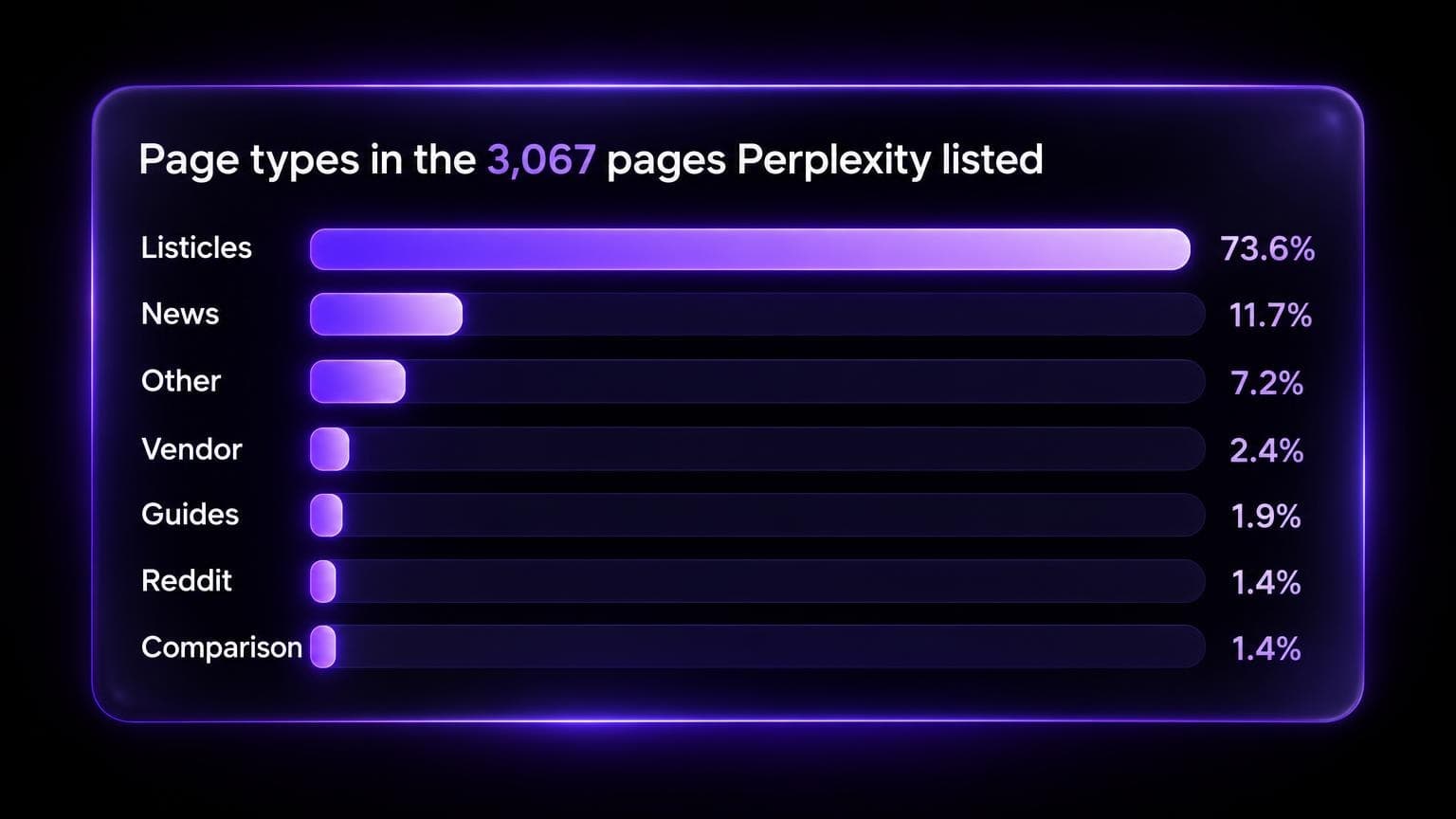
294 of 297 answers listed at least one listicle. The median was eight of ten.
Only 51 answers listed any vendor page.
Software and AI prompts look the same. In that subset (30 questions, 305 pages), 69.5% were listicles and 4.9% were vendor pages.
More findings from the same lists:
- Big domains. Of 2,703 listed pages with a DR figure, the median DR was 87. Only 86 pages (3.2%) were under 50, and 69% were 80 or higher. In the software subset, 10.7% were under 50. Small sites get in, but rarely. OneLittleWeb (DR 31) is in the best SEO tool answer.
- Not a Reddit engine here. The Reddit label covers 44 listed pages (1.4%). reddit.com itself supplied 39, YouTube 52 (1.7%), G2 8, and Wikipedia 1. AIOSEO says 46.7% of Perplexity's top-cited sources are community platforms such as Reddit, Quora, and forums. Stackmatix gives Reddit alone 46.7%. Neither page names a primary source, and the prompt mix differs. Test your own prompts.
- A site can take two slots. In nearly six of ten answers, at least one host appears twice or more among the ten. Perplexity does not cap a site at one source.
- Little overlap. 71% of the listed pages were listed by Perplexity and no other engine. About 12% of Perplexity's listed URLs also appeared in ChatGPT's list for the same question. The lists differ by engine, so check each one. For ChatGPT, see how to rank in ChatGPT.
- One search. The record shows one model search for 279 of the 297 answers: the prompt itself. 17 answers show two to six. For these simple prompts, the stored data does not show a question split into many sub-queries.
- Top hosts. nytimes.com supplied 128 listed pages, pcmag.com 110, forbes.com 107, consumerreports.org 103, and techradar.com 96. The ten biggest hosts supplied 27% of the pages. There were 856 distinct hosts.
The limits are real.
These are "best X" questions. Mostly consumer products. Scanned once. Sorted by our own page-type labels.
Do not stretch them to how-to or B2B prompts.
Run your own prompts before you act.

Does AI name you?
See if AI mentions your brand. Then get the pages to fix.
How to get cited by Perplexity
A week of useful work. In order.
1. Let the right crawlers in.
Allow PerplexityBot in robots.txt.
User-agent: PerplexityBot
Allow: /
The docs also say to permit the published IP ranges for PerplexityBot and Perplexity-User.
Behind a firewall? The docs give a Cloudflare rule: user agent contains PerplexityBot or Perplexity-User, IP source address in those ranges, action Allow.
Perplexity says robots.txt changes can take up to 24 hours to show.
Perplexity-User generally ignores robots.txt. So check your server logs for both names.
And make sure the page you want cited has no accidental noindex and no login wall.
2. Find your ten.
Run 10 to 20 prompts in Perplexity.
Copy every URL in each source list. Not only the linked ones.
Those URLs are your real competitors. Not the brands you listed in a deck.
3. Label the ten and act.
This table is a reading aid. Not a Perplexity rule.
| If the ten listed pages are mostly | Do this | What our data says |
|---|---|---|
| Listicles and roundups | Get on those lists. Pitch the authors and give them facts to quote. See listicle outreach and how to get cited in AI answers. | 73.6% of listed pages (69.5% for software prompts) |
| Vendor or docs pages | Write the page that answers the prompt: answer first, a comparison table, dated facts. | Vendor pages: 2.4% overall, 4.9% in software |
| News and review sites | Earn coverage or a review from those outlets. | News: 11.7% |
| Reddit, YouTube, forums | Take part where your own prompt set shows them. | Reddit 1.4% and YouTube 1.7% on these prompts. Check yours |
4. Write sections that stand alone.
Perplexity's research post says it splits pages into self-contained spans and ranks each span.
So each section has to work alone:
- Use a heading that matches the prompt.
- Put the answer in the first sentence under it.
- Use a table for a comparison.
- Write no section that needs the one before it.
The same post says a site heavy on list or table data may get more formulaic parsing.
This is the answer engine optimization advice. LLM SEO calls it writing for the long prompt.
Take the heading "How many sources does Perplexity list?"
Before: Many people ask how many sources Perplexity uses, and the answer depends on what you count.
After: Perplexity listed ten sources in 277 of 297 answers on our leaderboard. It linked three or four in the text when it linked any.
Page Inspector on AI SEO Tracker (higher plan) is the check for step 4: what does a model actually parse on that URL.
If the facts block is in a screenshot, you will lose to a markdown table on a weaker domain.
5. Date the facts and update them for real.
Three things Perplexity tells us:
- Its API returns a
dateand alast_updatedfor each result. - Its pipeline filters stale content.
- A model decides which URLs to re-index and when.
So show an "Updated" date. Keep price and engine lists current.
Your pricing or engine list changed? The page has to say so.
I will not repeat a blog's "90 days or you die" rule as fact.
6. Add what only you know.
Give the page something no roundup has:
- Original numbers, with a method
- Your engine list
- Your audit price
- Your prompt set
No original numbers? Cite the primary source and add the part only you hold.
State entity facts in plain text. Not only in a hero image or a script widget.
Example: "AI SEO Tracker tracks ChatGPT, Perplexity, Gemini, Copilot, and AI Overviews."
7. Skip the tricks.
- Do not buy links for "GEO backlinks". I know of no evidence that they work.
- Do not write "according to our research" with no method behind it.
- Do not show the bot a page that a person does not see.
How to track Perplexity source URLs
Three ways: by hand, with the API, or with a citation tracker.
Do not report "AI citations" as one cell.
Freeze a prompt set. Store this for each run:
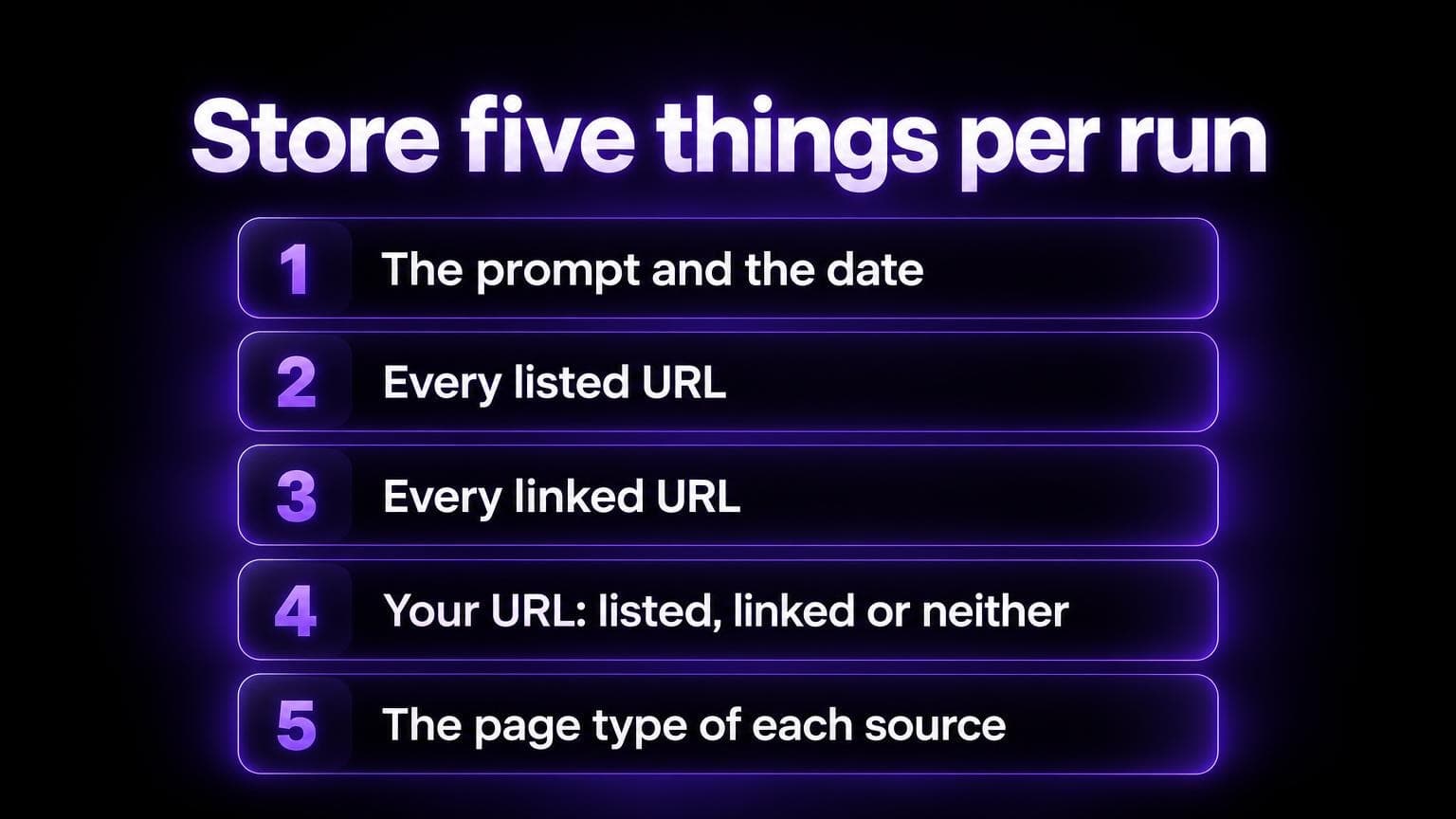
| Field | What to store | Why |
|---|---|---|
| Prompt and date | The exact wording, frozen, and the date of the run | Changing the wording changes the test |
| Listed URLs | Every URL in the source list | Your real competitors |
| Linked URLs | URLs tied to sentences in the answer | Who the answer leans on |
| Your URL | Listed, linked, or neither, and which page | The homepage, or the page you meant |
| Page types | Listicle, vendor, news, forum, video | Tells you the work |
Citation URL rate on Perplexity = prompts where your domain appears in the source list / prompts in the set.
Report two versions:
- Listed rate: a URL from your domain anywhere in the list.
- Linked rate: a URL from your domain tied to a sentence in the answer.
Mention rate is a second row. See AEO metrics.
By hand.
Open each prompt. Open the sources. Paste the URLs into the sheet.
Two free signals add to it:
- Server logs for PerplexityBot and Perplexity-User
- Your referrer report for perplexity.ai
They do not replace the prompt-level sheet.
With the API.
Perplexity's Agent API returns the sources as a search_results item, next to the message item that holds the answer.
In the docs example, each result has id, title, url, date, last_updated, snippet, and source.
The answer text carries numbered markers such as [1][3].
The call from the docs:
curl https://api.perplexity.ai/v1/agent \
  -H "Authorization: Bearer $PERPLEXITY_API_KEY" \
  -H "Content-Type: application/json" \
  -d '{"preset": "fast", "input": "your prompt here"}'
A warning on old guides.
Perplexity's migration guide says Sonar Chat Completions support ended on 27 September 2026.
Synchronous and streaming requests keep working, because Perplexity is reformulating them as Agent API requests. It recommends the Agent API for new projects.
Some tracking guides, such as Linksii, still tell you to read the Sonar citations array.
Build new tracking on the Agent API.
And the API is not the app. Check a sample of prompts by hand before you trust it.
Cadence.
Weekly.
Daily screenshots of one prompt will drive you mad.
After you ship a refresh, a same-week recheck is fair. Then go back to weekly.
Half-life.
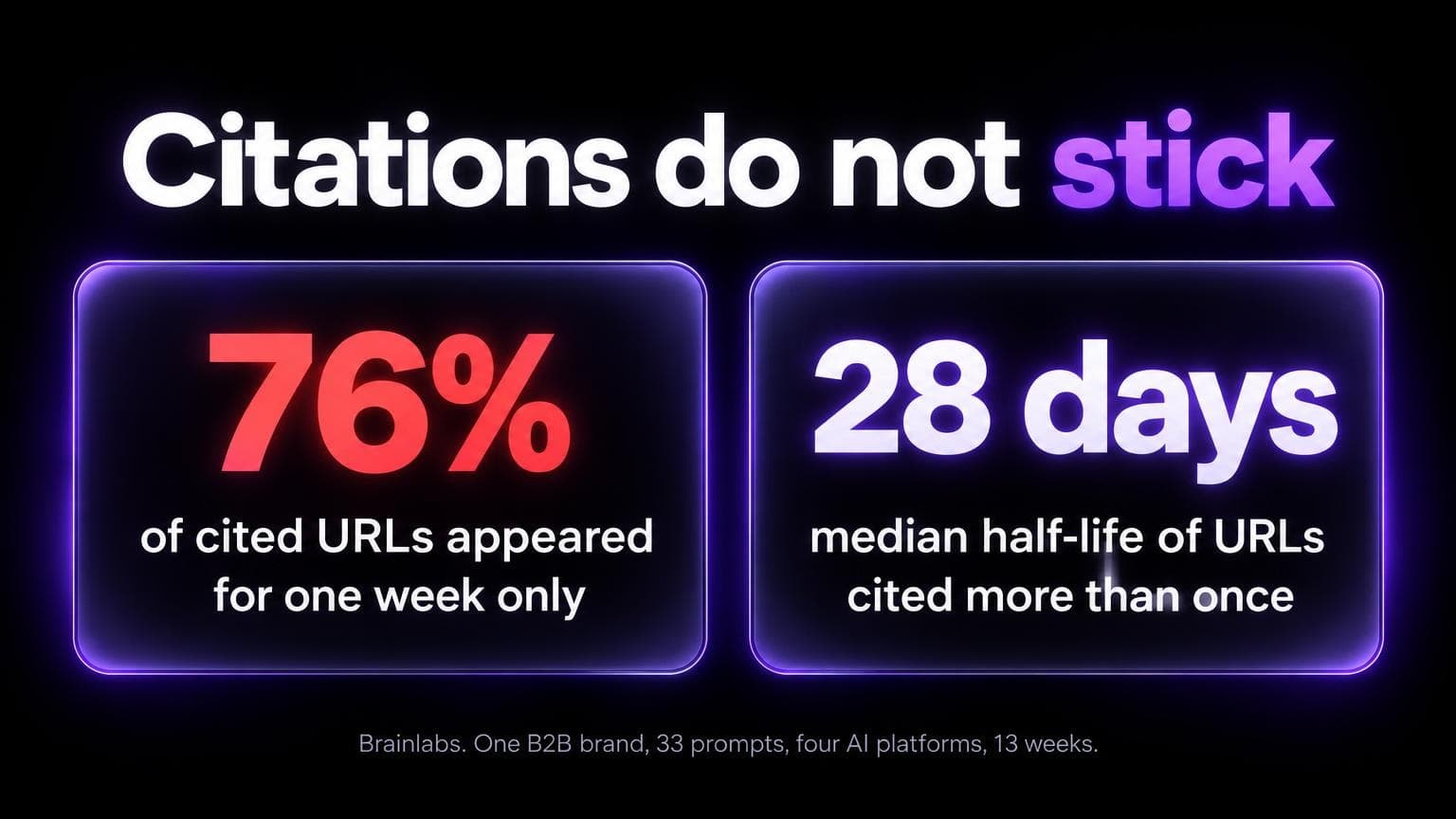
Brainlabs tracked one anonymized B2B brand for 13 weeks. 33 prompts on four AI platforms. Not Perplexity alone.
- 76% of cited URLs appeared for a single week and were never cited again.
- 28 days was the median half-life among URLs cited more than once.
Brainlabs says 13 weeks is too short a window to set a benchmark.
My rule stays simple.
Your URL sticks across four weekly scans? You have a page worth defending.
It flickers? You have a recency bump. Not an asset.
With a tracker.
AI SEO Tracker runs Perplexity next to ChatGPT, Gemini, Copilot, and AI Overviews on the same prompt list. That is the point of the engine split.
A $49 audit is enough to see whether Perplexity already uses you as a source.
Tracking from $79/mo is for the weeks after you change the page.
The report lists the sources each engine cited.
What nobody knows yet
Perplexity publishes no ranking weights.
It does not say how many sources it uses. And its help center describes modes that differ.
Our numbers are one snapshot of "best X" questions. I do not know how they hold for how-to or B2B prompts.
The Brainlabs numbers cover one brand.
Perplexity is the honest engine in this set. It shows its work.
Earn a URL on that list. Then keep the page fresh enough to stay there.
That is the job. The rest is vocabulary.