



TL;DR
- You need 3 signals: a query log, Search Console, and analytics. Each has a blind spot.
- Search Console: the AI report is live for everyone. No queries in it though.
- Clicks: they hide as normal Google traffic.
- Rank: there is none inside the box.
- Surprise: 27% of what AI Overviews cite is YouTube. ChatGPT: 0.3%.
Does AI name your brand? Check your site.
You can't track AI Overviews with one tool.
I wish you could. You can't.
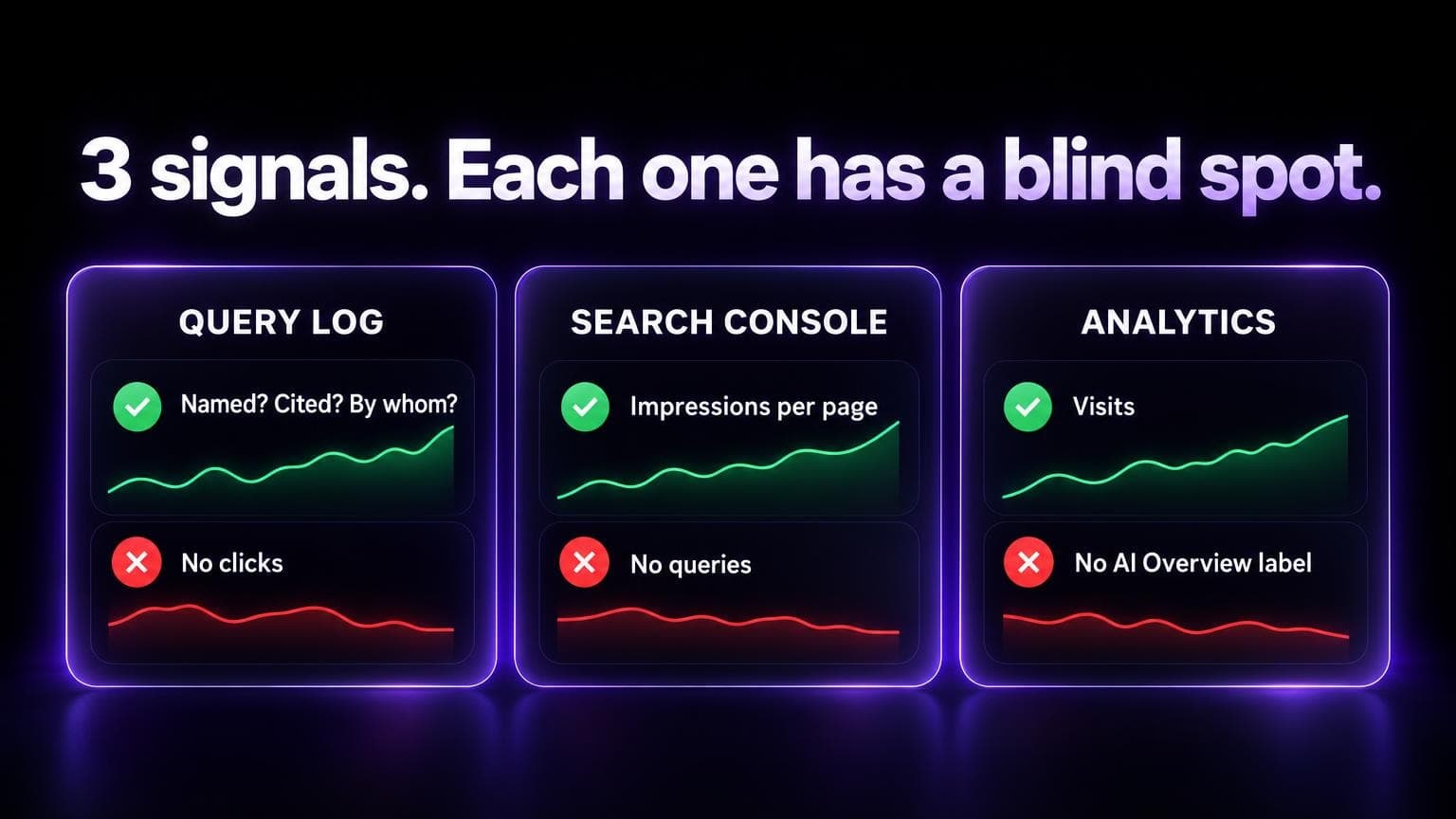
The log tells you if you're cited. Not if anyone clicked.
Search Console tells you impressions. Not for which search.
Analytics tells you visits. Not where they came from.
So you use all three. Here's how. It takes 30 minutes a week.
Three signals and what each one misses
| Signal | Tells you | Can't tell you |
|---|---|---|
| Query log | Is there a box? Are you in it? Who else? | Clicks |
| Search Console | Impressions per page | The query |
| Analytics | Visits | If it was an AI Overview |
Why can't Search Console show the clicks?
Because Google counts an AI Overview click like any other click. It's blended in with the rest.
What to log for each query
Six things. Skip one and the row is useless.
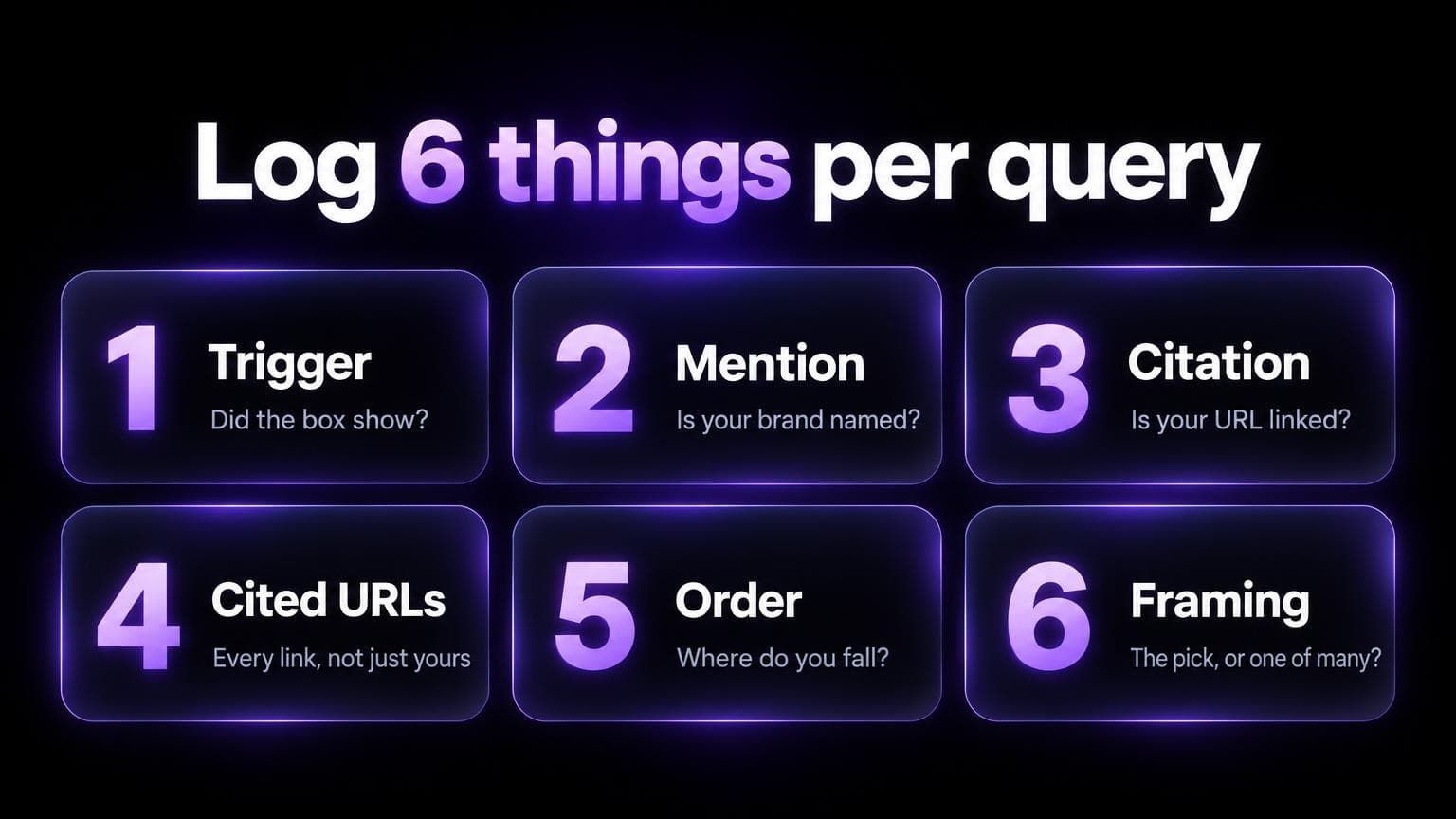
A mention and a citation are not the same. You can get one without the other. (More on that.)
Here's a real row. We scanned "best free video editors" on 24 September 2026.
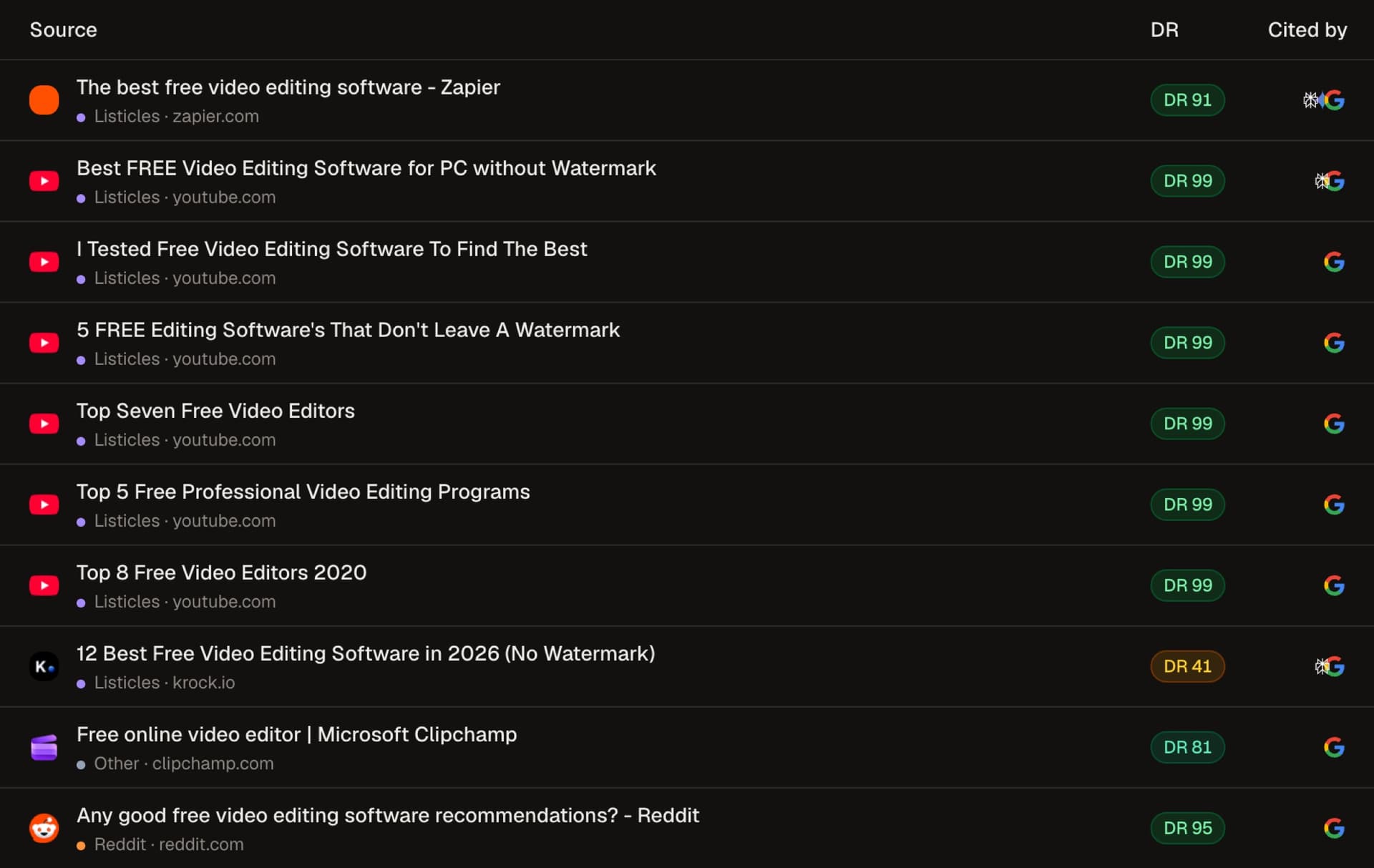
- Trigger: yes.
- Named: DaVinci Resolve, CapCut, Clipchamp, iMovie.
- Cited: 10 links. Zapier, six YouTube videos, krock.io, Clipchamp and a Reddit thread.
- Own site cited: only Clipchamp.
So four products were named. But only Clipchamp's own site was cited. The other three got no link.
That's "named, not cited". You only see it if you log all six.
Why one check is not enough
AI Overviews change. A lot.
Ahrefs watched 43,000 keywords for a month:
- 70% chance the Overview changed between two checks.
- 45.5% of the cited URLs were new each time.
Almost half the sources. Gone. Replaced.
So one check tells you almost nothing.
Google also changes things on its end:
- 27 Jan 2026: Gemini 3 became the default model.
- 6 May 2026: more links inside the text.
Write those dates in your log. A jump near one of them isn't your fault.
Four rules:
- Freeze your queries for 30 days.
- One location. One device.
- Check more than once. Report "cited in 3 of 4".
- Keep "no box" separate from "box without me".
The Search Console generative AI report
Google launched it on 3 June 2026. Everyone has it since 31 August.
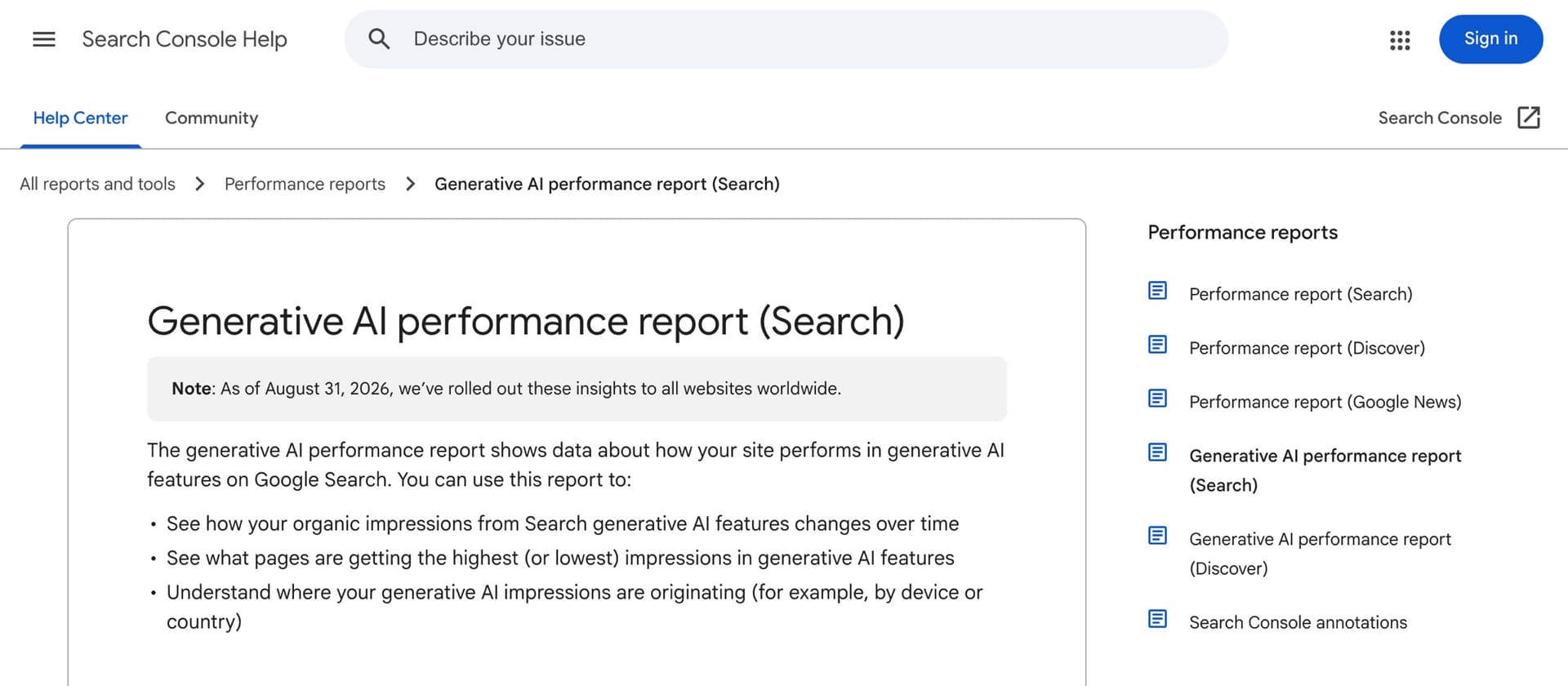
What you get:
- Impressions in AI Overviews and AI Mode
- By page, country, date and device
What you don't get:
- The query
- AI Overviews split from AI Mode
- Clicks
So it tells you which pages Google uses. Not for what.
Two gotchas:
- The totals won't match your log. It counts all searches, not your 30.
- Check Google's data anomalies page before you panic. A logging bug lowered the numbers for 13 to 17 August 2026.
What rank means in an AI Overview
There is no rank.
Search Console gives the whole box one position. Every link in it gets the same number.
First link or sixth link? Same position.
So log the order yourself.
And don't assume your Google rank carries over. Ahrefs found only 37.9% of cited pages rank in the top 10.
"We rank #3, so we're in the Overview" is a guess.
Clicks from AI Overviews
The hard part.
Google's AI report has no clicks. And in GA4, an AI Overview click looks like plain google / organic.
There's one trick. The text fragment.
Sometimes Google adds #:~:text= to the link. You can catch that with Google Tag Manager. Kick Point has a guide.
But does it still work? The experts disagree.
- Kick Point says Google removed it in May 2026.
- Ahrefs still recommends it in August 2026.
I don't know who's right. So test it yourself. Takes 2 minutes:
- Search something you're cited for.
- Click your own link in the box.
- Look at the address bar. See
#:~:text=? It works. No? Don't build on it.
No fragment? Then look for this in Search Console: CTR drops while position holds. That's the AI Overview fingerprint.
Ahrefs checked its own site. Informational queries lost 42% of their CTR from April to May 2025.

Does AI name you?
See if AI mentions your brand. Then get the pages to fix.
Where AI Overviews get their links
This one surprised me.
We scanned 343 "best X" questions on five engines. Then counted where each one gets its links.
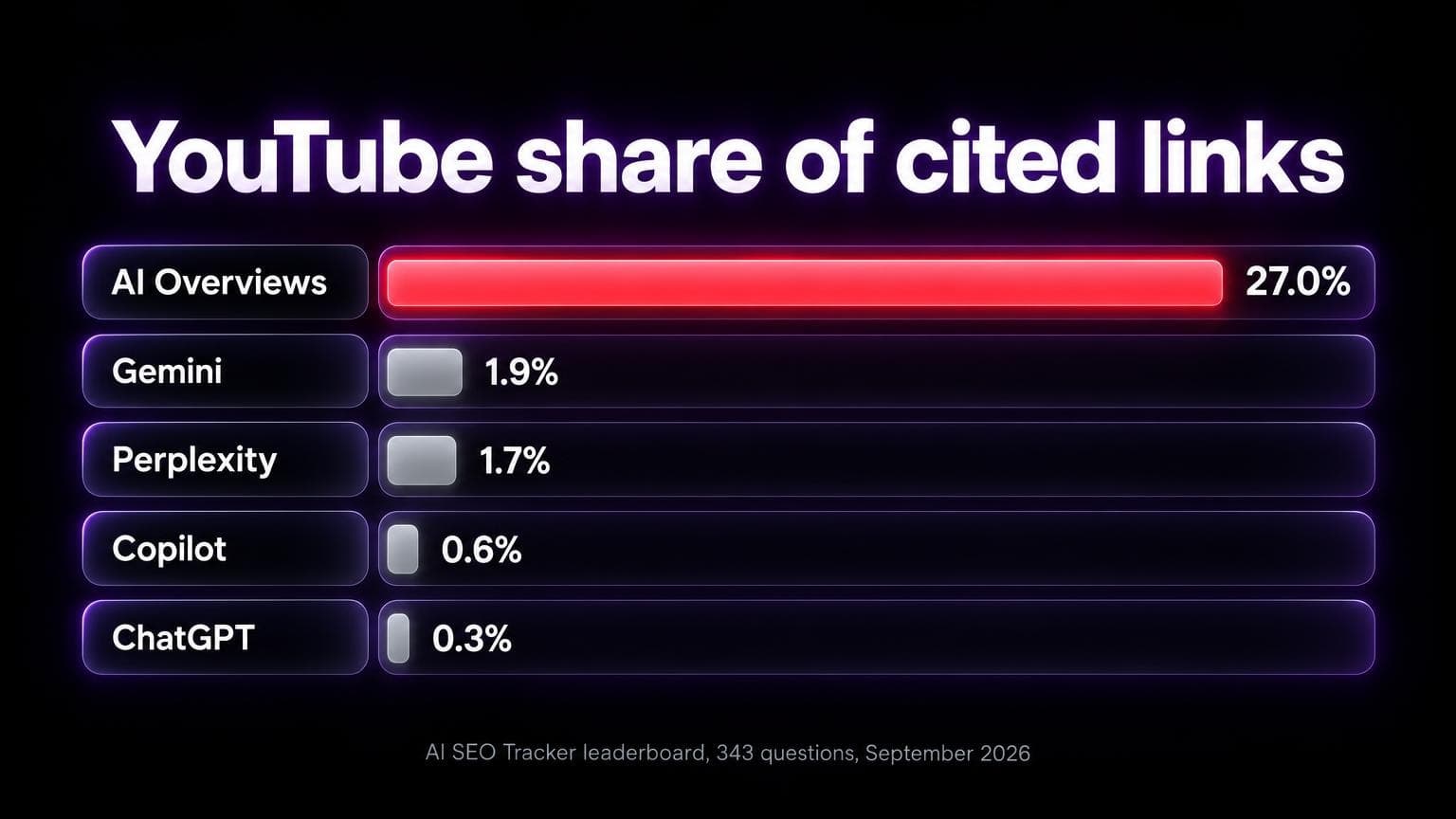
27% of what Google's AI Overview cites is YouTube.
ChatGPT? 0.3%.
On 72% of questions, the AI Overview cited at least one video.
Think about what that means. If you want Google's AI to cite you on buying questions, part of the job is video.
And you'd never know if you only logged "cited: yes or no". Log every URL.
Limits: these are "best X" questions only. One scan each. It's a snapshot.
A weekly routine in 30 minutes
One minute per query. Thirty queries.
- Pick 30 queries. How-tos, "best X", "X vs Y", your money terms, your brand.
- Same setup every week. Private window. Same location. Same device.
- Log the six things. Screenshot when you or a rival is cited.
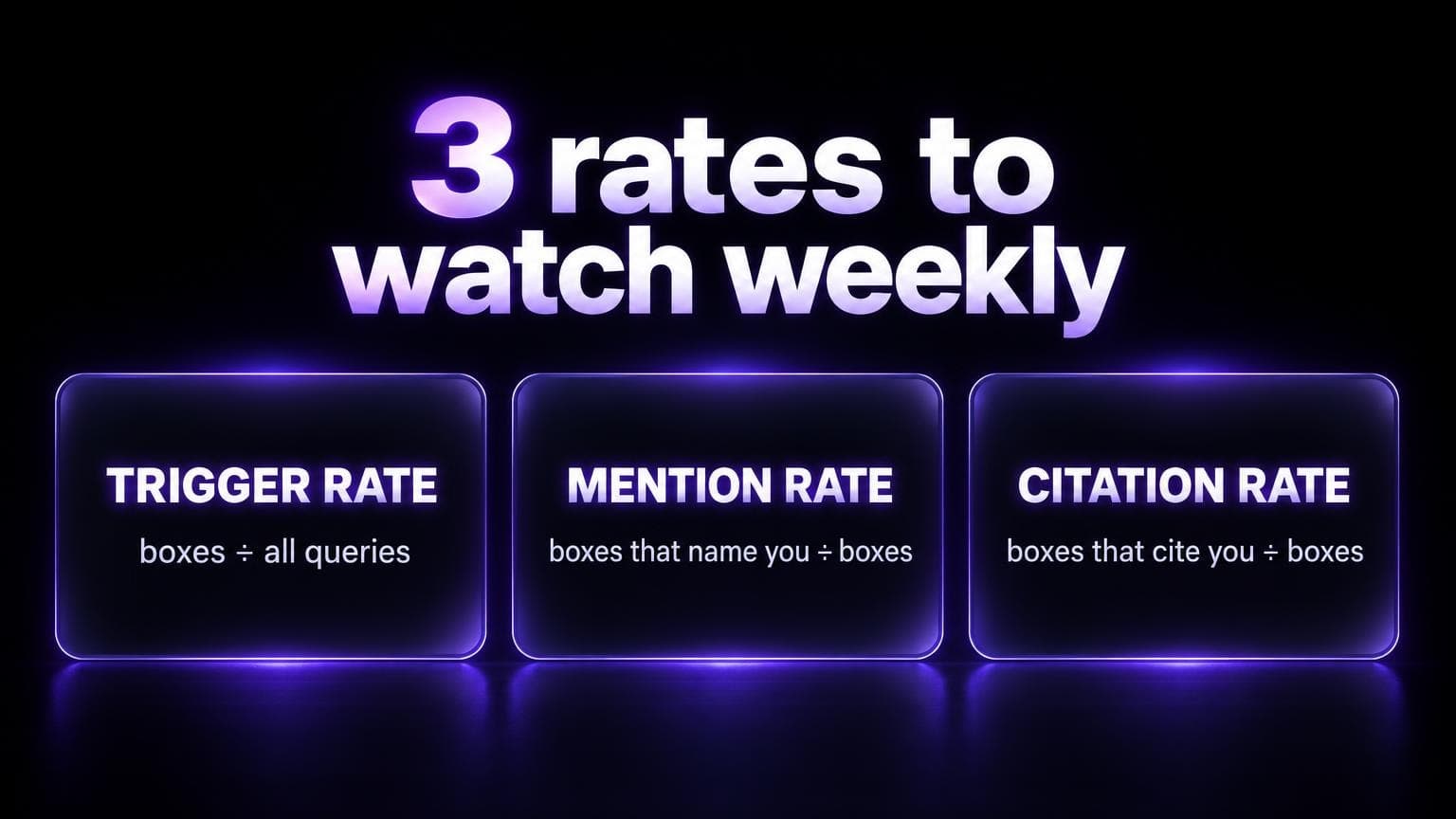
- Work out three rates.
The golden rule: never change the queries and the content in the same week. You won't know which one moved the number.
The sheet, the trigger rate formula and the citation rate formula are in AI Overview tracker. Mention rate is the same sum: count the rows where your brand is named, and divide by boxes.
When a tracker is worth it
Buy a tool when:
- You keep skipping weeks
- You need more than one country or device
- You want competitor history
You may already have one. Semrush shows trigger and citation rate. Ahrefs has an AI Overview filter. And there's a free Ahrefs preview with no signup.
Mine: AI SEO Tracker. $49, once. Up to 50 prompts on ChatGPT, Perplexity, Gemini, Copilot and AI Overviews. Daily for 7 days. Tracking starts at $79/mo.
No free scan. No AI Mode.
More options: AI search monitoring tools.
What to do with each result
| You see | It means | Do this |
|---|---|---|
| No box | Nothing to win here | Check again next month |
| Box, you're not in it | Google uses other sources | Read the cited URLs. That's your to-do list |
| Cited, not named | Google used your page but named someone else | Put your name next to the answer |
| Named, not cited | Others describe you | Add a quotable passage. How |
| Cited in 1 of 4 | Unstable | Check again before you act |
| Impressions dip | Maybe a Google bug | Check the anomalies page |
One more: never change the URL of a page Google cites. Update the content. Keep the address.
FAQ
Is this the same as ranking in Google SGE?
SGE was the old name. Now it's AI Overviews. How to rank in it.
Does Search Console tell me if I appear for keyword X?
No. The report has no queries. Use your log.
Can I track AI Mode apart from AI Overviews?
Not in Search Console. Some tools do. We don't scan AI Mode.
Will getting cited win back the clicks?
Sometimes. I don't have a number. Track presence first, clicks second.