



TL;DR
- What it is: your server returns Markdown instead of HTML when a client sends
Accept: text/markdown. Same URL. How it works. - Who asks: Claude Code, Cursor, OpenCode, Copilot and OpenClaw send the header. ChatGPT, Perplexity, Gemini, Claude.ai and Grok fetch HTML only, in AcceptMarkdown's matrix (updated June 2026). Which agents ask.
- How to ship it: Cloudflare Pro or higher has a toggle. Next.js, Nginx, Markdown files and WordPress need a short setup. Pick your setup.
- How to check it:
curl -sI -H "Accept: text/markdown" URLmust returntext/markdownand aVaryheader with Accept. Test it. - The limit: it cuts what agents download. Public tests found no clear rise in AI bot visits or citations. SEO and AI visibility.
Does AI name your brand? Check your site.
An agent asks for your page.
Your server sends Markdown. Not HTML.
Same URL. Browsers still get HTML.
That's markdown for agents.
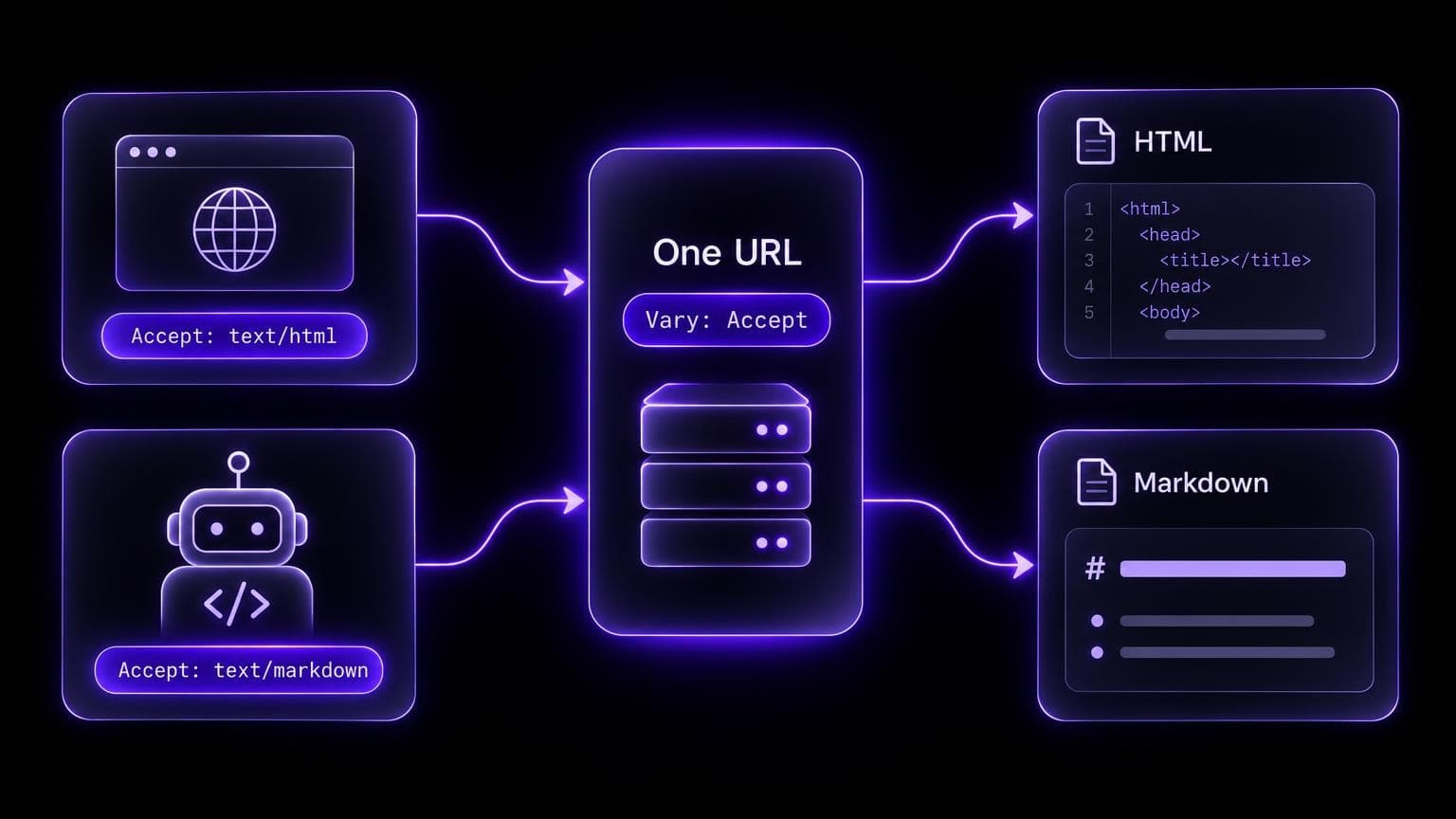
The client sends Accept: text/markdown. The server answers in Markdown. The mechanism is HTTP content negotiation. It's decades old.
Why bother? An agent pays for every token it reads.
Coding agents such as Claude Code and Cursor get the page without the navigation, scripts and wrappers.
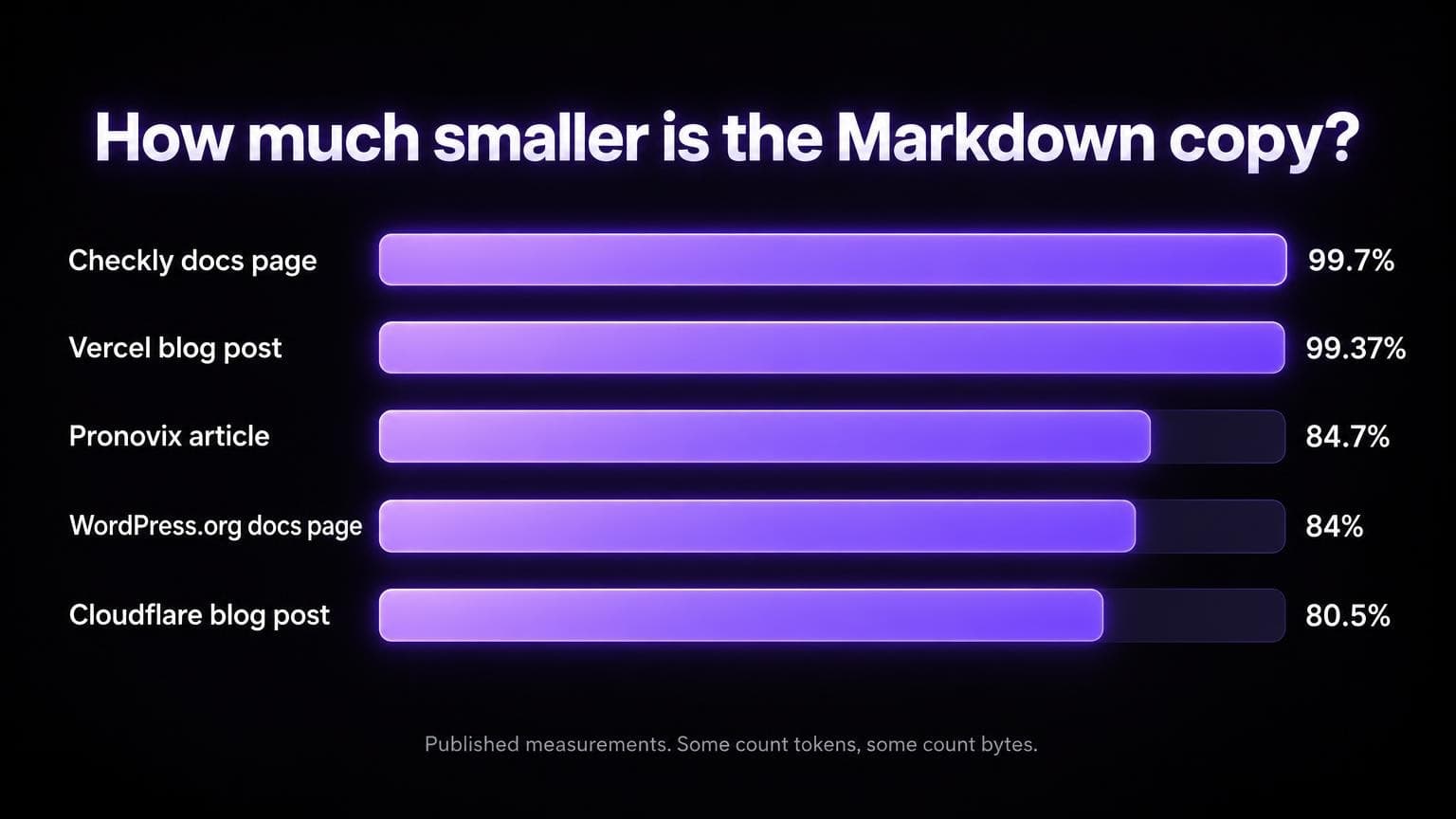
On the pages measured below, the Markdown copy is 80% to 99.7% smaller than the HTML.
And for AI search? The short answer: it's plumbing for coding agents today.
Public tests found no clear gain in citations.
One more thing. "Markdown for Agents" is also the name of Cloudflare's feature. The practice works on any stack.
How markdown for agents works
A client lists the formats it wants in the Accept header.
A server that supports Markdown answers with Content-Type: text/markdown.
Any other client gets HTML.
Claude Code, for example, sends Accept: text/markdown, text/html, */*.
RFC 7763 registered the text/markdown type in 2016.
This is a trimmed response from Cloudflare's documentation:
HTTP/2 200
content-type: text/markdown; charset=utf-8
vary: accept
x-markdown-tokens: 725
x-original-tokens: 12345
content-signal: ai-train=yes, search=yes, ai-input=yes

---
title: Markdown for Agents · Cloudflare Agents docs
---

## What is Markdown for Agents
What Cloudflare's converter does:
- Drops headers, footers, navigation, scripts and styles
- Builds YAML frontmatter from the
title,descriptionandog:imagemeta tags - Keeps JSON-LD at the end
Always send Vary: Accept.
Without it, a CDN can hand HTML to an agent. Or Markdown to a browser. (AcceptMarkdown)
There are three ways to ship it.
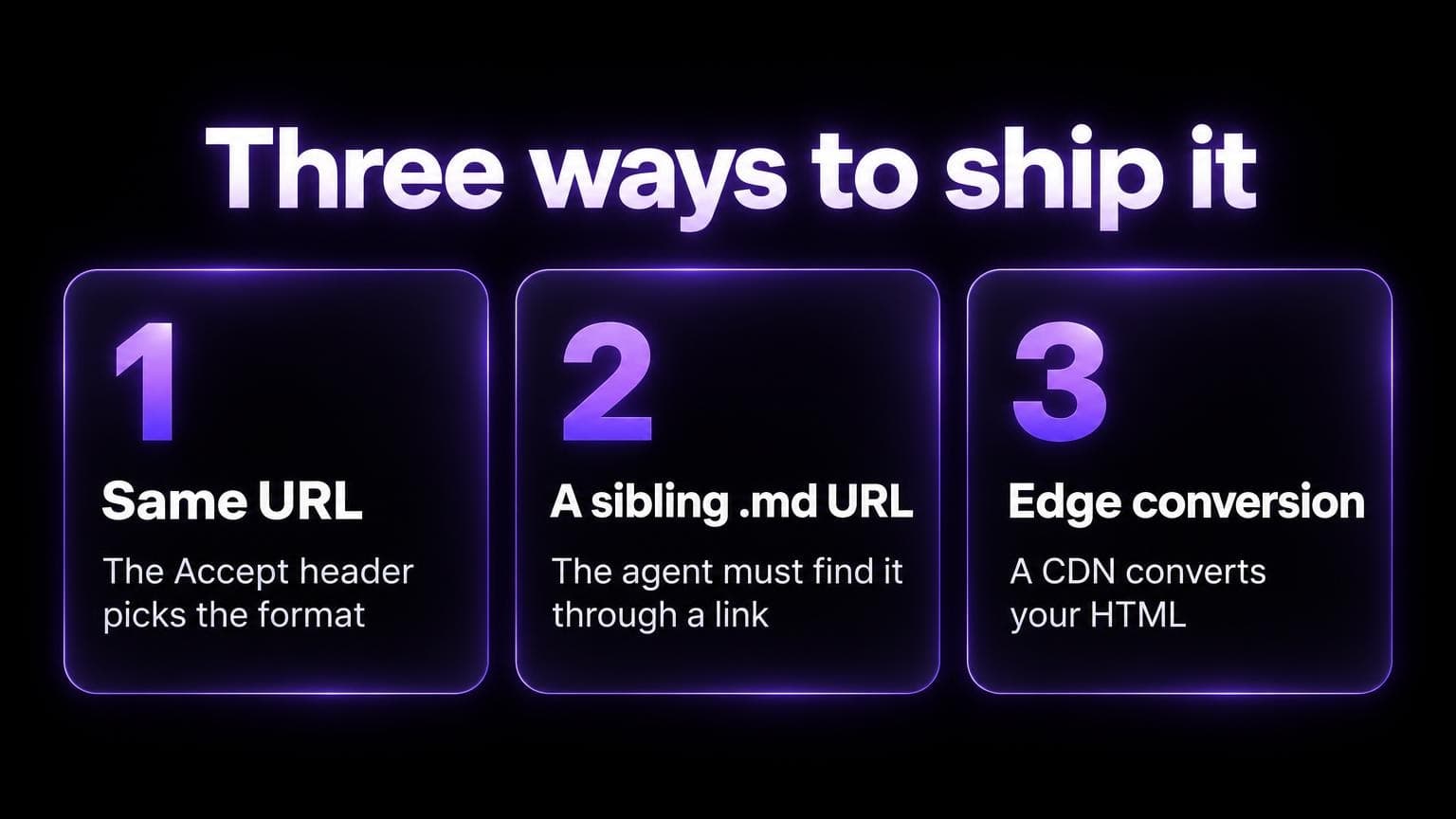
- Negotiation on the canonical URL. The header picks the format. The agent needs no knowledge of your site. Vercel says this beats separate
.mdURLs for that reason. - A sibling
.mdURL. The agent must know it or find it through a link. Roots notes that a.mdURL that ignores the header is not content negotiation. - Edge conversion. A CDN does the first way for you by converting your HTML.
What this site does: the second way.
A Markdown copy of this post lives at /markdown/blog/markdown-for-agents with noindex.
A request to the blog URL with the header still returns HTML. (Checked with curl on 2 October 2026.)
The LLMOnly component post covers the user agent route and when it counts as cloaking.
Do not confuse the term with:
- AGENTS.md: a file of instructions for coding agents.
llms.txt: an index of your site for LLMs.
Which agents ask for Markdown
Mostly coding agents ask. Most answer engines don't.
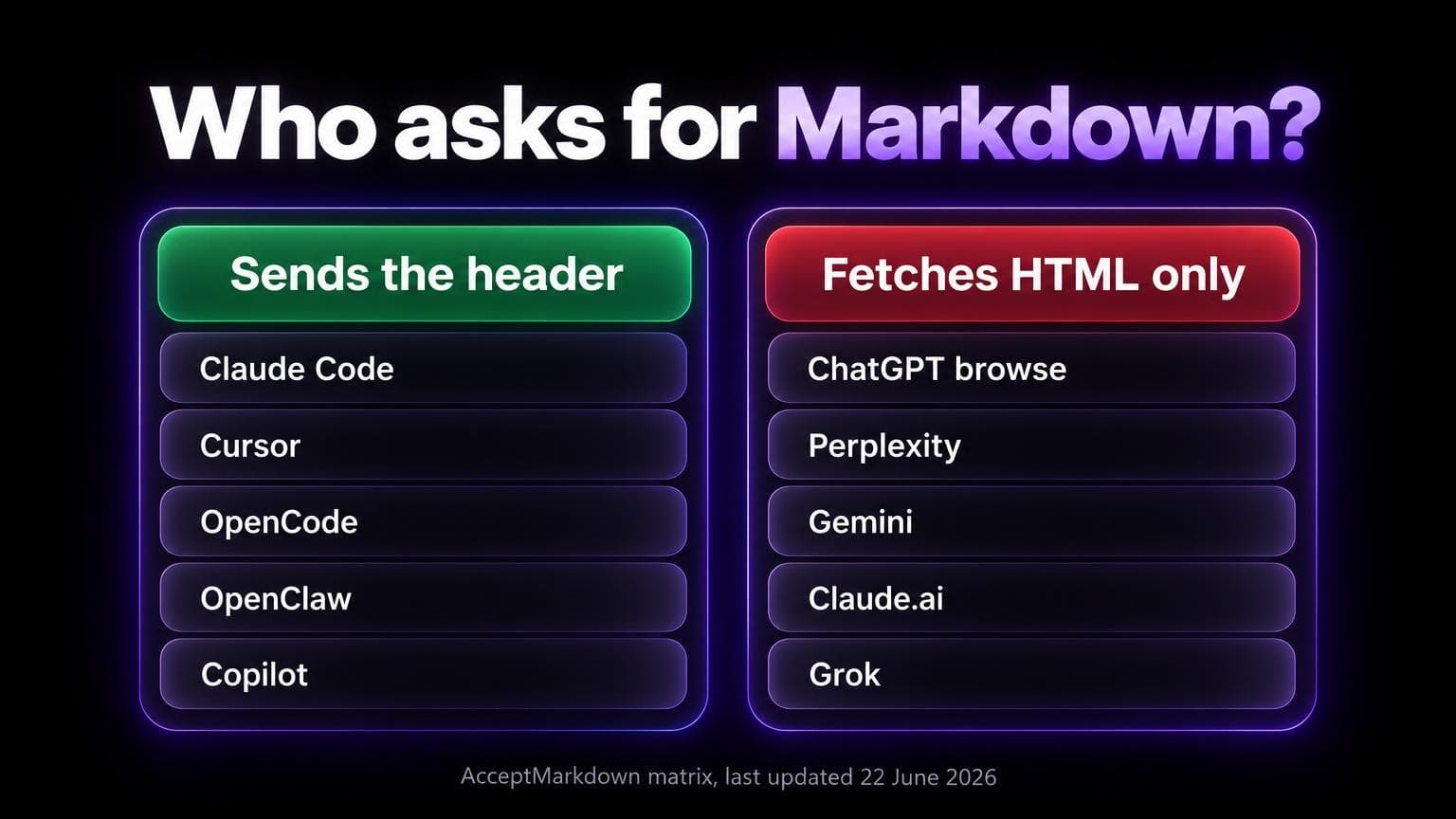
AcceptMarkdown.com keeps a matrix of which AI tools send Accept: text/markdown. It tests each tool's own browse or fetch tool.
The page says "Last updated 2026-06-22". Brackets show each row's verified date:
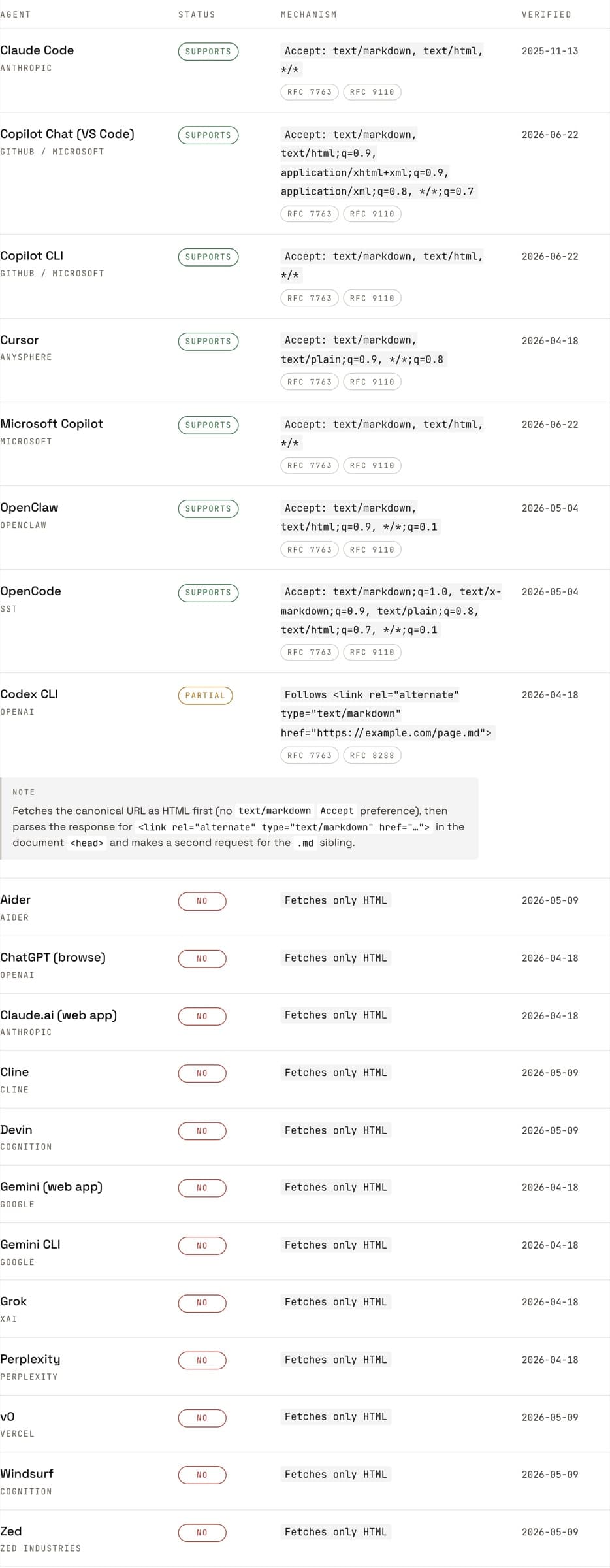
| What the tool does | Tools in the matrix |
|---|---|
Sends Accept: text/markdown | Claude Code (13 November 2025), Cursor (18 April 2026), OpenCode and OpenClaw (4 May 2026), Copilot Chat in VS Code, Copilot CLI and Microsoft Copilot (22 June 2026) |
Partial: fetches HTML, then follows a Markdown rel="alternate" link | Codex CLI (18 April 2026) |
| Fetches only HTML | ChatGPT browse, Claude.ai web app, Gemini web app, Gemini CLI, Grok and Perplexity (18 April 2026). Aider, Cline, Devin, v0, Windsurf and Zed (9 May 2026) |
Support moves.
In February 2026, a Checkly test found that GitHub Copilot's fetch tool did not send the header.
The June matrix says Copilot does.
So check your own tool.
One limit. These tests cover each tool's built-in fetch. Not the search crawlers that OpenAI or Google run.
The tools that ask are coding agents.
The answer engines that most people want citations from did not ask.
How much smaller the page gets
Five published measurements. Plus this site's own.
Units differ.
| Page and source | HTML | Markdown |
|---|---|---|
| Cloudflare blog post | 16,180 tokens | 3,150 tokens (80.5% fewer) |
| Pronovix article, OpenAI token estimator | 16,933 tokens | 2,583 tokens (84.7% fewer) |
| WordPress.org docs page, measured by Roots | 271,268 bytes | 44,841 bytes (84% fewer) |
| Vercel blog post | about 500 KB | 3 KB (99.37% fewer) |
| Checkly docs page | 180,573 tokens | 478 tokens (99.7% fewer) |
| Four pages on this site, own curl on 2 October 2026 | 111,732 to 272,026 bytes | 3,097 to 17,899 bytes (93.4% to 97.5% fewer) |
Cloudflare's 80% is the lowest figure here. Not the typical one.
The saving depends on how much of the page is markup, navigation and scripts. So measure your own pages.
The copies on this site are each page's source. Not a conversion of the HTML.
Pick your setup
| Your situation | Use this | Watch for |
|---|---|---|
| On Cloudflare Pro, Business or Enterprise | Enable Markdown for Agents in AI Crawl Control, or add a configuration rule for one path | The default content-signal is ai-train=yes, search=yes, ai-input=yes. HTML only. The origin response cannot exceed 2 MB. Webflow has the same toggle on Enterprise Workspace plans |
| Next.js | A beforeFiles rewrite on the Accept header to a Markdown route handler | Vary: Accept on both responses. Next.js 16 renamed middleware to proxy |
| Static files on Nginx | Pre-render .md next to each page and map Accept to the extension | The recipe matches a substring, so text/markdown;q=0 still gets Markdown |
| Content already in Markdown or MDX | Publish the source as .md, link it with rel="alternate", add negotiation if you can | Agents find a sibling only if you advertise it. Keep the HTML page canonical. Strip MDX components |
| WordPress | A plugin that reads Accept on the canonical URL | Some SEO plugins add .md URLs and ignore the header |

Does AI name you?
See if AI mentions your brand. Then get the pages to fix.
Set it up
On Cloudflare
- In the dashboard, select the zone.
- Open AI Crawl Control.
- Enable Markdown for Agents.
Cloudflare's availability note lists Pro, Business and Enterprise plans, and SSL for SaaS. At no cost.
Only one subdomain or path? Add a configuration rule with an expression such as starts_with(http.request.uri.path, "/blog/").
One thing to do first. If your origin sets its own content-signal header, Cloudflare keeps it.
Want a stricter policy than the default? Set it before you enable the feature.
In a Next app
Vercel's blog shows a rewrite. It sends requests with a Markdown Accept header to a Markdown route. Trimmed:
// next.config.ts
const nextConfig = {
  async rewrites() {
    return {
      beforeFiles: [
        {
          source: '/blog/:path*',
          has: [{ type: 'header', key: 'accept', value: '(.*)text/markdown(.*)' }],
          destination: '/md/blog/:path*',
        },
      ],
    }
  },
}

export default nextConfig
The route handler at /md/blog/... returns Markdown with Content-Type: text/markdown; charset=utf-8.
Posts already in Markdown or MDX? Return the source.
Send Vary: Accept on both responses.
A rewrite needs no middleware file. And Next.js 16 renamed that convention to proxy.
On Nginx
AcceptMarkdown's recipe pre-renders a .md file next to each page. Nginx picks one from the Accept header. Trimmed:
map $http_accept $preferred_ext {
  default ".html";
  "~*text/markdown" ".md";
}

server {
  root /var/www/yoursite;
  add_header Vary Accept always;

  location / {
    try_files $uri$preferred_ext $uri/index$preferred_ext $uri.html $uri/index.html =404;
  }

  location ~* \.md$ {
    default_type text/markdown;
    charset utf-8;
    add_header Vary Accept always;
  }
}
The map matches a substring. So a client that sends text/markdown;q=0 still gets Markdown.
For strict handling, the recipe suggests a small app that parses Accept.
AcceptMarkdown also has Caddy and Apache recipes.
From Markdown files or WordPress
Already write Markdown? Publish the source.
A warning from Flavio Copes. He converted his HTML back to Markdown at the edge. Every request became a metered Workers invocation.
His static site started to use up the free quota.
He now builds a .md file next to each post.
Advertise the file with a link in the page head:
<link rel="alternate" type="text/markdown" href="/page.md">
Codex CLI follows this tag, per AcceptMarkdown. Pronovix also sends it as an HTTP Link header.
On WordPress, pick a plugin that reads the header on the canonical URL.
- Roots found that AIOSEO's
.mdfeature never looks at the header. - The Markdown for AI Agents plugin says it reads the header and sets
Vary: Accept. - Roots publishes roots/post-content-to-markdown.
Those are the projects' own descriptions. Test with curl before you trust either.
Test it
Run three commands.
(If your stack does not answer HEAD requests, use curl -s -D - -o /dev/null instead of curl -sI.)
curl -sI -H "Accept: text/markdown" https://yoursite.com/page | grep -i -E "content-type|vary"
curl -sI -H "Accept: text/html" https://yoursite.com/page | grep -i content-type
curl -s -H "Accept: text/markdown" https://yoursite.com/page | head -30
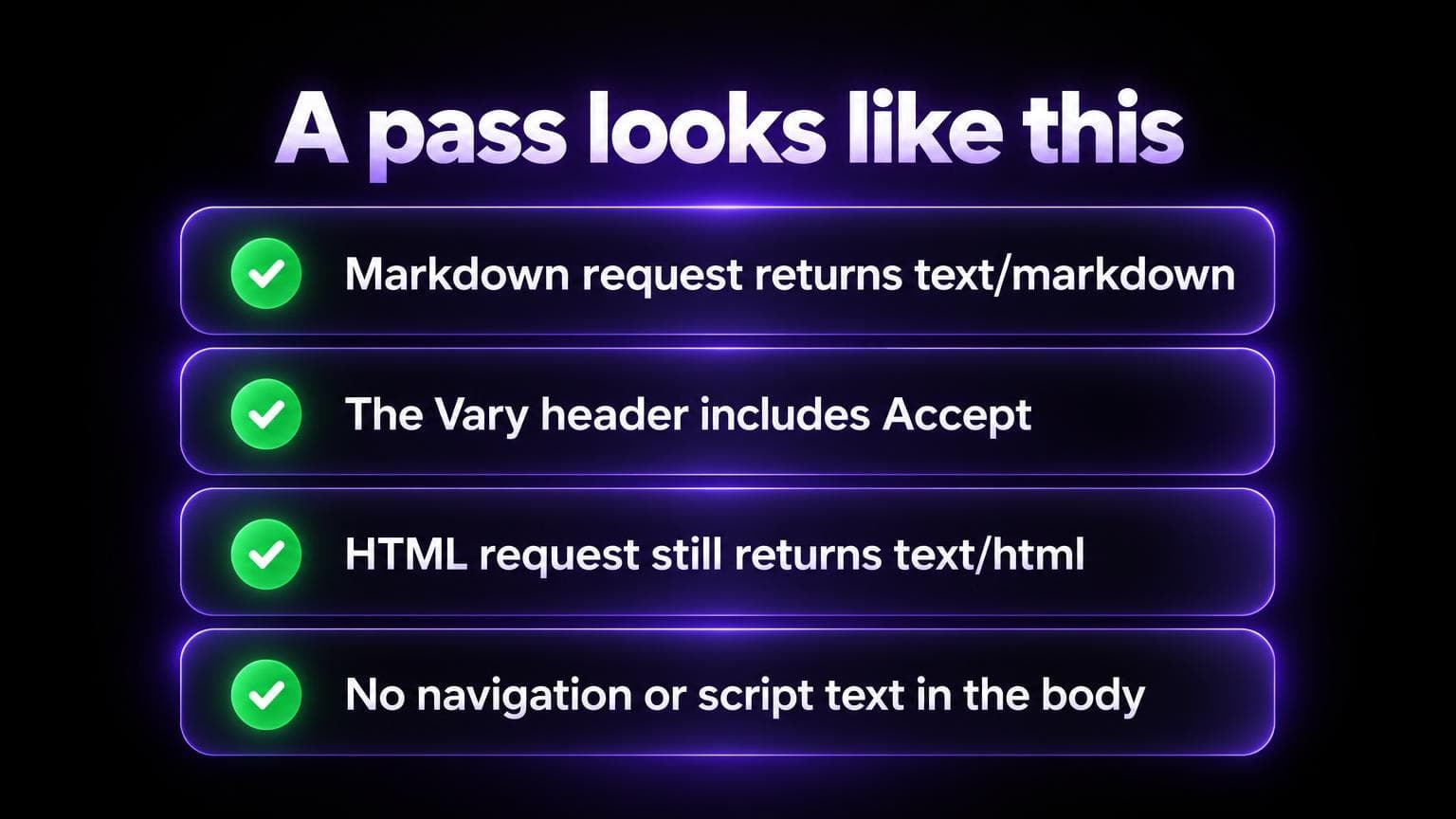
A pass looks like this:
- The first returns
text/markdownand avaryheader with Accept. - The second still returns
text/html. - The body starts with a title or frontmatter and has no navigation or script text.
- Headings, prices and links match the HTML page.
Then check the cache.
Request Markdown, then HTML. Twice each.
A CDN that ignores Vary: Accept can hand the wrong body to the next client.
Next, find out who asks.
- Ask your own coding agent to fetch
https://httpbin.org/headers. Read theAcceptline. (Checkly's method.) - Add
$http_acceptto your access log. AcceptMarkdown shows formats for Nginx, Apache and Caddy.
John Mueller's advice is the same: log the header and check the metrics first.
Three free tools help:
- AcceptMarkdown.com checks a URL for Markdown, the
Varyheader and q-values. - Is Your Site Agent-Ready? scans for Markdown negotiation and other agent standards.
- markdown.new previews a public URL as Markdown. Prepend
markdown.new/to the URL.
Want to see what AI can read from your HTML today? Page Inspector fetches a public URL and shows the extract: title, meta description, headings, copy and visible page text.
What it does for SEO and AI visibility
It lowers what an agent downloads.
That's the proven part.
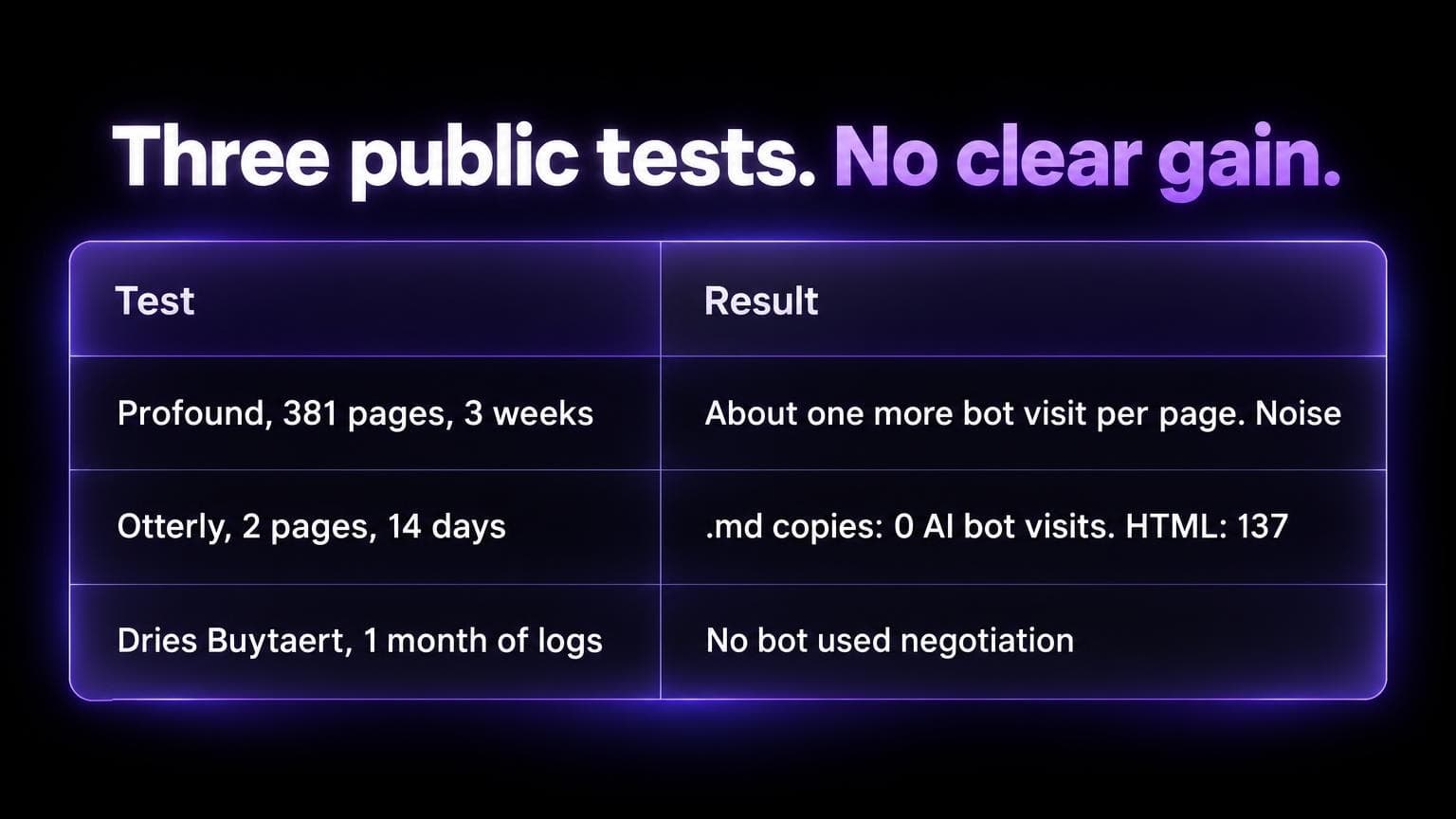
AI bot visits? Citations? Public tests found no clear gain.
| Test | Setup | Result |
|---|---|---|
| Profound, February 2026 | 381 pages on six sites, split at random. For three weeks, AI bots saw Markdown on 192 pages and HTML on 189. Profound does not say it used the Accept header | About one more median bot visit per page. Profound calls it consistent with noise and rules out gains of 40% or more. It counted visits, not citations |
| Otterly, 2026 | Two pages on its own site, each with a .md copy linked in the footer, for 14 days. It tested .md URLs, not the header | The .md copies got no AI bot visits. The HTML pages got 137. No AI search platform cited a .md URL. One brand, not an industry study |
| Dries Buytaert, March 2026 | A month of Cloudflare logs on a site with .md URLs and negotiation | No bot used negotiation. Several AI crawlers fetched .md files through the auto-discovery link. Crawler traffic rose about 7%. His advice: skip it unless it is easy |
Google.
In July 2026 John Mueller replied that a separate "agent-friendly" version of a site builds technical debt. (Search Engine Journal)
In August, Search Engine Journal quoted him again: on his test sites, only SEO tools claim to accept Markdown. (Source)
Cloaking.
Google's spam policy defines cloaking as showing users and search engines different content to manipulate rankings.
In February 2026, Search Engine Journal noted two things. Mueller's criticism targeted bot pages served by user agent. And Google had not said whether header negotiation counts.
The safe pattern, from Pronovix and Roots:
- The same facts in both formats
- No user agent checks
- The HTML page canonical
rel="alternate"on any.mdcopy
Bing.
Fabrice Canel wrote in February 2026 that Bing ranks on what customers see. And he asked who fixes a Markdown copy that breaks. (Search Engine Roundtable)
The rule.
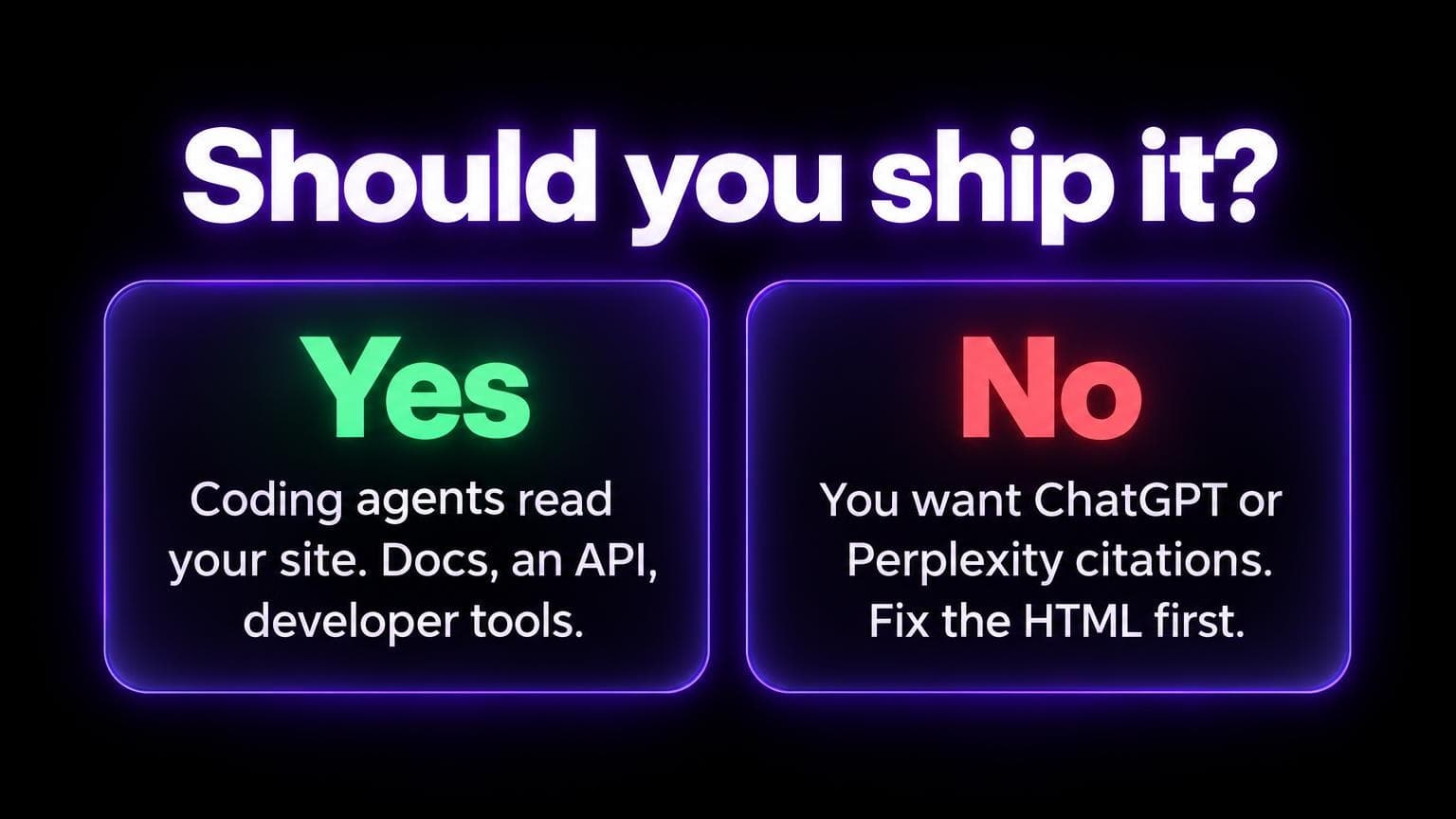
Ship it if coding agents read your site (docs, an API, developer tools). Or if you already write in Markdown.
Do not ship it to win ChatGPT or Perplexity citations.
Fix the HTML first:
- Put the answer in the page text.
- Let the bots in.
- Say the thing plainly.
Then read AI citations, how to get cited in AI answers, generative engine optimization and answer engine optimization.
A live example. The review of The Prompting Company records that its site returns Markdown for /pricing with the header, as of 2 October 2026.
If you ship Markdown, check whether AI answers change. AI SEO Tracker shows how ChatGPT, Perplexity, Gemini, Copilot and Google AI Overviews mention and cite a brand.