



TL;DR
- What it is: You compare your site with the sites that rank for your keywords. To see what you miss.
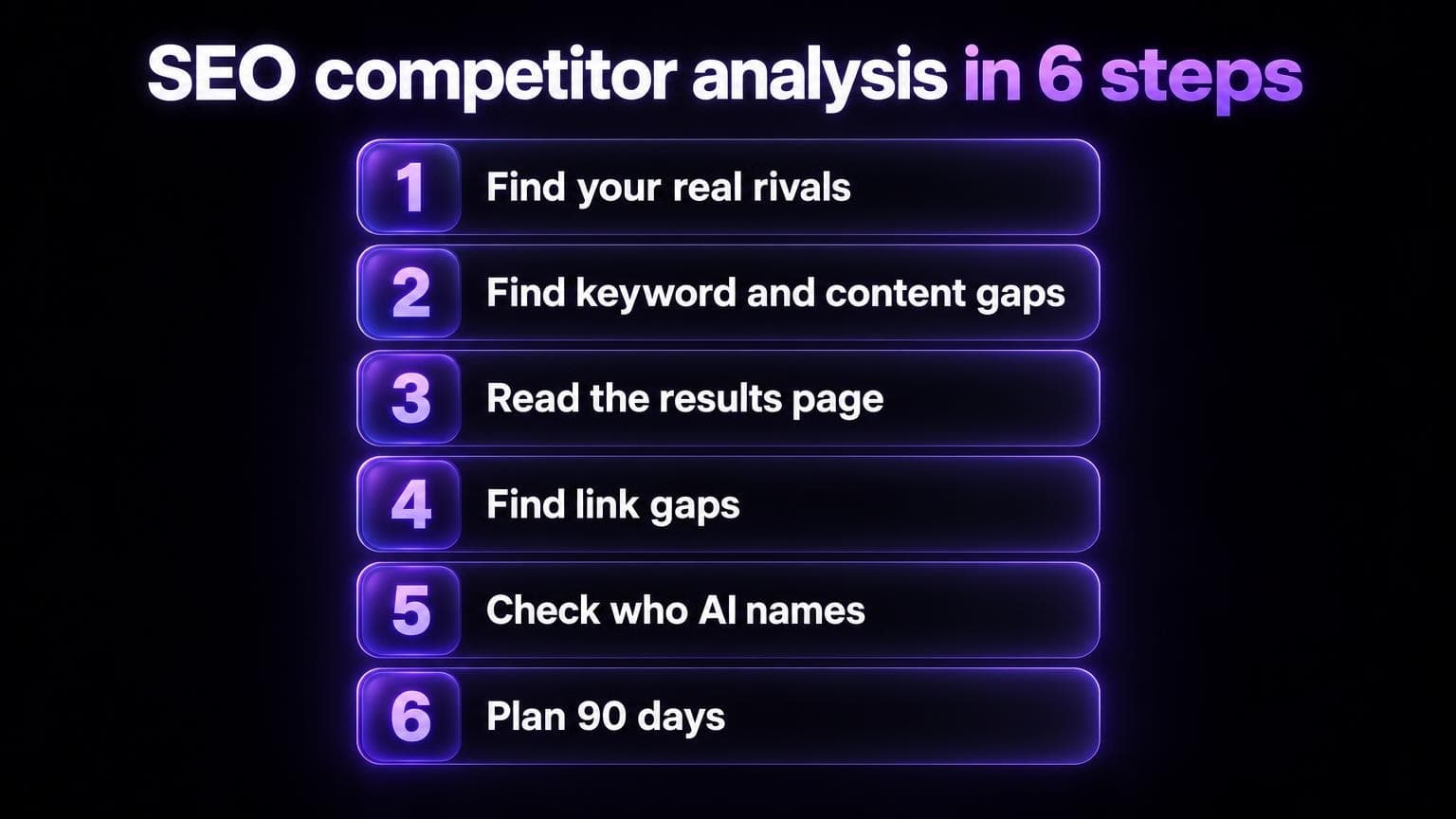
- Six steps: rivals, gaps, the SERP, links, AI answers, a 90-day plan.
- Can you win the keyword? Check the top ten first. Here, 8 of 9 results sit on DR 80+.
- AI: The Google top 10 is not the AI list. Only 7 of 12 AI Overview links are organic results.
- Free route: Free tools cover your own site well. A rival only roughly.
Does AI name your brand? Check your site.
An SEO competitor analysis is simple.
You look at the sites that rank for your keywords. You find what they have and you don't. Keywords. Pages. Links.
Two things most guides miss.
Your SEO competitors are often not your business competitors.
And AI answers pick a third list. Ahrefs found that about 38% of the pages cited in Google AI Overviews also rank in the top 10 for the query. (Ahrefs, March 2026.)
(An earlier Ahrefs study found about 76%. Ahrefs improved its parsing since, so the two numbers aren't like for like.)
This post has a worked example: the live results for this very search. With the DR and referring domains of each page.
What Is an SEO Competitor Analysis?
You study the sites that rank for the keywords you want.
It shows three things:
- What works in your niche.
- Where a rival is thin.
- How hard the fight is. Before you spend on it.
Who are your SEO competitors? Not always who you think.
HubSpot notes that Reddit threads, Quora pages, Trustpilot or G2 pages and media sites often outrank direct rivals. Because of their domain authority. (HubSpot, updated April 2026.)
When to run one:
- You launch a site or enter a new topic.
- Rankings drop. Run a targeted check on the affected keywords.
- You're about to publish a major page for a competitive keyword.
- Each planning cycle. HubSpot recommends a full analysis at least quarterly.
Find your real SEO competitors
Start from who ranks. Not from who you think you compete with.
Use four sources. Compare the lists.
1. Search Console (free). Export your top queries by clicks and impressions. Search them. Note who ranks next to you. HubSpot calls this the most reliable starting point, because it shows your actual search footprint. (It shows your queries. Not a rival's data.)
2. Google in a private window. Search your top five keywords. Note every domain on page one. Domains that appear for several keywords are your search competitors.
3. A tool report. Ahrefs Site Explorer has an Organic competitors report. Semrush Domain Overview lists Main Organic Competitors. Moz True Competitor shows Overlap and Rivalry metrics for each rival.
4. AI answers. Run 10 buyer prompts in ChatGPT, Perplexity and Gemini. Log the brands each answer names. A brand that shows here and not in Google is an AI search competitor. (Step 5 has the full method.)
Then sort the list into buckets.
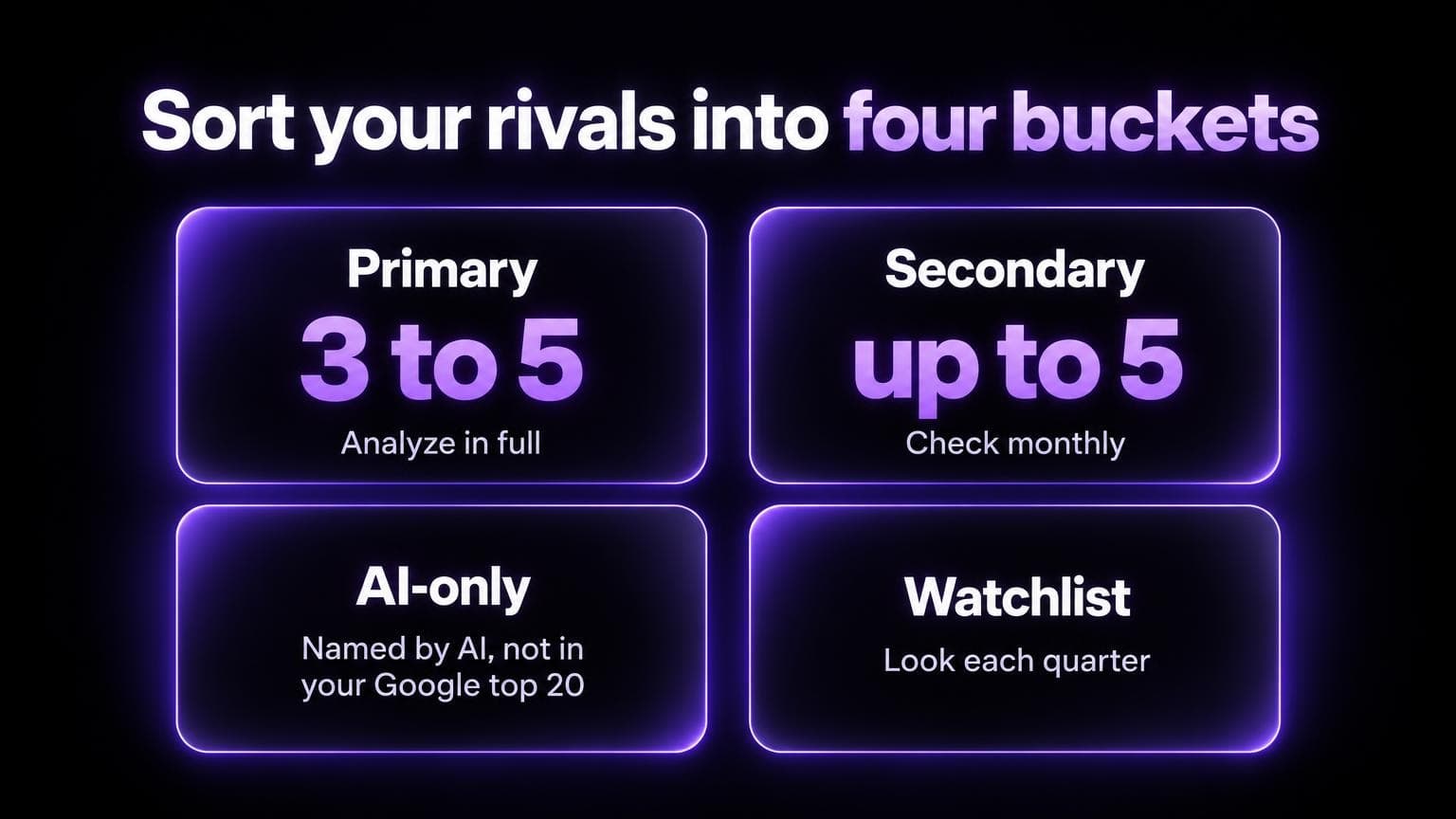
- Primary, 3 to 5. Rivals that beat you on several core keywords. Analyze these in full. Semrush also advises starting with three to five. (Semrush.)
- Secondary, up to 5 more. They rank for some of your keywords. Check them monthly.
- AI-only. Brands that AI answers name but that aren't in your Google top 20. Track them apart.
- Watchlist. Everyone else. Look each quarter.
Stop at 10 rivals in total. A longer list is one you won't read.
Log each rival the same way. Six fields are enough.
| Field | What to log | Where it comes from |
|---|---|---|
| Domain and kind | Tool, guide site, media or forum | The results page |
| Keywords they have and you lack | The count, and the top few by volume | A keyword gap report |
| Top pages | Their five best pages by traffic | The top pages report in your SEO tool |
| Referring domains | The number for the site and for the top pages | A backlink report |
| Last update | The date of their best page on your keyword | The page itself |
| AI mentions | The prompts that name them, per engine | Your prompt log |
Run a keyword and content gap analysis
A keyword gap is a list. The keywords where rivals rank and you don't.
Three tools build it:
- Ahrefs: Content gap (inside Competitive analysis).
- Semrush: Keyword Gap.
- Moz: Keyword Gap. It takes up to 3 competitors. It also finds keywords where you rank in the top 20 and a rival ranks higher. (Moz.)
In Semrush: add your domain and a rival. Click Compare. Select Missing. Use the Position filter to show only keywords where the rival is in the top 10. (Semrush.)
In Ahrefs: two filters get the same list. Look at the two orange ones in the screenshot:
- "Target's organic position: No"
- "Competitors' organic positions: At least 1 in top 10"
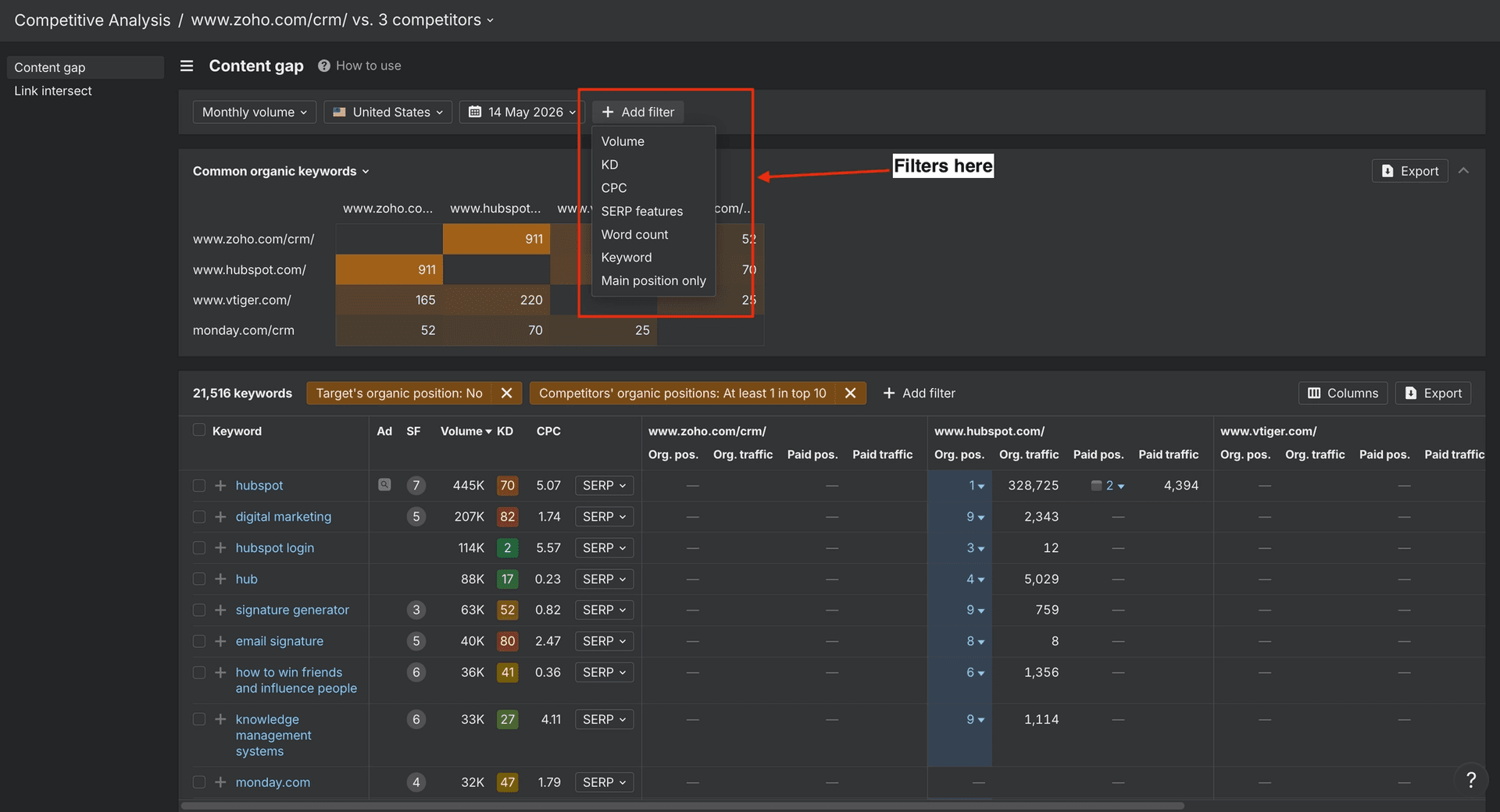
Even with both filters, 21,516 keywords are left. For one CRM page against three rivals. (United States, 14 May 2026.)
So the next job is sorting. Four passes:
- Drop branded and navigational keywords. You won't rank for a rival's name.
- Check intent. Open the SERP for each keyword (step 3). A page type you can't build is not a gap you can fill.
- Look at positions 4 to 15. A rival page just below the top is the easiest one to replace.
- Check their paid keywords. Siteimprove notes that a competitor who pays to appear for a term values it. (Siteimprove.) Add the high-intent ones to your list.
Then map each keyword to one page of yours. An existing page to update, or a new page to write.
Keywords that show the same pages in the SERP can share one page.
The content gap.
Pull each rival's top pages by organic traffic. Label them by type: blog post, comparison, product page, glossary or tool.
Look for topics where a rival has several pages and you have none.
A warning before you fill every gap with AI content.
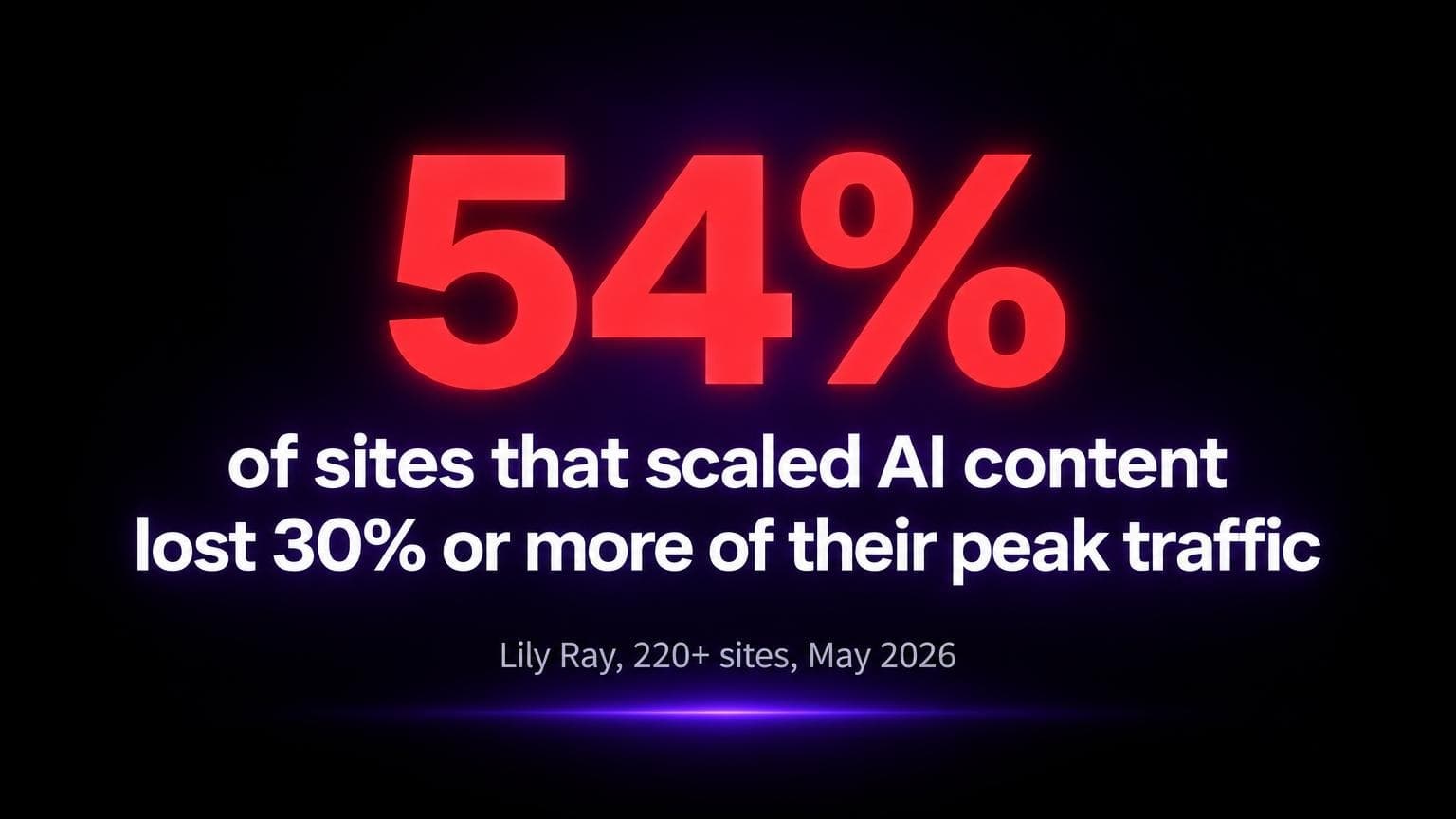
Lily Ray monitored 220+ sites that publicly used AI content platforms. (May 2026.)
54% lost 30% or more of their peak organic traffic.
The pattern: fast page growth. A traffic peak within roughly three to six months of the content peak. Then a steep drop.
Build fewer, better pages.
Read the SERP and compare one competitor page
Read the results page before you copy a rival's page.
Search the keyword. Note four things:
- Page types: guides, tools, listicles or product pages.
- Dates and depth: how recent each page is, and how much it covers.
- Extras: images, templates, calculators or video.
- Features: is there an AI Overview? A People Also Ask box? The questions in that box are questions your page must answer.
The mix tells you the intent.
- Tools fill the page? An article starts at a disadvantage.
- The dates are old? A current page has an opening.
Then check how strong the ranking pages are. The DR of the site. The referring domains of the page.
Worked example on the live SERP for this query
Let's do it for real.
Here are the nine organic results Google showed in the US for "seo competitor analysis". 30 September 2026, from Ahrefs SERP Overview.
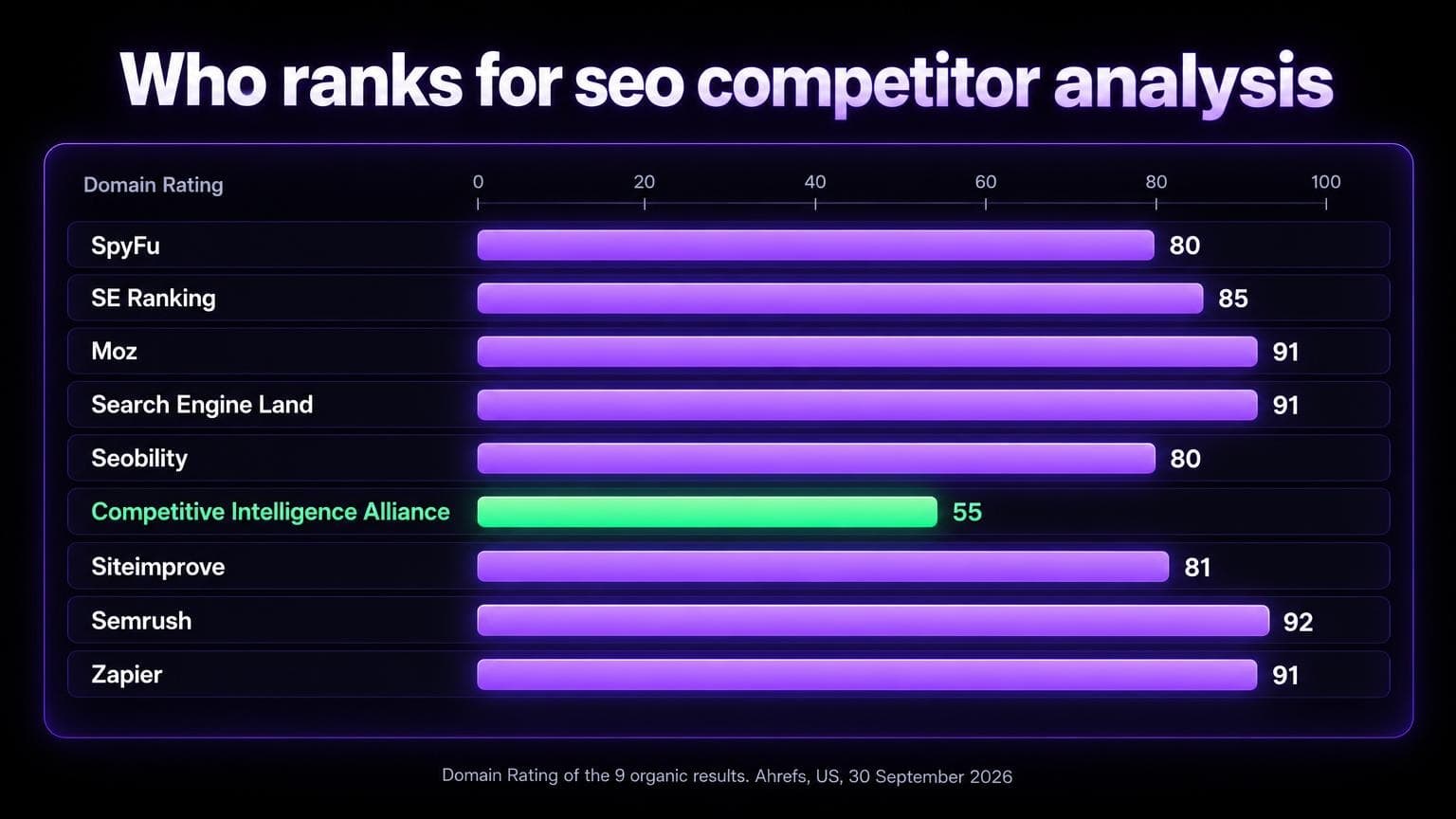
| Result and kind | DR | Referring domains |
|---|---|---|
| SpyFu home page (tool) | 80 | 9,213 |
| SE Ranking competitor traffic research (tool) | 85 | 365 |
| Moz SEO competitor analysis (guide) | 91 | 244 |
| Search Engine Land free competitor tool (tool) | 91 | 20 |
| Seobility SEO competitor analysis tools (tool) | 80 | 3 |
| Competitive Intelligence Alliance (guide) | 55 | 28 |
| Siteimprove glossary (guide) | 81 | 30 |
| Semrush competitive analysis (guide) | 92 | 507 |
| Zapier competitor analysis tools (roundup) | 91 | no value |
(DR and referring domains come from the Ahrefs index. Another tool will show other counts. And a SERP is a snapshot.)
Three things to take from it:
- The intent is mixed. Four results are tools. Four are guides. One is a roundup of tools. A guide competes with a tool for the same query.
- Strength is high. Eight of the nine sit on DR 80 or more. The exception: Competitive Intelligence Alliance, at DR 55 with 28 referring domains.
- Links don't explain the order. Seobility ranks fifth with 3 referring domains to the page. The SpyFu home page has 9,213. Intent and site strength count too.
What does that mean for you?
A young site should treat this head term as a later goal. Win the longer, more specific searches first.
Run the same check on your own keyword before you commit. No top-ten result sits below the pack? Pick a narrower keyword.
Compare one page and not the whole site
Pick the best rival page for your keyword. Score it on six lines:
- Title and promise: what it says you'll get.
- H2 list: which questions it answers and which it skips.
- Depth: steps, examples and numbers. Not word count alone.
- Last update: the date shown, and whether the facts match it.
- Extras: images, templates, tools or video.
- Original data: anything it shows that no other page has.
Beat it on the line where it's weakest.
Want to see what AI can read on that page? Paste its public URL into Page Inspector. It shows the clean text: title, meta description, headings and copy.
And skip the habit of copying a rival's JSON-LD schema.
Ahrefs tracked 1,885 pages that added schema. It matched them against 4,000 control pages. (Ahrefs, May 2026.)
- No gain in AI Mode or ChatGPT citations.
- AI Overview citations fell 4.6% against the controls. A drop Ahrefs couldn't pin on schema.

Does AI name you?
See if AI mentions your brand. Then get the pages to fix.
Find link gaps and broken backlinks
Links matter for AI answers too.
SE Ranking found that sites with over 32K referring domains are 3.5x more likely to be cited by ChatGPT than sites with up to 200. (SE Ranking, 2025.)
And a rival's link profile shows what earns links in your niche.
- Count referring domains for your top 3 rivals. Use Ahrefs Site Explorer, the Semrush Backlinks tool or Moz Link Explorer.
- Run a link gap. Ahrefs Link intersect and Semrush Backlink Gap list the domains that link to rivals and not to you. Semrush compares you and up to three rivals. A domain that links to two or three rivals is your best target.
- Reclaim broken backlinks. In Ahrefs Site Explorer, open Backlink profile, then Broken backlinks. Sort by referring domains. Check the Wayback Machine for what the dead page held. Build a better version. Ask each linker to switch.
- Check Best by links for each rival. The same format tops several lists? A data study, a free tool? That format earns links in your niche.
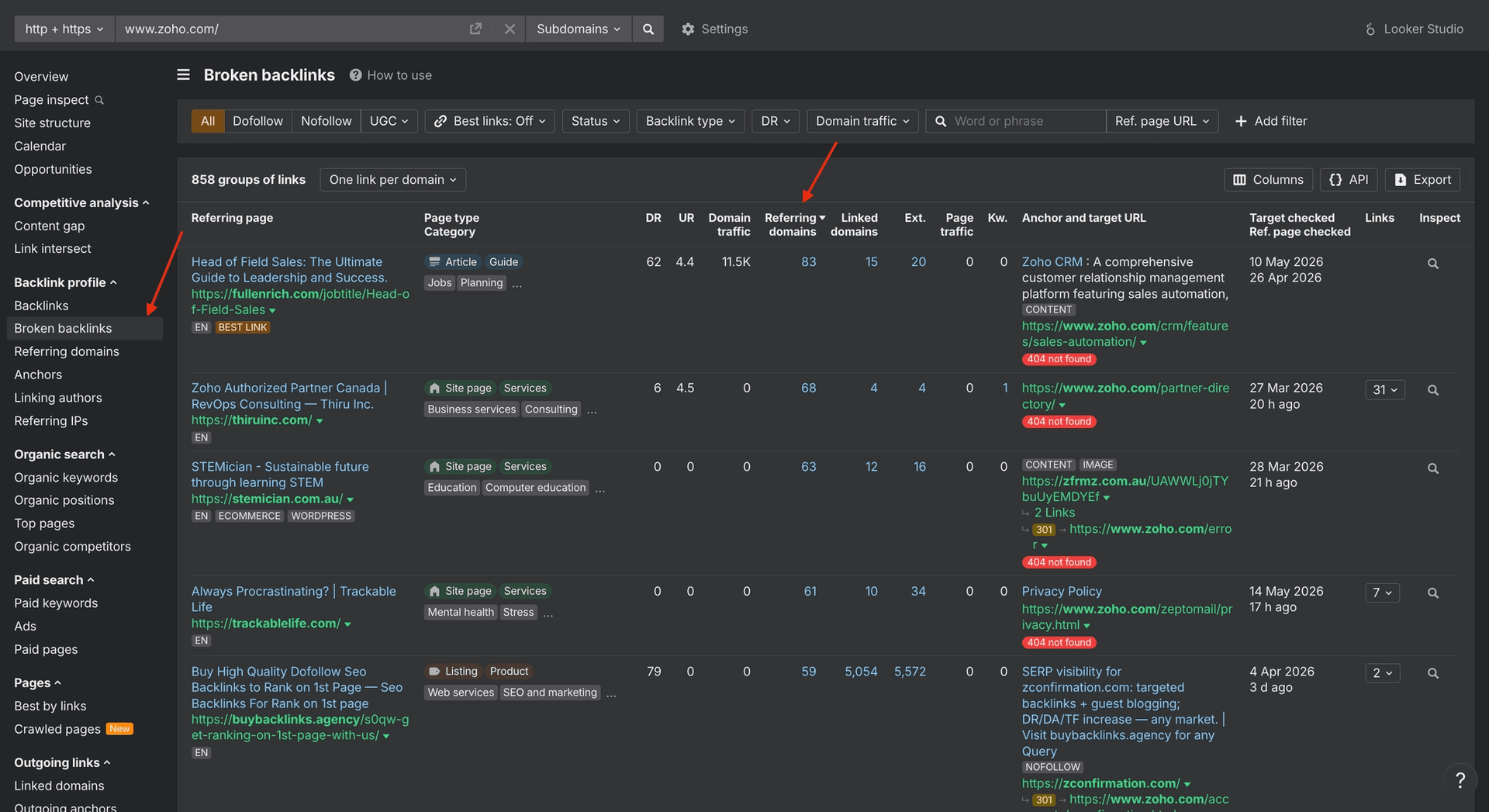
The report above sorts one site's (zoho.com) broken backlinks by referring domains.
Each red 404 label marks a dead page that still has links.
Skip junk linkers. Like the "buy backlinks" listing in the last row.
Check who AI answers name
Google rivals aren't the only list.
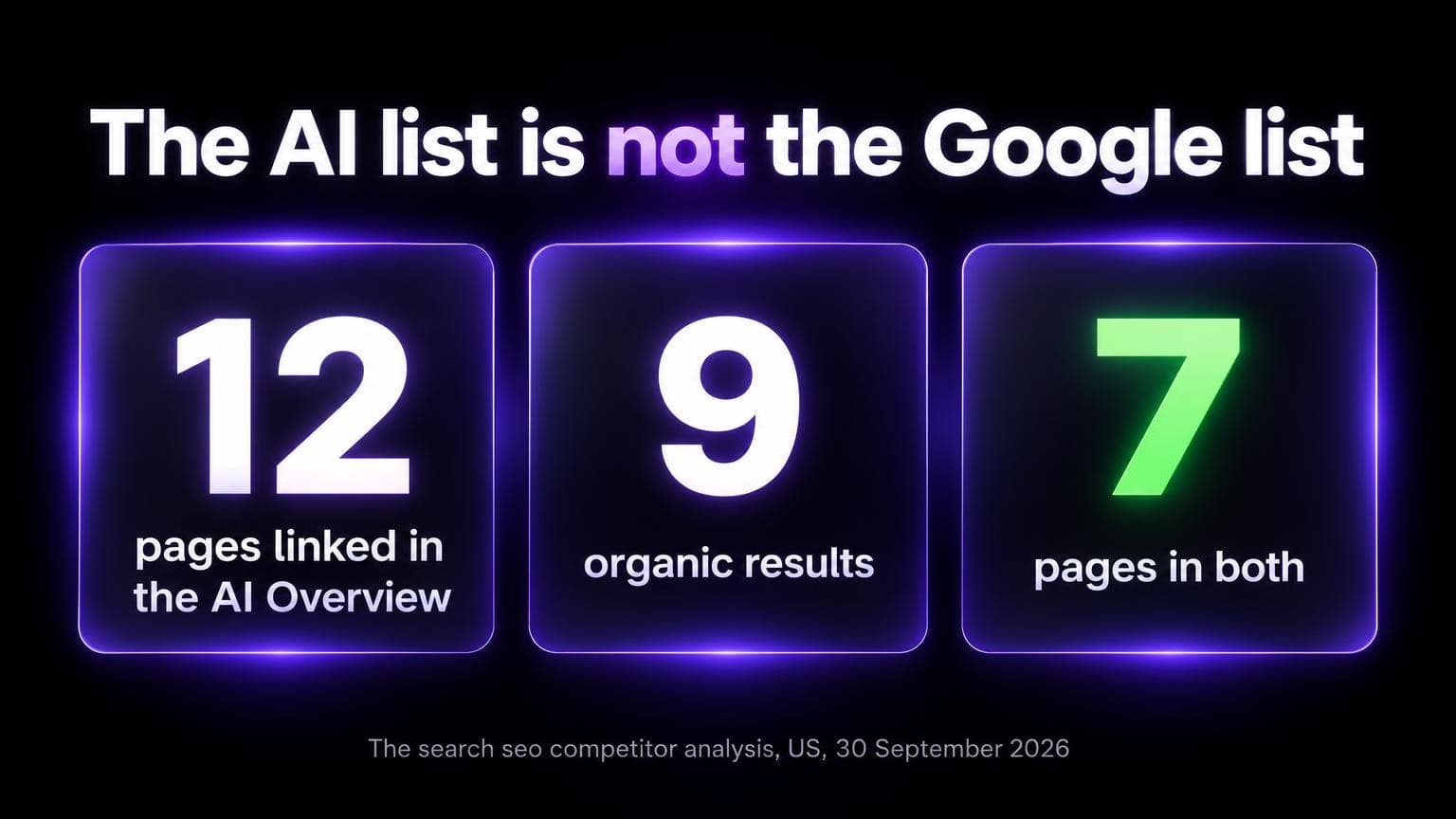
For this very search (Ahrefs SERP Overview, US, 30 September 2026):
- The Google AI Overview links 12 pages.
- The organic block has 9.
- 7 pages are in both.
Five show only in the AI Overview: Semrush's how-to guide, two YouTube videos, a Moz competitive research page and a Sociummedia guide.
Two organic results aren't linked in it: the Search Engine Land tool and the Competitive Intelligence Alliance guide.
One query. One day. But you get the idea.
How to find your AI rivals.
Write 10 to 20 buyer prompts. Two kinds:
- Category prompts: "best CRM for small teams" or "alternatives to Mailchimp".
- Branded prompts: "is [rival] worth it" or "[rival] vs [rival]".
Run each prompt in ChatGPT, Perplexity, Gemini and Google (AI Overviews and AI Mode).
Run it more than once. One answer is one sample.
Log three things: the brands named, the URLs cited, and your position (first, later or missing).
Then look for source domains that repeat across prompts. They're your map.
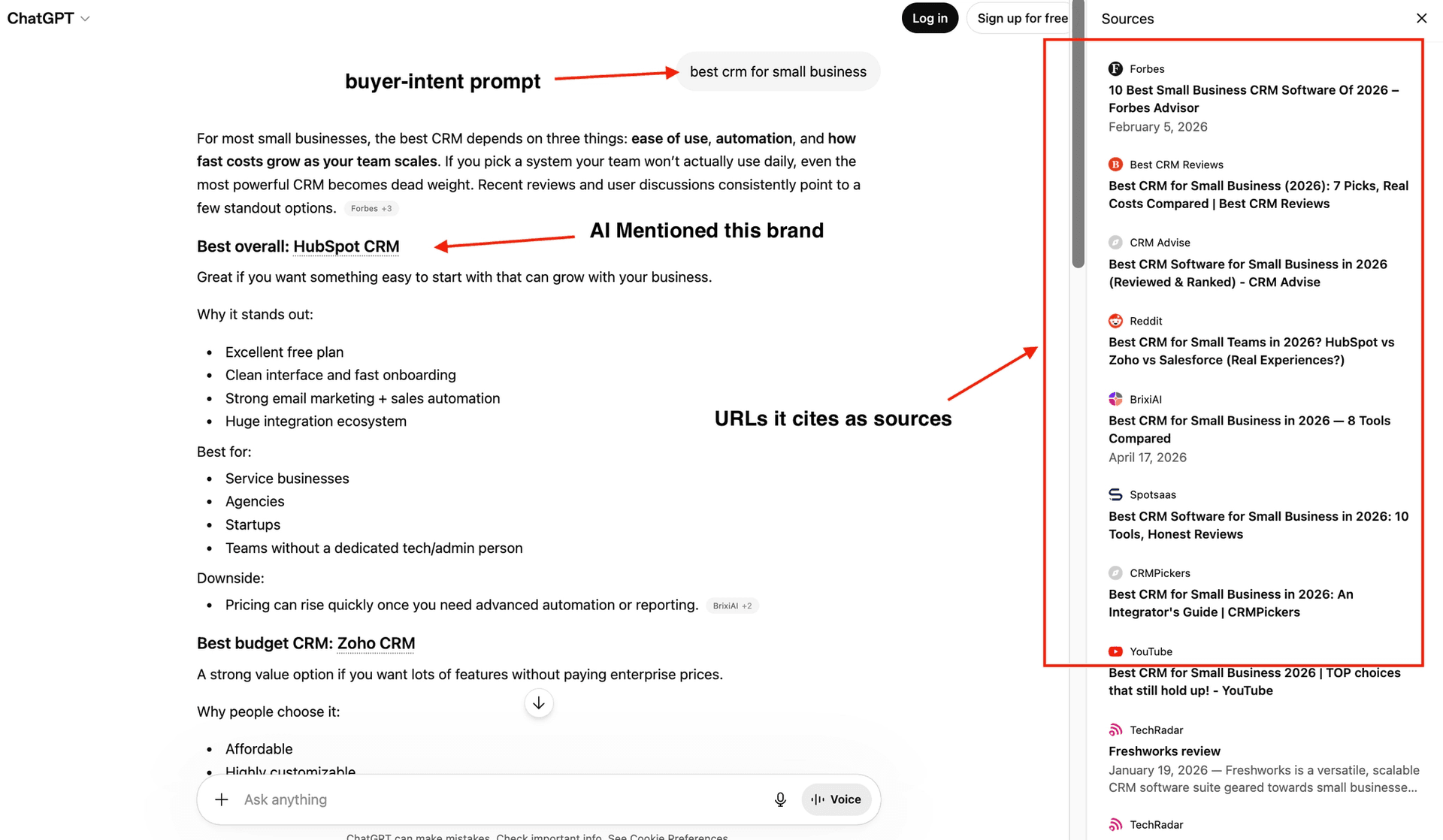
In the answer above, log the brand it names and every URL in the Sources panel.
What a result set looks like.
The AI SEO Tracker leaderboard scans five engines for "best SEO tool". It lists 14 products.
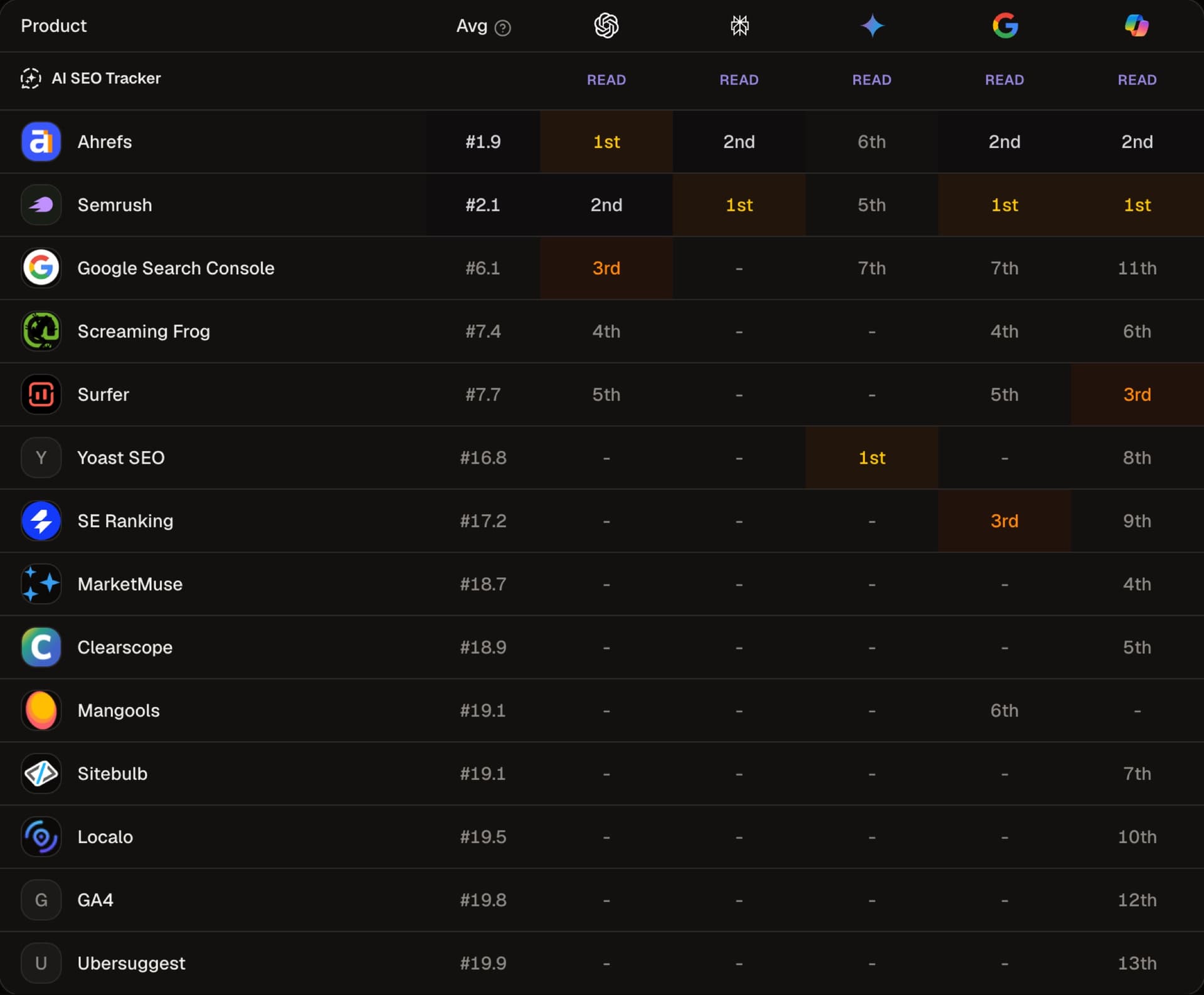
- Ahrefs: average rank 1.9.
- Semrush: 2.1.
- Google Search Console: 6.1.
- Screaming Frog: 7.4.
- Surfer: 7.7.
Now compare with Google.
- Moz and SpyFu both hold Google positions for this post's head query. Neither is among the 14.
- SE Ranking holds the second organic result here. Only the AI Overview (third) and Copilot (ninth) name it.
- Of the 24 pages cited in that scan, 14 are listicles.
The limit: this is one prompt, "best SEO tool". Not "competitor analysis tool". It shows how different the two sets can be. Nothing more.
Then get named where the engines cite.
- Start with the listicle authors. Pitch each one once. (Pitch playbook.)
- Add reviews on G2 or Capterra.
- Leave real comments in Reddit threads.
- Get into YouTube comparison videos.
SE Ranking found that domains with millions of brand mentions on Quora and Reddit have roughly 4x higher chances of being cited by ChatGPT than domains with minimal activity there. (SE Ranking, 2025.)
The free Keyword research tool takes a site URL and returns high-intent prompts worth testing.
The full method: competitive analysis of AI answers and the 15-prompt manual check.
Want to skip the spreadsheet?
The AI SEO Tracker report runs up to 50 prompts, written from your site and confirmed by you. It scans ChatGPT, Perplexity, Gemini, Copilot and Google AI Overviews. Daily for 7 days. One brand. $49, once.
It doesn't scan Google AI Mode. Check that one by hand.
Turn it into a 90-day plan
By now you have gaps, broken links, keyword targets and AI sources.
Don't try everything. Pick a few moves in each lane. Block 90 days.
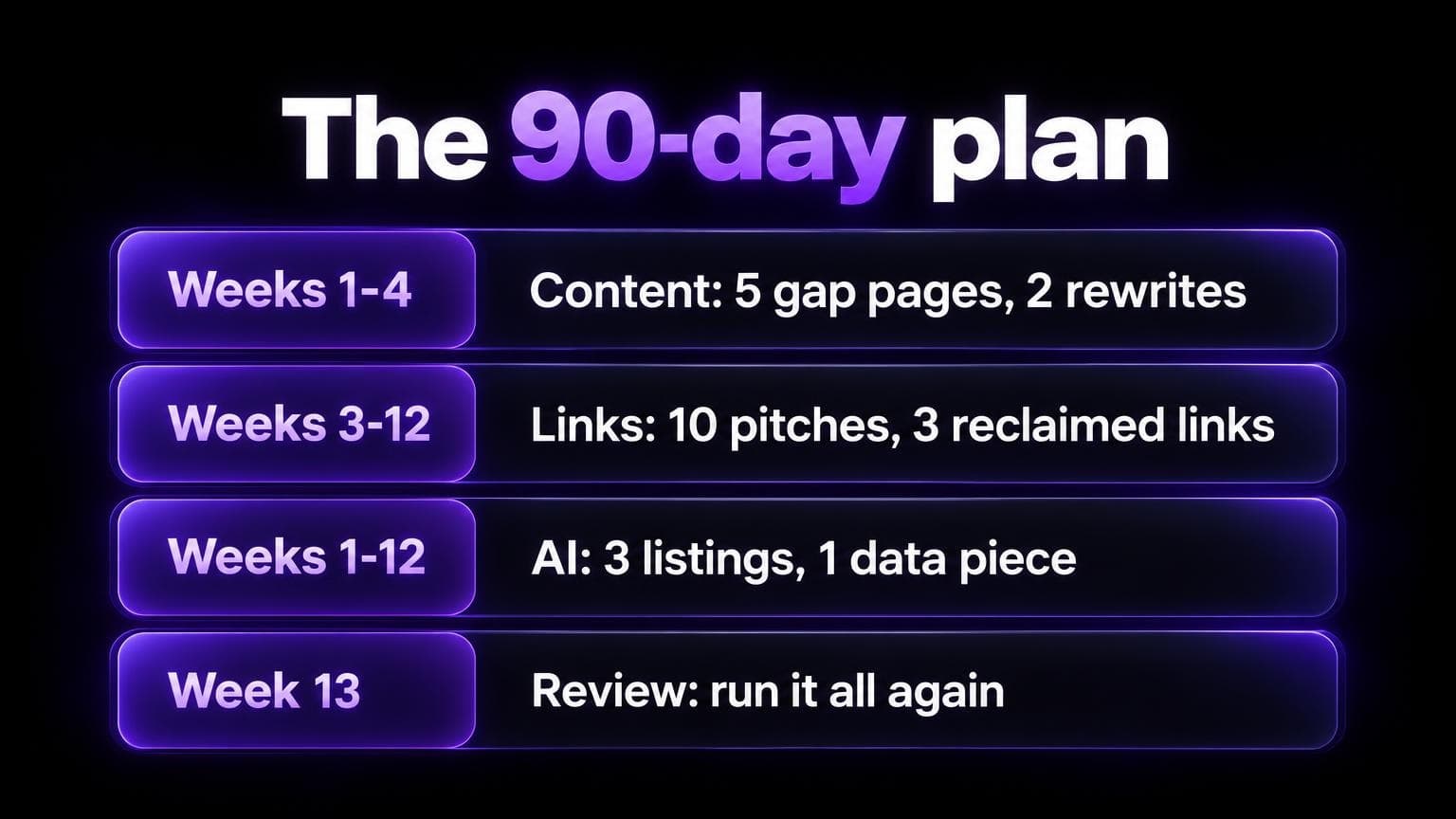
| Weeks | Lane | Actions |
|---|---|---|
| 1 to 4 | Content | Publish 5 gap pages where rival pages are weak. Rewrite 2 of your own pages to beat a weak rival page. |
| 3 to 12 | Links | Send 10 pitches to domains that link to 2 or more rivals. Reclaim 3 broken backlinks. |
| 1 to 12 | AI | Get listed on 3 sources your prompt log flagged. Publish 1 original data piece. Join 1 podcast or YouTube channel where rivals appeared. |
| 13 | Review | Re-run the five keywords and the AI prompts. Compare with week 1. |
That is about two actions a week.
One honest note.
This plan won't beat a rival with 10x your link budget on every keyword.
It can close the gap on the keywords where the gap is small. The worked example above shows how to tell which.
Check your rivals every month
15 minutes. Your primary rivals only.
- Re-run your five keywords in a private window. Note who moved.
- Re-run five of your AI prompts. Note new brands and new cited URLs.
- Look for new pages and new referring domains on each rival.
A rank tracker can do part of this for you. Moz Pro Campaigns track up to three competitors side by side and show how they rank each week. (Moz.)
More options: best rank tracking tools.
What free tools can and cannot show
| Job | Free route | Limit |
|---|---|---|
| Your own queries | Google Search Console | Shows your queries, not a rival's |
| Crawl a rival's site | Screaming Frog free version | 500 URLs per crawl, and crawls cannot be saved (Screaming Frog) |
| Your own links and keywords | Ahrefs Free | Verified websites only. Ahrefs says paid plans analyze competing websites (Ahrefs) |
| A rival's links | Ahrefs free Backlink Checker | A limited version that Ahrefs calls a glimpse of the paid tool (Ahrefs) |
| A quick rival look | Search Engine Land free tool, Semrush free plan | The tool runs on Semrush data (Search Engine Land). The free plan gives 1 demo project and 10 reports a day (Semrush) |
Two things to know.
Competitor traffic is an estimate. Semrush says so itself: you have no access to the rival's actual traffic data. (Semrush.)
Free routes cover your own site well. A rival only roughly.
The manual SERP, prompt and page checks in this post cost nothing.
FAQs
How often should you do an SEO competitor analysis?
A full one each quarter. HubSpot recommends at least quarterly.
Add a 15-minute check each month. And a targeted one after a ranking drop, or before a major content launch.
What is the best free SEO competitor analysis tool?
No single free tool covers it.
- Your own queries: Search Console.
- Crawl a rival: Screaming Frog, up to 500 URLs per crawl.
- The rest: manual SERP and AI prompt checks.
Ahrefs Free doesn't analyze rival sites. See the limits table.
How many SEO competitors should you analyze?
Start with 3 to 5 primary competitors, as Semrush advises. Keep the full list to 10.
Can you give an example of an SEO competitor analysis?
Yes. The worked example reads the live results for this query. It shows the kind, DR and referring domains of each result. And what they say about whether you can win.
What is the difference between SEO and AI competitor analysis?
SEO competitor analysis studies Google rankings, links and content.
AI competitor analysis studies which brands the answers name, and which pages they cite. In ChatGPT, Perplexity, Gemini, Copilot and AI Overviews.
The two lists overlap only in part. For this query, 7 of the 12 pages in the AI Overview are in the organic results.
You need both.