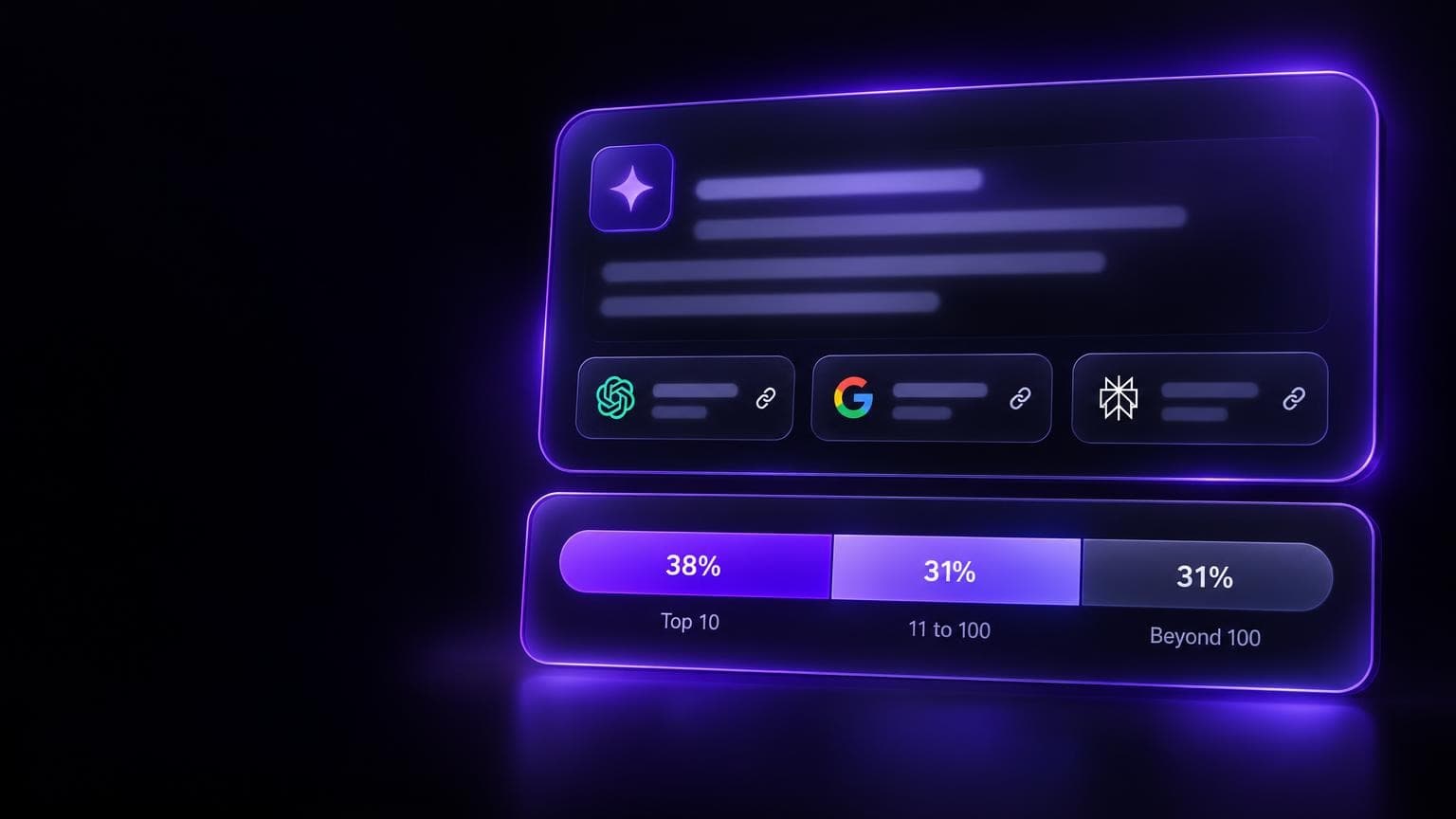




TL;DR
- Which strategy: the phrase means a plan to get named in AI answers or a plan to use AI tools for SEO. This post is the first.
- Goal, prompts, baseline: one goal sentence, 25 to 50 frozen prompts, and a scan before you change anything. The metric is mention rate, not traffic.
- On-page: let the crawlers in, put the content in the HTML, one page per missing intent. Skip llms.txt and special schema for Google.
- Off-page: get named on the pages the engines already cite. In an Ahrefs study, web mentions tracked AI Overview mentions far more closely than backlinks did (0.664 against 0.218).
- Measure: scan the same prompts again. Review at day 90. One answer is noise. The rate is the number.
Does AI name your brand? Check your site.
An AI SEO strategy fits on one page.
It says four things:
- Which AI answers you want your brand to appear in
- Where you stand today
- What you will change, on your site and off it
- The date you will check the result
That's it.
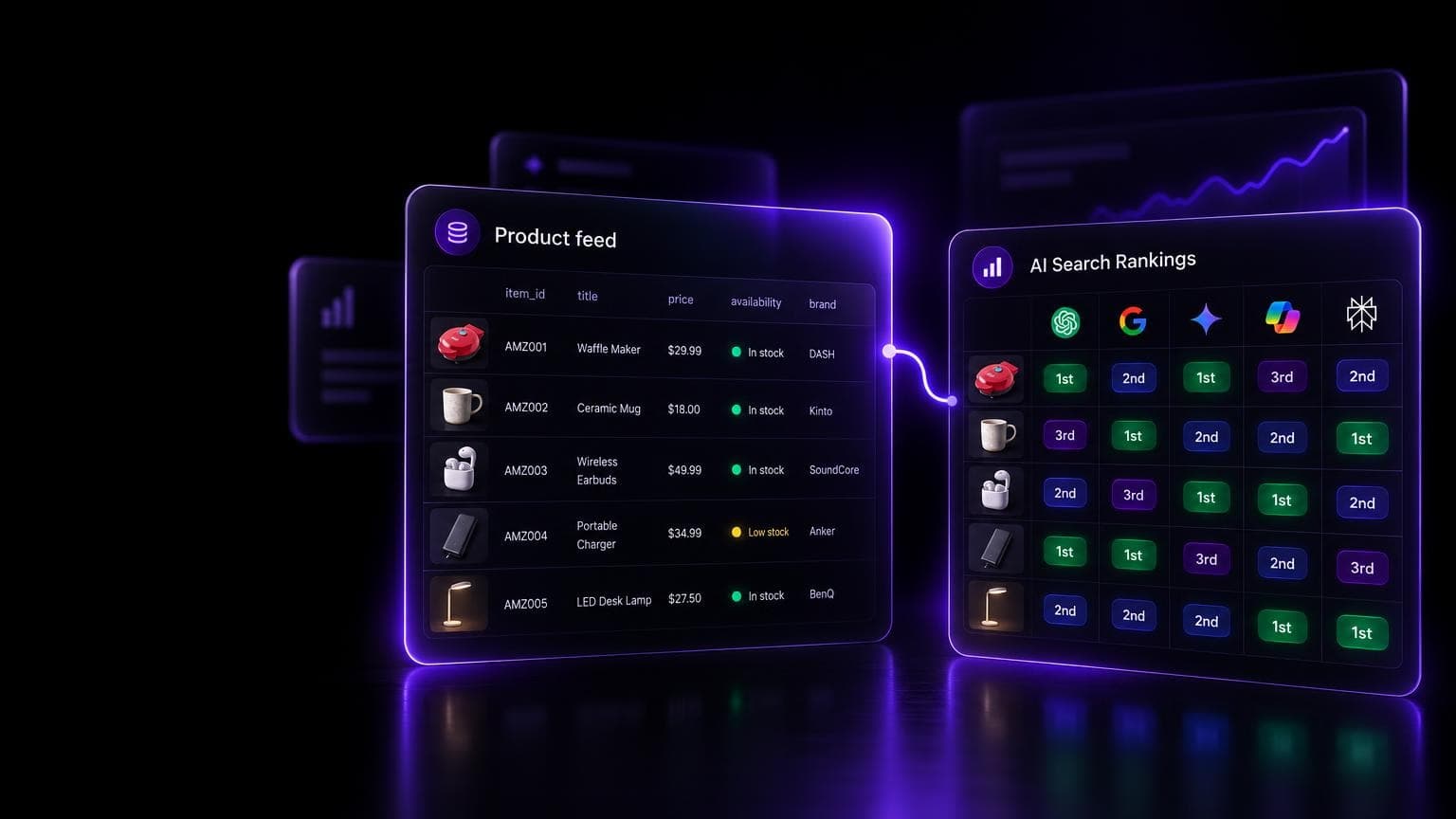
One warning. The phrase has a second meaning: a plan to use AI tools to do SEO work. The search results mix the two.
This guide is the first meaning. A plan for ChatGPT, Perplexity, Gemini, Copilot and Google AI Overviews.
What to hand to AI covers the second in short. ChatGPT for SEO covers it at length.
Each section ends with an output you can write down.
Each number links to its source. Where I have no source, I say so.
What an AI SEO strategy contains
Two plans share the name. Pick the one that matches your goal.
| If you want | The strategy is | Start here |
|---|---|---|
| Your brand named and cited in AI answers | A visibility plan: goal, prompts, baseline, on-page, off-page, measurement. This post. | The goal |
| Faster SEO work with AI tools | A workflow plan: what AI drafts, what a person checks, what stays human | Using AI tools to run the plan |
Most teams need both. And the second can run the first.
Is the work new? Mostly not.
Google's guide to generative AI features (updated July 2026) says AI Overviews and AI Mode are rooted in its core Search ranking and quality systems.
Its page on AI features says SEO best practices remain relevant. And that both may use "query fan-out": several related searches across subtopics and data sources.
My reading: a page that also answers the follow-up questions has more chances to be retrieved.
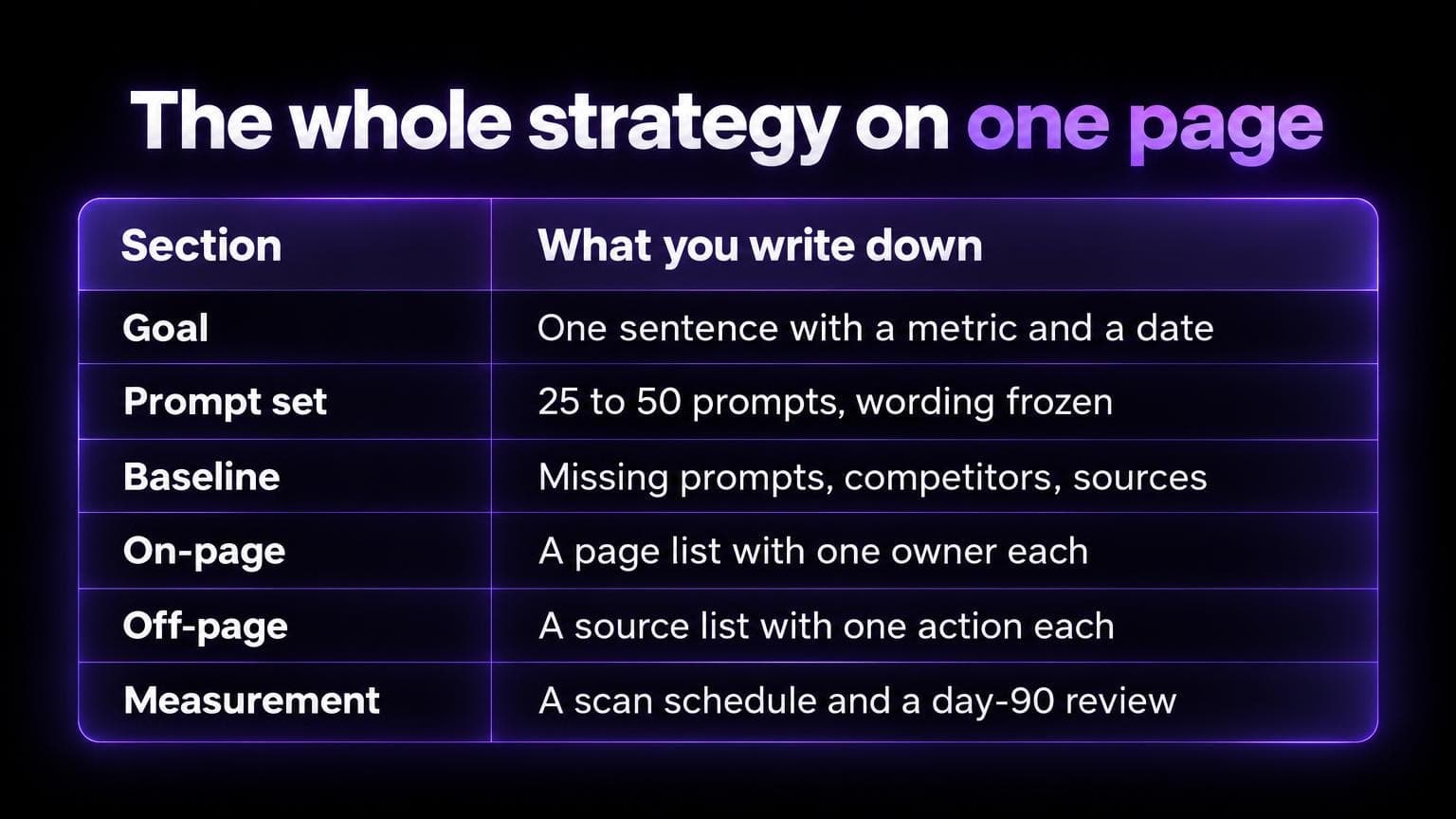
Here is the full document on one page.
| Section | The decision | The output |
|---|---|---|
| Goal | Which answers, on which engines, by which date | One sentence with a metric and a date |
| Prompt set | Which buyer questions you track | 25 to 50 prompts with frozen wording |
| Baseline | Where you are before any change | Missing prompts, competitors named, sources cited |
| On-page | What you change on your site | A page list with one owner for each page |
| Off-page | Where else your brand must appear | A source list with one action for each source |
| Measurement | How you read the result | A scan schedule and a review on day 90 |
For single tactics, see AI search optimization, answer engine optimization, and AI SEO vs traditional SEO.
Set the goal before the tactics
Write the goal as one sentence.
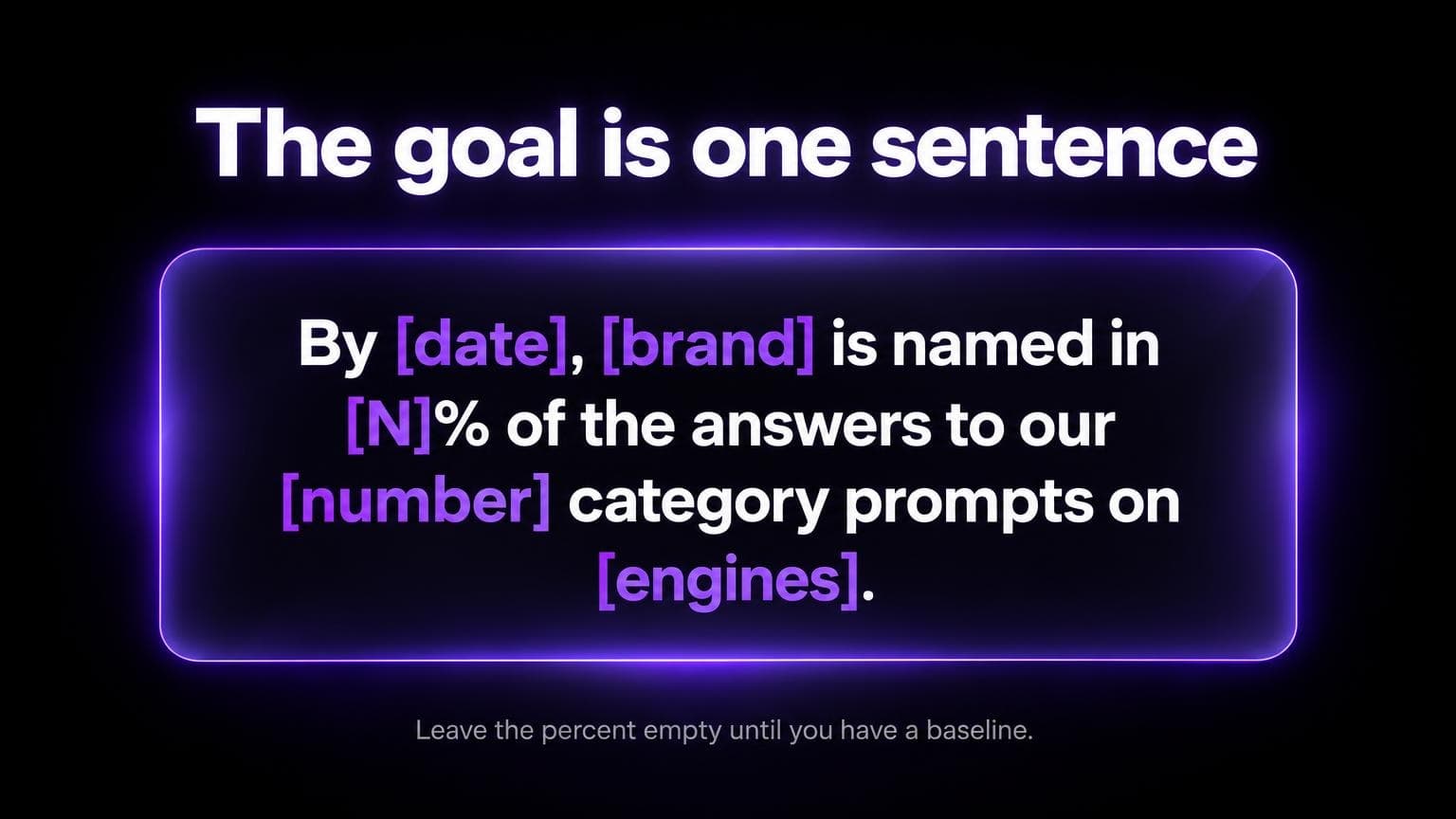
"By [date], [brand] is named in [N]% of the answers to our [number] category prompts on [engines]."
Leave the percent empty until you have the baseline.
A target without a baseline is a guess.
The metric: mention rate.
The share of scanned answers that name your brand.
Do not make AI traffic the goal. Here's why.
On aiseotracker.com, the DataFast referrer report for 1 July to 30 September 2026 shows 5,375 visitors. ChatGPT, Claude and Perplexity were the referrer for 37 of them.
About 0.7%.
Ahrefs reported 0.5% of visitors and 12.1% of signups from AI search on its own site.
Both are single-site data. But see the gap?
A buyer who sees your name in an answer and types your URL later arrives as direct traffic. So traffic misses part of the channel.
The engines.
Pick the engines your buyers use. Your analytics referrers show which assistants send visits now.
Don't know? Start with all five. The baseline example shows why: the engines cite different pages.
The prompt type.
Set the goal on category prompts. "best [category] for [use case]". The buyer does not know you yet.
Branded prompts must name you already. So report the two groups apart.
Output: one sentence, one owner, one date.
Build the prompt set
The prompt set is the scope of the strategy.
A page or a mention that helps no prompt in the set? Out of scope.
Where to get prompts:
- Sales calls
- Support tickets
- Search Console queries that are full questions
- Comparison searches
- The free keyword research tool (free account)
You do not need each buyer's exact words.
In a January 2026 SparkToro and Gumshoe study, 142 volunteers each wrote their own prompt for the same need. Little wording in common.
Four headphone brands still appeared in 55% to 77% of the 994 answers.
So cover each intent one time. Not ten variants of one question.
How many? I recommend 25 to 50.
Enough to cover each intent. Few enough that you can read every answer.
Tag each prompt with its intent: category, use case, comparison, problem, or branded. (The full bucket list.)
Then freeze the wording.
Change the prompts between scans and you cannot tell whether the engine changed or your question did.
Output: a list of 25 to 50 prompts, each with an intent tag.
Take a baseline before you change anything
Run each prompt on each engine in the goal.
For each answer, record four things:
- Does it name your brand?
- Does it cite one of your URLs?
- Which competitors does it name?
- Which URLs does it cite?
Run each prompt more than one time.
In the same SparkToro study, volunteers ran 12 prompts 2,961 times.
Its estimate for ChatGPT and Google's AI: ask the same question 100 times, and the chance that you get the same list of brands twice is under 1 in 100.
The share of answers that named a brand was more stable.
So record rates. Do not report a position from one answer.
How to run it.
A spreadsheet is sufficient for a first pass.
The AI SEO Tracker report does this step for $49, one time. You enter your website. It writes up to 50 prompts from your site for you to confirm. Then it scans ChatGPT, Perplexity, Gemini, Copilot and Google AI Overviews daily for 7 days.
The seven daily scans give you repeated runs of each prompt. A single manual check does not.
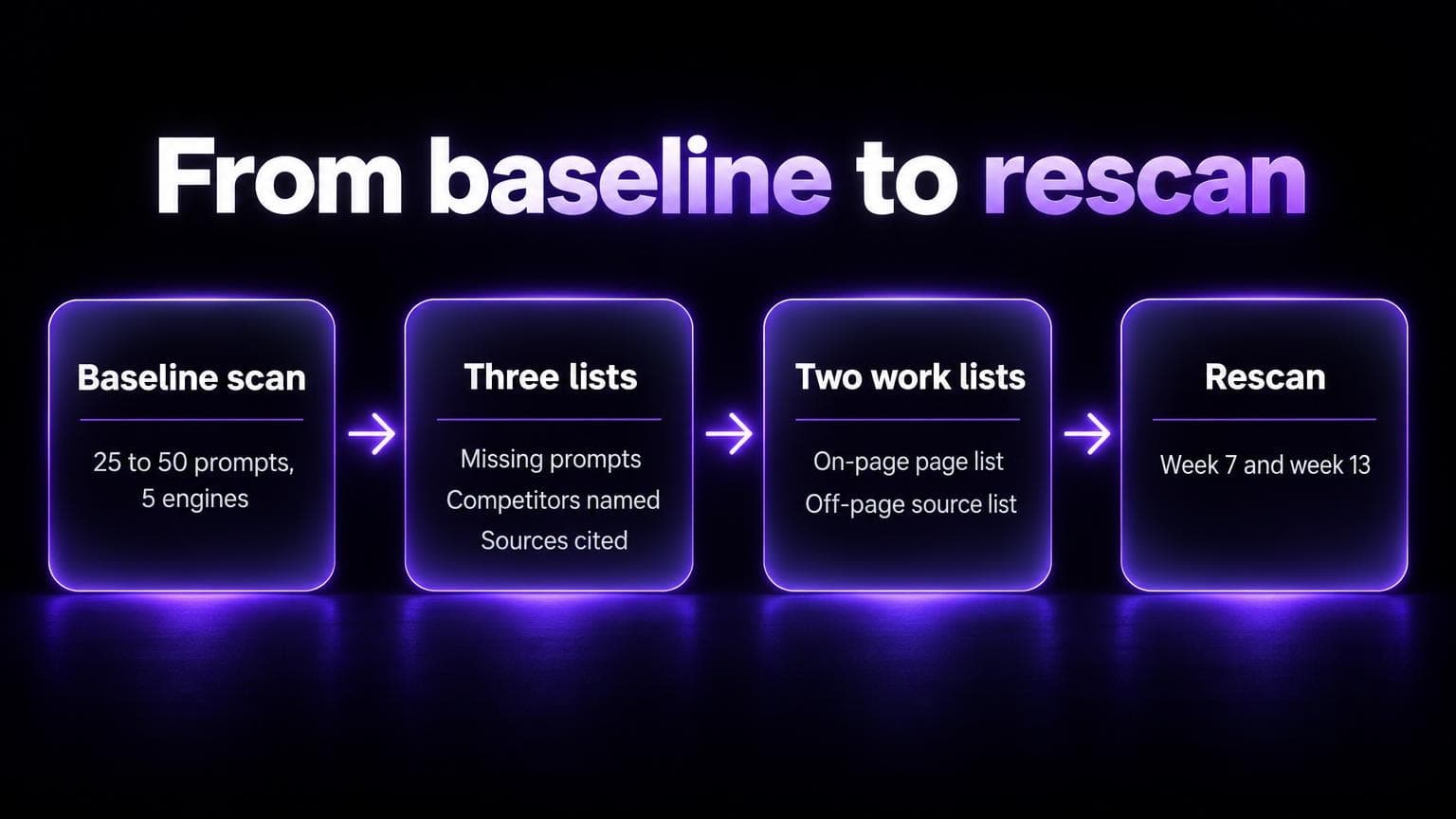
The baseline gives you three lists:
- Missing prompts: the prompts where no answer names you. This is the work list for on-page and off-page.
- Competitors named: the brands that appear where you do not.
- Sources cited: the URLs the engines used, sorted by how often they appear. This is the off-page list.
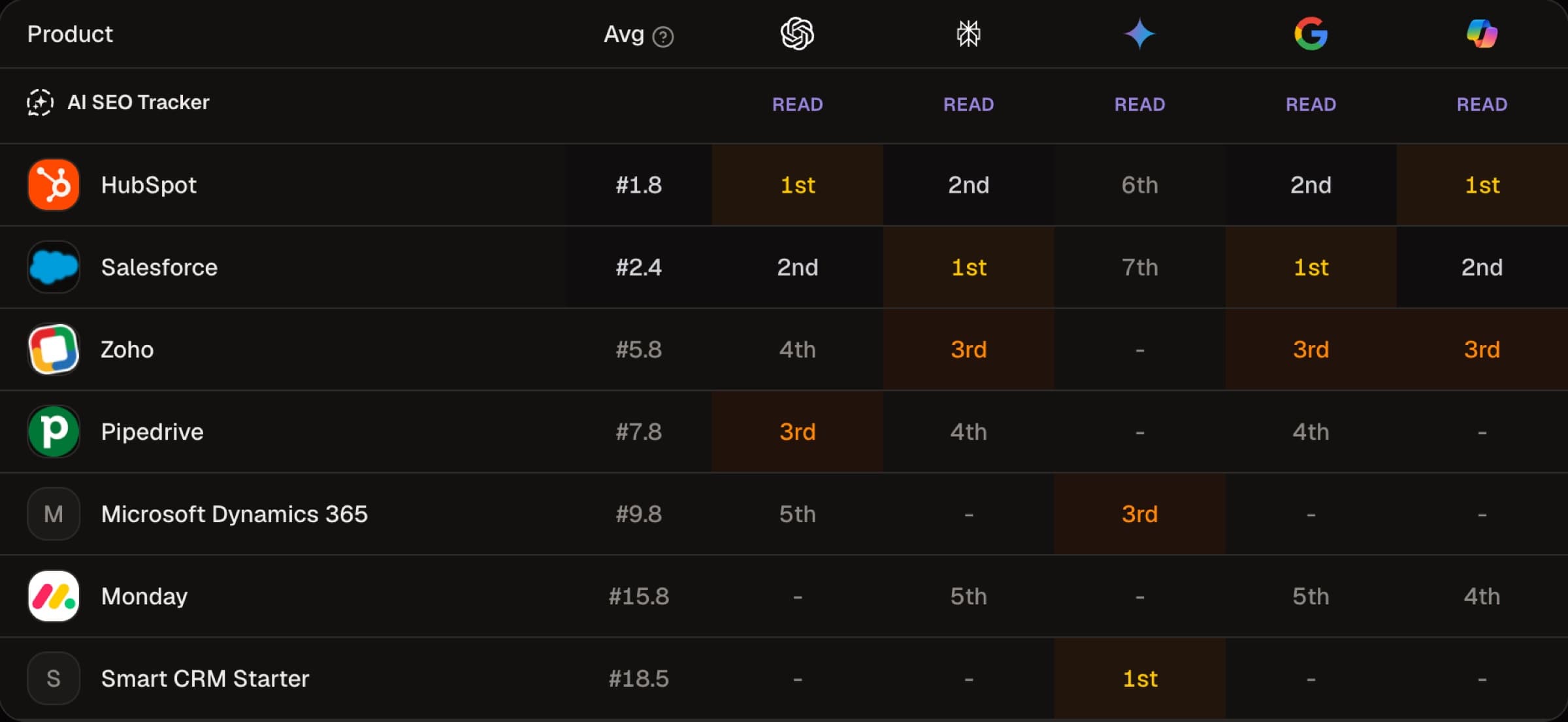
What it looks like for one question.
The leaderboard page for "best CRM software" shows one scan from 23 September 2026 on five engines.
HubSpot is named by all five. First on ChatGPT and Copilot. Sixth on Gemini.
The engines cited 24 pages:
- 11 "best of" lists
- 4 directories
- 3 vendor pages
- 4 other pages
- 1 news article
- 1 Reddit thread
Output: the three lists, and the percent that goes into the goal sentence.

Create Content for People and AI Answers
On-page work has two parts: access and content.
Do access first. Content cannot help if the crawler cannot read it.
Access
| Engine | What to check | Source |
|---|---|---|
| ChatGPT search | Your robots.txt allows OAI-SearchBot. A site that opts out does not appear in ChatGPT search answers, though it can still appear as a navigational link. GPTBot is the training crawler and is a separate decision. | OpenAI crawler documentation |
| Perplexity | Your robots.txt allows PerplexityBot. | Perplexity crawler documentation |
| Google AI Overviews and AI Mode | The page is indexed and can show a snippet. The Search generative AI control in Search Console includes your site, which is the default. | Google guide, Search Console help |
Then check that the content is in the HTML.
A December 2024 analysis by Vercel and MERJ found that the crawlers of OpenAI, Anthropic, Meta, ByteDance and Perplexity did not run JavaScript. Googlebot (which Gemini uses) and AppleBot did.
The free Page Inspector shows what AI can read on a page.
Content
Start from the missing-prompt list.
One page for each intent. Not one page for each prompt.
Google says that separate content for every variation of a query, made mainly to manipulate rankings or AI answers, violates its scaled content abuse policy.
1. Make the title and the URL say what the question asks.
From the Ahrefs ChatGPT study:
- Titles: cited pages had titles closer in meaning to the prompt than retrieved pages that were not cited. Cosine similarity 0.602 against 0.484.
- URLs: results with a natural-language slug were cited 89.78% of the time. Against 81.11%.
2. Write what only you can write.
Google calls this non-commodity content. A point of view and first-hand detail that a summary of other pages lacks.
Google says this will likely matter more in the long run than any other suggestion in its guide.
3. Show your evidence.
The GEO paper (KDD 2024) tested nine changes to source pages.
Cited sources, quotations and statistics gave a 30% to 40% relative improvement on Position-Adjusted Word Count, one of its two visibility metrics.
It is a lab benchmark. Not a promise.
What to leave out
Google's guide lists things to ignore for Google Search.
Some ranking pages still give them as advice.
| Advice you will see | What Google says (Google Search only) | Where you will see it |
|---|---|---|
| Add an llms.txt file | Google Search itself does not use these files. Keeping one neither helps nor harms your visibility there. | Step 9 of LLMrefs; a suggestion in WSI |
| Add special schema for AI | Structured data is not required for generative AI search, and no special schema.org markup is needed. It still helps with rich results. | Semrush (FAQ schema), Xponent21 |
Google's list also names three more: cutting pages into tiny "chunks", writing in a special way for AI systems, and seeking inauthentic mentions.
The table covers Google Search only.
But neither llms.txt nor schema is named as an input on the crawler pages of OpenAI and Perplexity. So I keep both off the plan.
Output: a page list. Each row has the intent, the URL, the change, the owner, and the date.
Earn third-party mentions
What tracks AI Overview mentions best? Not backlinks.
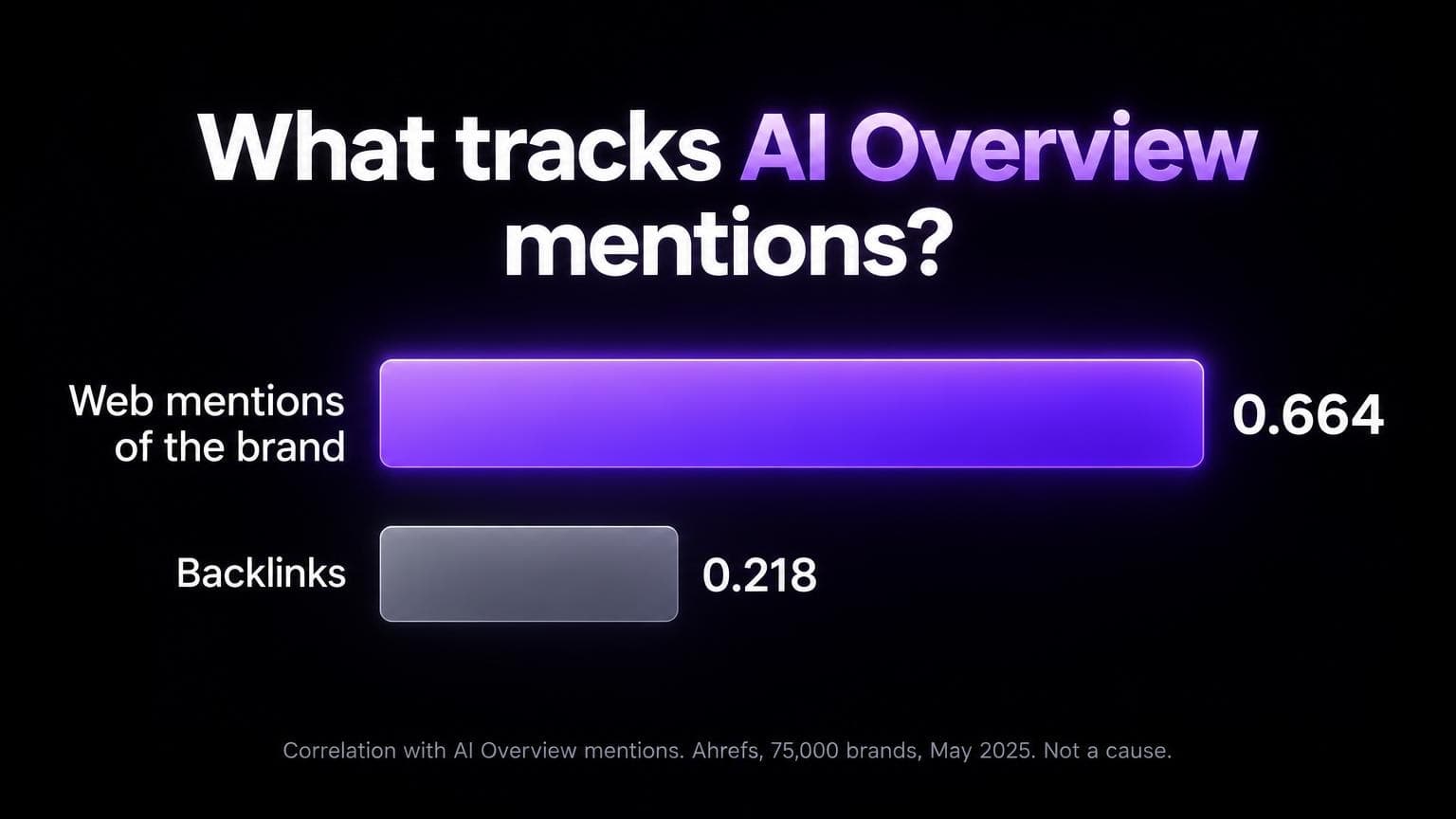
In a May 2025 Ahrefs study of 75,000 brands:
- Web mentions of the brand: 0.664. The strongest correlation with AI Overview mentions.
- Backlinks: 0.218.
A correlation is not a cause. And large brands have more of everything.
Where to start.
Take the cited sources in your baseline. Sort them by frequency. Give each source a type and one action.
| Source type | What it means for you | Action |
|---|---|---|
| A "best of" list on another site | The answer takes brands from a list that you are not on | Ask the author to review your product, with a reason that helps their reader. |
| A review site or directory | Your profile is absent or thin | Complete it. Ask real customers for reviews. |
| A forum thread | Users discuss the category without you | Answer as yourself, with your name and company. |
| A competitor's own page | The competitor has a page for this intent and you do not | Move the intent to the on-page list. |
| News or trade press | Editorial coverage names other brands | Pitch a story with data that only you have. |
For the first row, see the playbook for getting into roundup posts. I wrote it for my own category.
Sort by engine too.
In the "best CRM software" scan, each engine cited a different number of pages. And different kinds.
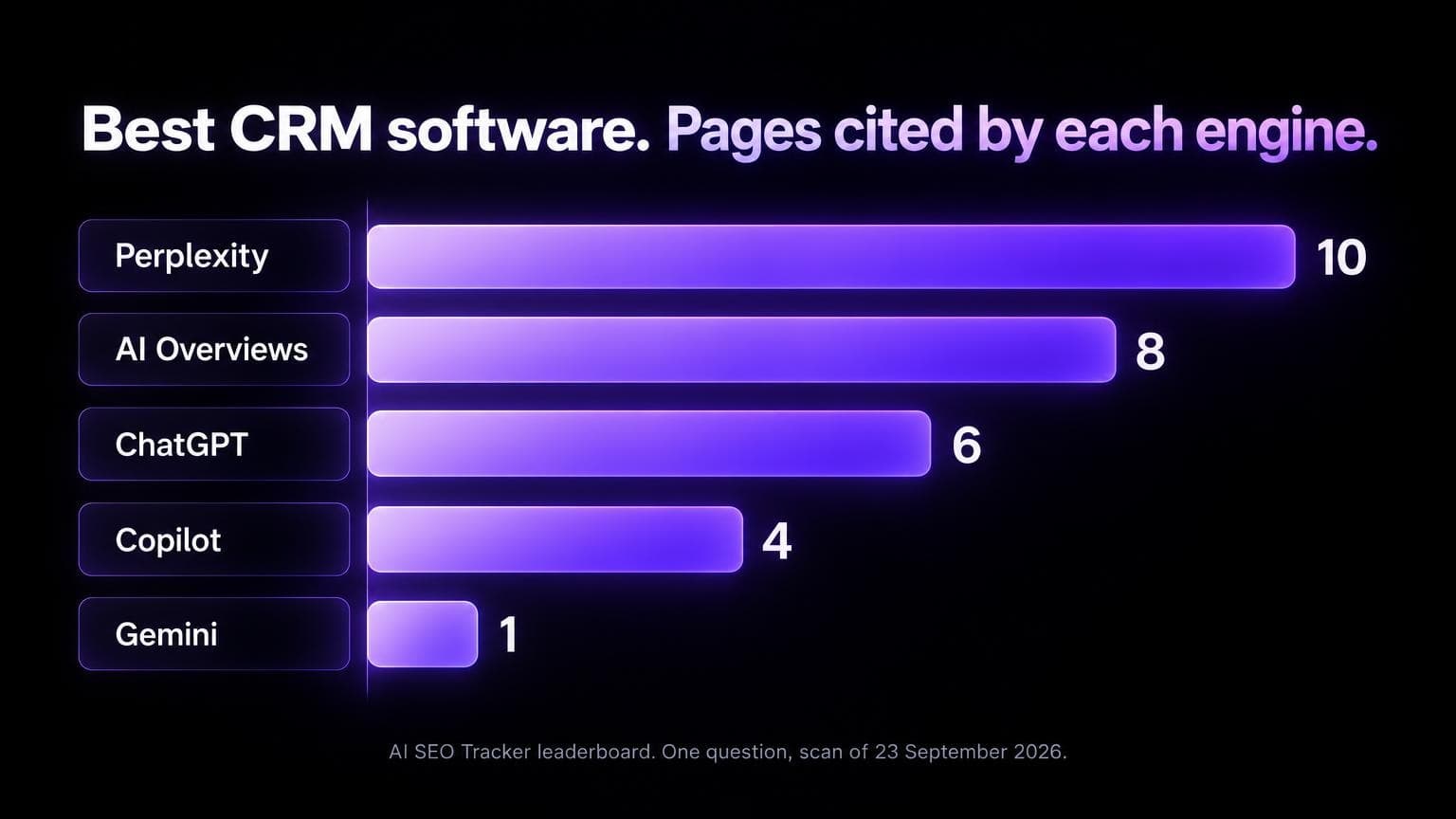
- ChatGPT: six pages. All on the sites of CRM vendors: HubSpot, Pipedrive, Salesforce and Zoho.
- Perplexity: ten. From "best of" lists, review directories and one news site.
- AI Overviews: eight. Including three YouTube videos and one Reddit thread.
- Copilot: four.
- Gemini: one.
It is one question on one day. Read it as an example, not a rule.
A cited vendor page means you need a page for that intent.
A cited list means outreach.
The cited sources are not the full picture.
In the Ahrefs ChatGPT study, Reddit made up 67.8% of the URLs that ChatGPT retrieved but did not cite.
A forum can shape an answer and never appear in your source list.
Do not buy mentions.
Google's guide says that inauthentic mentions are not as helpful as they might seem.
Keep one thing consistent: the same category name, one-line description and prices on each profile you control. LLM SEO explains why.
Output: a source list. Each row has the URL, the type, the action, the owner, and the date.
How to measure AI SEO performance
Scan the baseline prompts again.
Same engines. Same competitors. Then compare the rates.
Keep four numbers for each engine:
- Mention rate
- Share of voice
- Citation rate
- The count of missing prompts
The formulas are in how to measure brand visibility in AI and AEO metrics.
First-party data
| Tool | What it shows | What it does not show |
|---|---|---|
| Google Search Console, Generative AI performance report | Impressions of your links in AI Overviews and AI Mode, by page, country, device, and date. Launched in June 2026 for a subset of sites. Google's help page dates the rollout to all sites at 31 August 2026. | Queries are not a dimension. It shows nothing outside Google. |
| Bing Webmaster Tools, AI Performance | Citations of your pages in Copilot, Bing's AI summaries, and select partner integrations; the pages cited; the grounding queries used for retrieval (a sample). Public preview since February 2026. | Whether the answer named your brand, and where the citation was placed in the answer. |
Neither report names ChatGPT or Perplexity as a surface it covers.
For those engines, use the prompt scan.
For a business check:
- Add "How did you hear about us?" to the signup form.
- Watch referrals from assistant domains.
- Watch branded search in Search Console.
These numbers validate the scan. They do not replace it.
How to read the numbers
- Treat small changes as noise. SparkToro lists the number of runs for a sound result as an open question. Compare rates on the full set. Look for prompts that move from missing to named and stay there for several scans.
- Keep a change log. Write the date when a page goes live or a mention appears. Or you cannot connect a change in the rate to its cause.
Output: a scan schedule, a change log, and a review date.
The 90-day plan
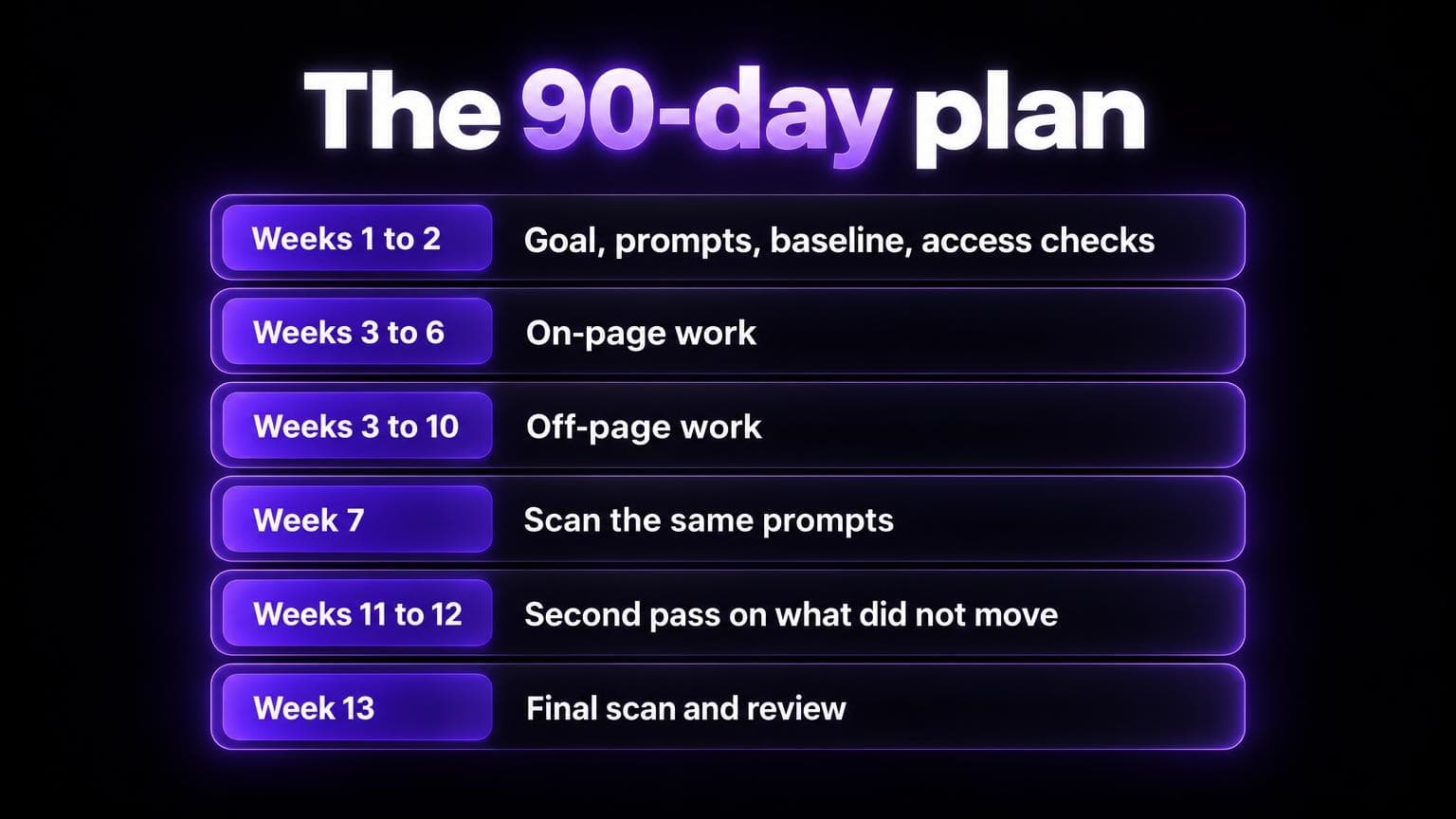
| Weeks | Work | Done when |
|---|---|---|
| 1 to 2 | Goal, prompt set, baseline scan, access checks | The one-page document is complete |
| 3 to 6 | On-page: fix access, then improve or write one page for each of the top missing intents | Each page on the list is live and indexed |
| 3 to 10 | Off-page: work the source list from the top | Each source has a result: listed, declined, or no reply |
| 7 | Scan the same prompts | You have a second data point |
| 11 to 12 | A second pass on the prompts that did not move | The change log is up to date |
| 13 | Final scan and review | Each prompt has a decision: keep, change, or drop |
Day 90 is a review date.
I do not state a time to results. I have no source for one.
New is not the goal.
In the Ahrefs ChatGPT study, the median cited page from the search channel was about 500 days old. (Ahrefs notes that its pool of non-cited pages is much smaller, which limits the conclusion.)
My reading: improve a page that exists before you write a new one.
At the review, answer three questions:
- Which missing prompts name you now?
- Which sources did the engines cite for those prompts?
- Which work had no effect?
Then write the next goal sentence, with the new rate as the baseline.
Want the scan to continue without the spreadsheet? AI SEO Tracker has weekly reports for a set of 50 or 500 prompts.
Using AI tools to run the plan
The other meaning of "AI SEO strategy": a plan for what AI does in your SEO work.
HubSpot's guide gives a vendor's rule of thumb that fits:
- Automate a task when it is repetitive, well defined, and checkable.
- Use AI help when a person reviews the result.
- Keep it human when judgment, voice, or strategy is involved.
Mapped to the steps above. (The mapping is my reading.)
| Step in the plan | Who does it | The check |
|---|---|---|
| Draft the first prompt list from sales questions and Search Console queries | AI drafts, a person confirms each prompt and its tag | Freeze the wording after that. |
| Run the scans every week | A tool: the task repeats and the output can be checked | Read a sample of full answers by hand. |
| Group cited sources, draft page briefs and first versions | AI drafts, a person reviews | Google: manually fact-check all AI-generated content, including title elements, meta description elements, structured data, and alt text. |
| One page for each prompt variation, written in bulk | Nobody | Google: this can violate its scaled content abuse policy. |
| Positioning, first-hand detail, claims, the final edit | A person | Google asks for non-commodity content. |
Why the review? Google's guidance on AI-generated content gives the reason: generative models predict a likely sequence of words and do not retrieve facts.
Google's guide also says that no third-party tool has access to its internal systems.
An answer scan reports what the engines said. AI SEO Tracker claims no more.