




TL;DR
- The difference: Voice is the input. Market share is the result.
- The link: 10 points of extra voice went with 0.5 points of share in a year. Nielsen, 2009.
- The limits: It's an average, for paid ads. Not for mentions or AI answers.
- The target: No SOV is "good". Compare it to your own market share.
- AI answers: No study links AI mentions to market share. I looked.
Does AI name your brand? Check your site.
Share of voice is what you put in.
Share of market is what you get out.
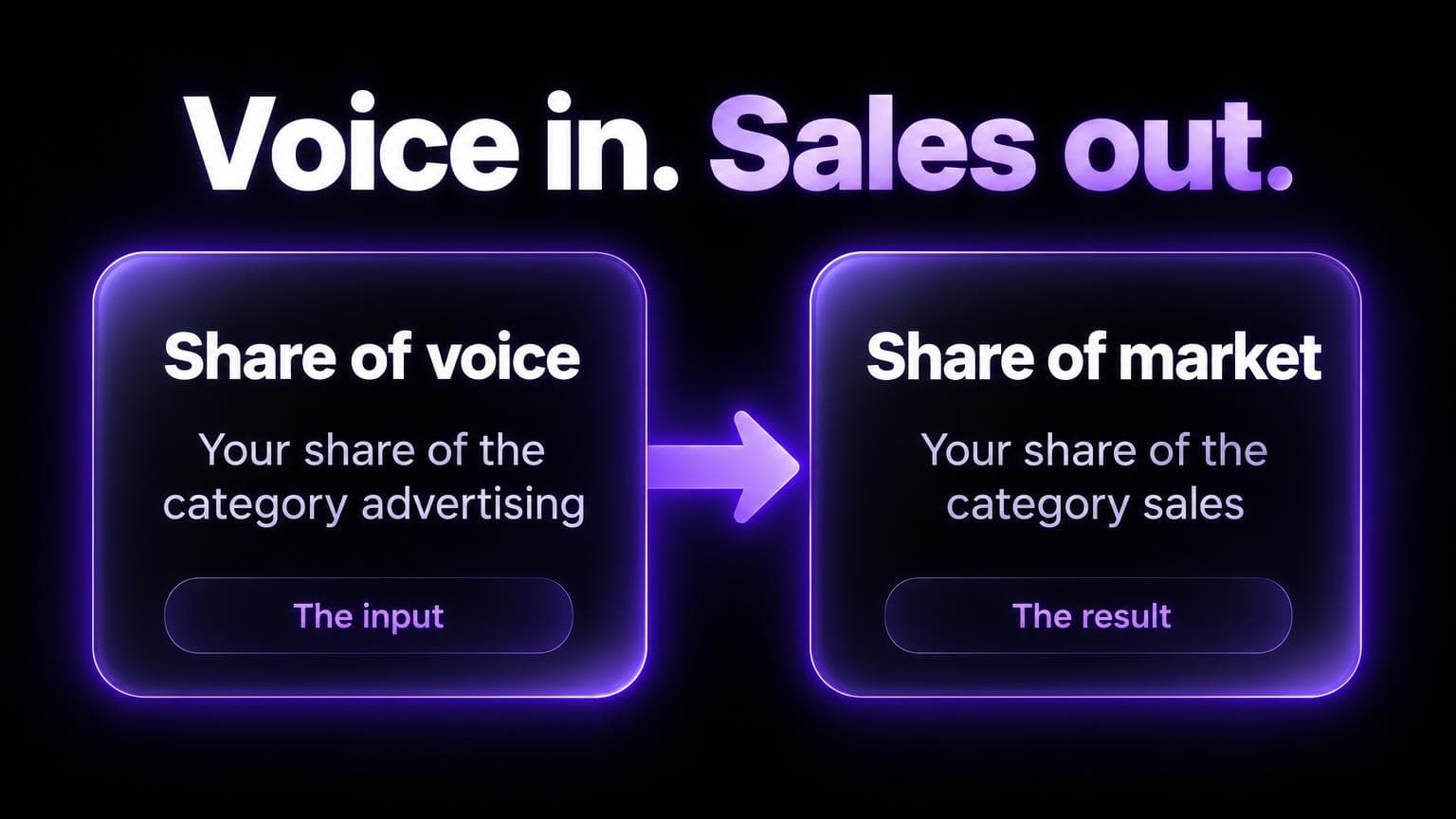
- Share of voice (SOV): your part of the category's advertising.
- Share of market (SOM): your part of the category's sales.
- Excess share of voice (ESOV): SOV minus SOM. The gap.
Why does the gap matter?
One finding. Nielsen studied 123 brands in 2009. 10 points of ESOV went with about 0.5 points of extra share in a year.
That's an average for normal advertising. It's not a forecast for your brand.
And I found no public study that measured it on mentions, rankings or AI answers.
For the channel formulas, see how to calculate share of voice.
Share of voice vs share of market side by side
| Share of market (SOM) | Share of voice (SOV) | |
|---|---|---|
| Formula | Your sales ÷ category sales | Your ad spend ÷ category ad spend |
| Timing | Lagging: what buyers did | Leading, on average: what buyers could see |
| Main risk | You see the problem after it cost you sales | The number goes up and sales don't |
SOM is the past. Sales that already happened. Reported late.
SOV is closer to the future.
What "voice" means in the research: advertising. Not mentions.
- Nielsen (2025): a brand's media spend as a percentage of all media spend in the category. In that market, on that channel, at that time.
- John Philip Jones (Harvard Business Review, 1990): a brand's share of the total value of the main media exposure in its category.
Where it comes from. Tom Roach's history, with input from Les Binet (Marketing Week, 2024):
- 1960s: Unilever used SOV. And kept quiet.
- Early 1970s: Peckham at Nielsen made it public.
- Around 1990: Jones made it famous.
- 1993: Binet says he coined ESOV.
Today the term covers a lot more. Impression share in Google Ads. Organic visibility. Social mentions. Mentions in AI answers.
The growth research wasn't done on those.
How to Calculate These Metrics Without Lying to Yourself
ESOV = SOV minus SOM. In percentage points.
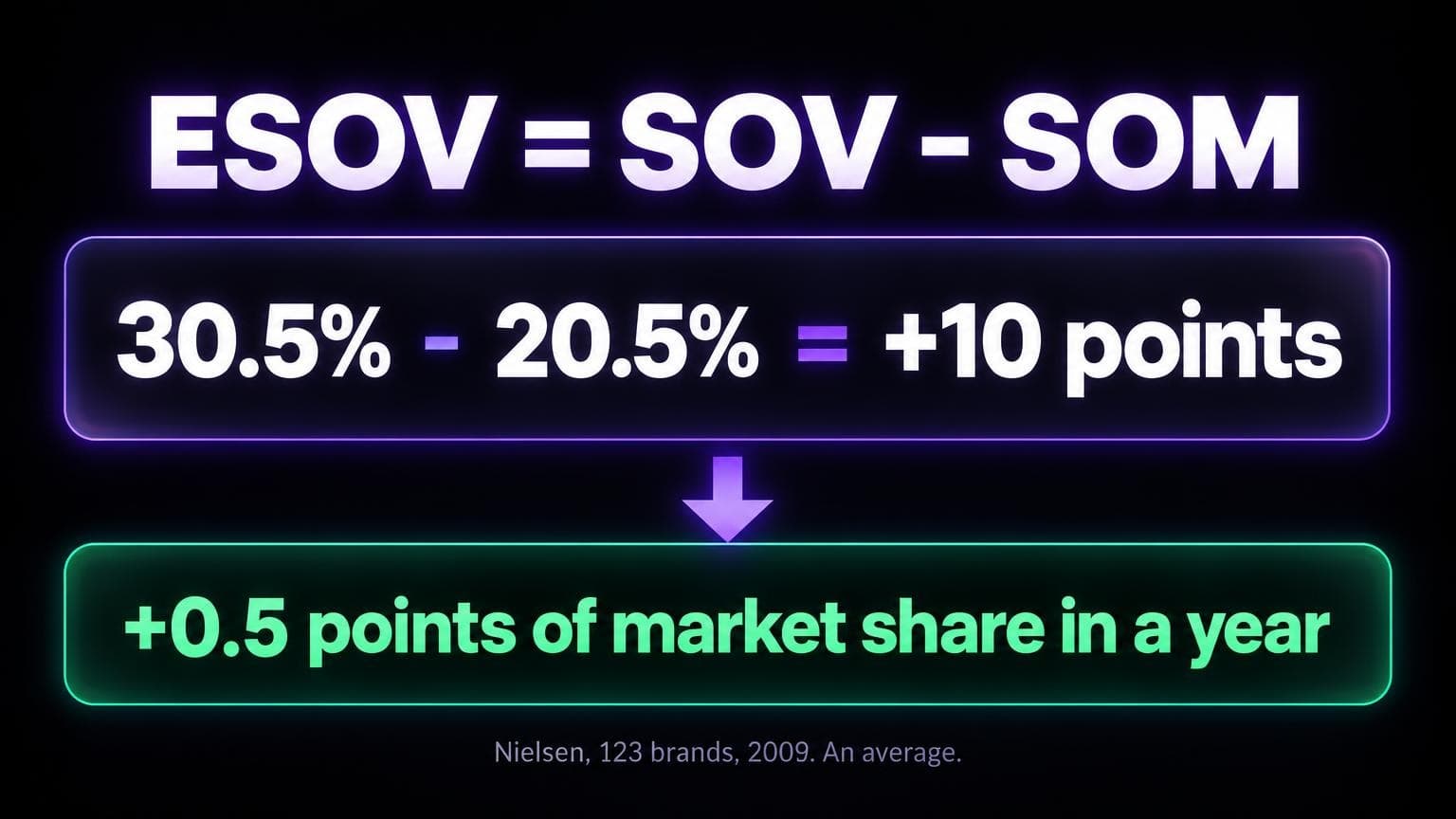
Nielsen's example, step by step:
| Step | Nielsen's example |
|---|---|
| SOM | 20.5% |
| SOV and ESOV | 30.5% minus 20.5% = +10 points. Nielsen gives ESOV. The 30.5% is worked out |
| Share a year later | 20.5% + 0.5 points = about 21% |
Easy. But people get the rate wrong.
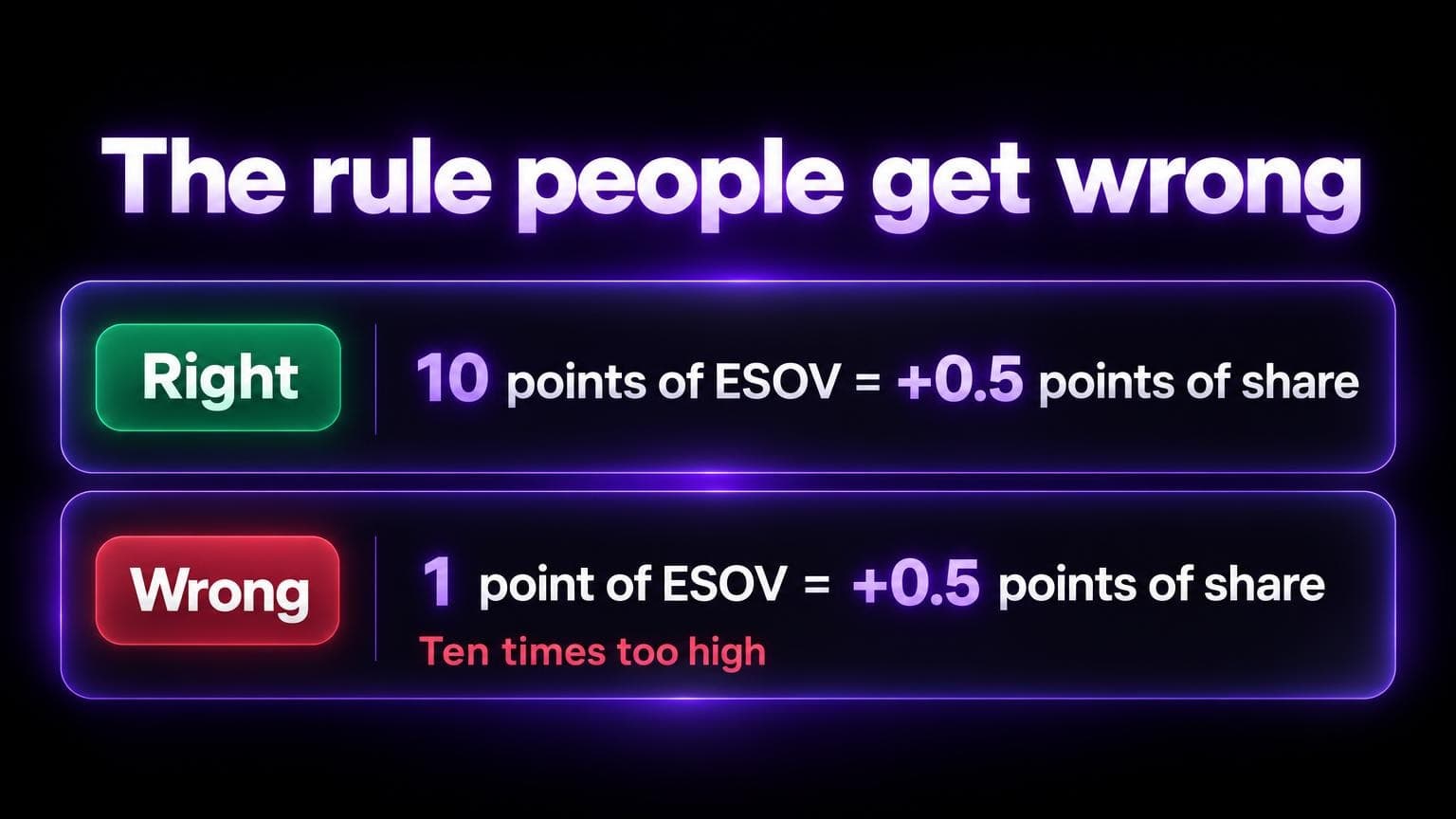
Take a brand with 15% SOM and 20% SOV. ESOV is +5 points.
| Reading of the rule | Arithmetic | Share a year later |
|---|---|---|
| Right: 0.5 points per 10 points of ESOV | 5 ÷ 10 × 0.5 = +0.25 points | About 15.25% |
| Wrong: 0.5 points per 1 point of ESOV | 5 × 0.5 = +2.5 points | 17.5% |
The second one is ten times too high.
And it's out there. A 2026 guide from Cometly states the rule correctly for 10 points. Then as 0.5% per point. Then builds its 15% to 17.5% example on the wrong version.
Three more mistakes that break the pair:
1. Two categories. Your SOM is "all CRM software". Your SOV is "dental CRM ads". The gap means nothing. Use one category and one competitor list. If you estimate category sales, say so.
2. A channel score with the same name. Google's impression share is your impressions divided by the impressions your ads were eligible for. Google estimates that. It's not your share of the category's advertising.
3. Percent and percentage points. 25% SOV and 15% SOM is 10 points of ESOV. Not a ratio.
Why Your SOV Is a Growth Engine for Market Share
Three sets of evidence.
Nielsen and the IPA, 2009
Nielsen analysed 123 brands in 30 categories. Typical advertising, not award winners. Published with the IPA.
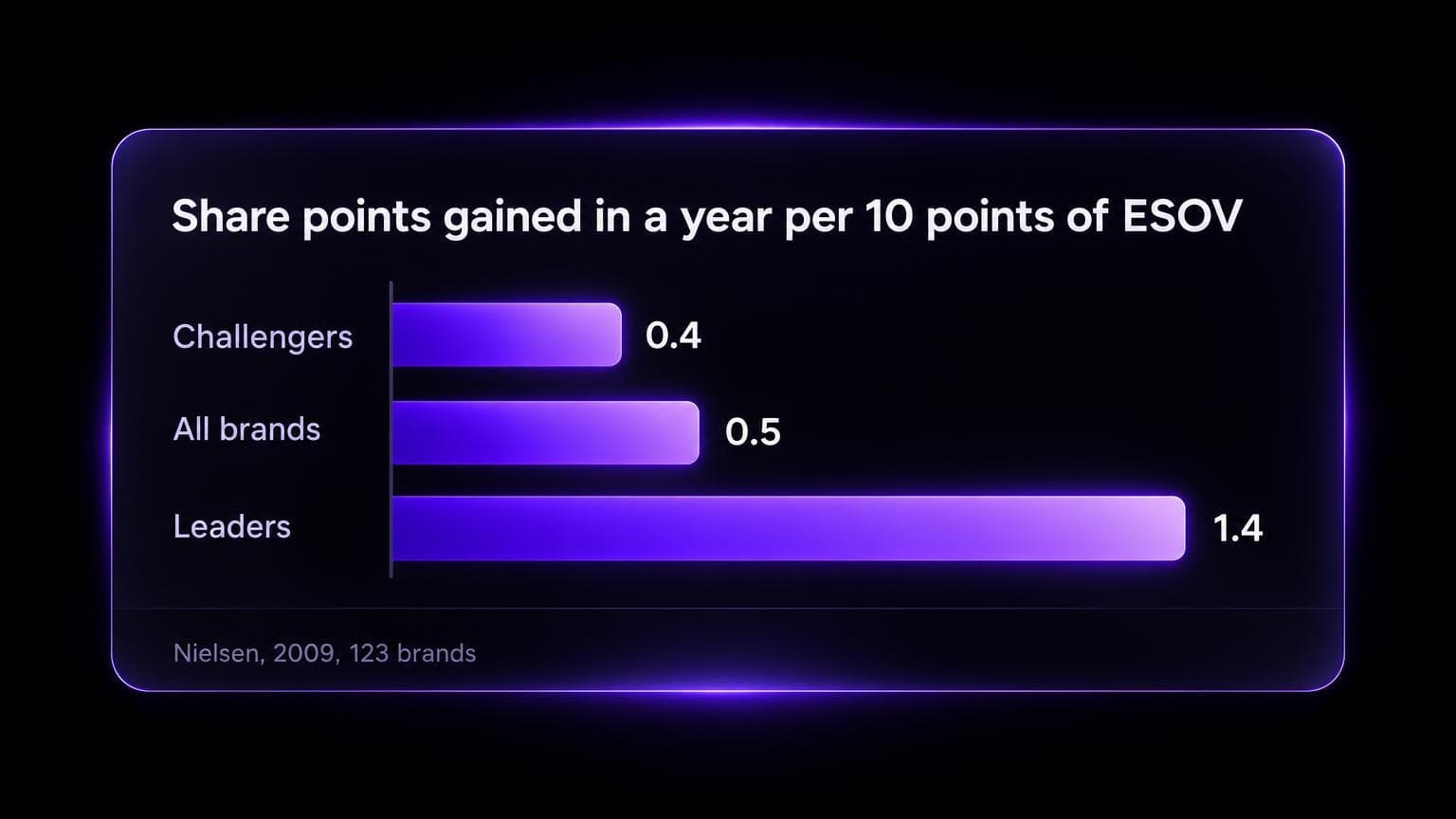
Per 10 points of ESOV:
- All brands: +0.5 points of share.
- Leaders: +1.4.
- Challengers: +0.4.
So a typical FMCG challenger must be at least 3.5 times as effective as the leader to level the field.
Nielsen says to use the 0.5 norm for fast-moving consumer goods (FMCG).
Binet and Field, IPA Databank
Same kind of analysis. Different data: IPA Effectiveness Awards cases. (Effectiveness in Context, IPA, October 2018.)
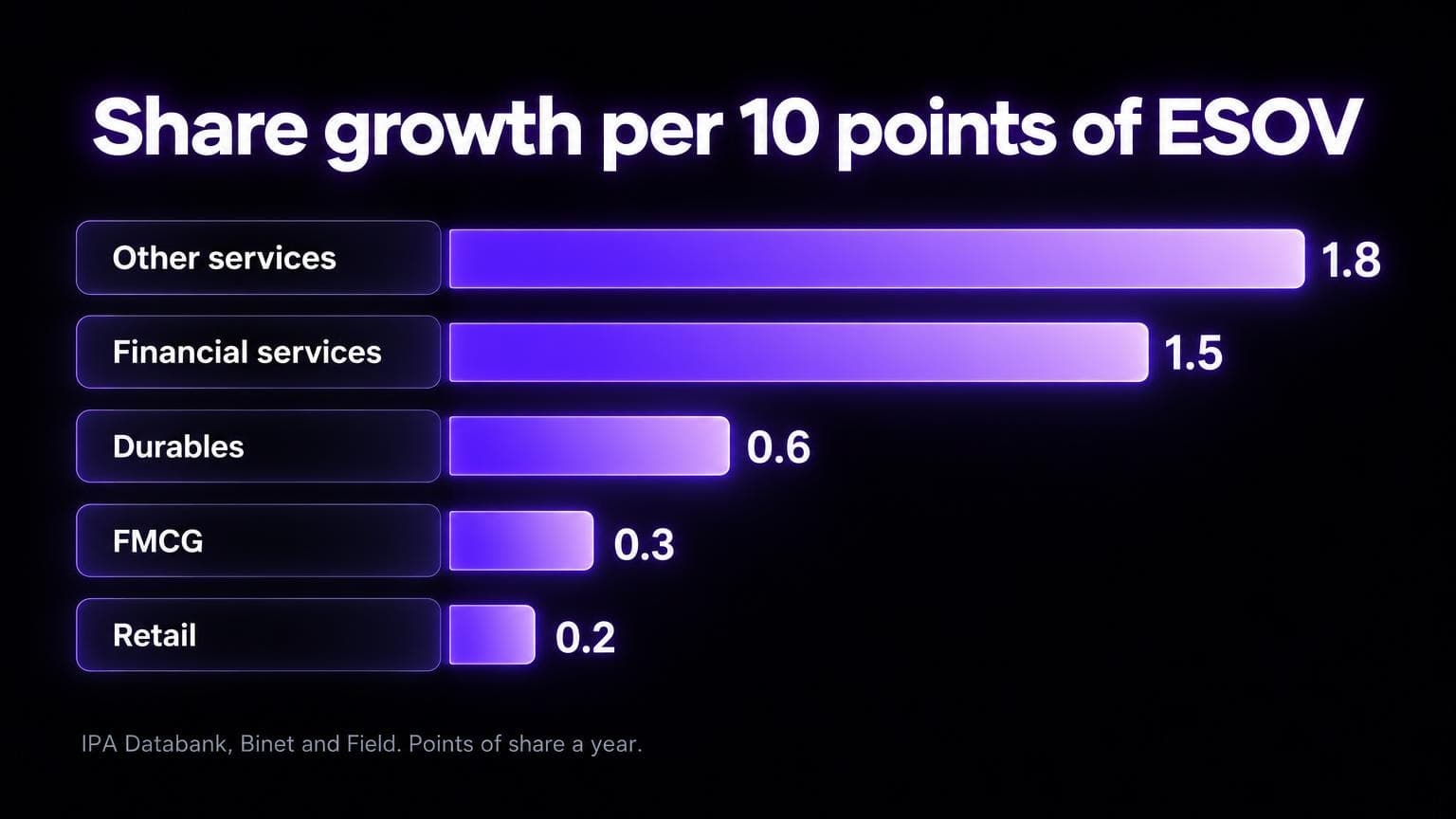
| Sector | ESOV efficiency |
|---|---|
| Retail | 0.2 |
| FMCG | 0.3 |
| Durables | 0.6 |
| Financial services | 1.5 |
| Other services | 1.8 |
| B2C average | 0.6 |
| B2B | 0.7 |
Sources: Binet's November 2020 slides for the sectors. LinkedIn's B2B Institute for the two averages (January 2020).
A note on the unit. Binet's slide says "ESOV Efficiency". No unit.
The B2B Institute report prints the same chart as Figure 4 (IPA Databank, 1998 to 2008 cases). It labels the average as 0.6 points of share a year per 10 points of ESOV. So the bars read in that unit.
The other direction
What if you stop?
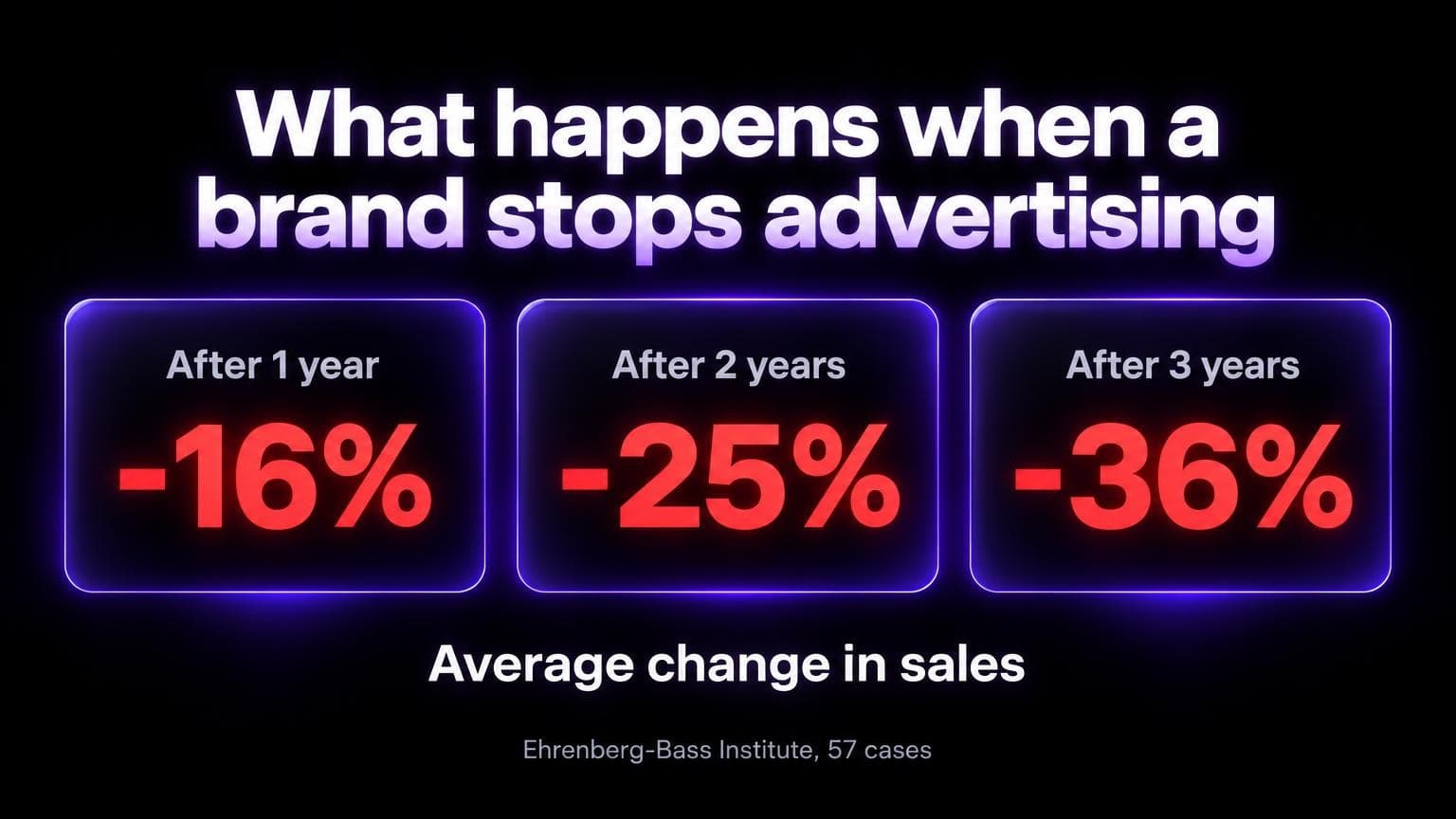
The Ehrenberg-Bass Institute studied 70 brands in one Australian consumer goods category. It found 57 cases where a brand cut all mass media spend for a year or more.
Average sales after the stop (Journal of Advertising Research, 2021). The 1-year figure rests on 57 cases, the 2-year figure on 34, the 3-year figure on 17:
- After 1 year: down 16%.
- After 2 years: down 25%.
- After 3 years: down 36%.
Small brands fell fastest. Big brands were fairly stable for the first one to two years.
Nielsen's model says the same. A leader cuts media to zero for two years, while the others raise budgets 2% a year. It falls from 33.3% to 28.5% share in the third year.
(That one is a model. Not an observed case.)
What the evidence does not show
The 10 to 0.5 rule gets repeated without its limits. Here they are.
It's an average. With a wide spread.
- The IPA sector bars run from 0.2 to 1.8.
- The IPA's FMCG bar is 0.3. Nielsen's FMCG norm is 0.5.
- Nielsen told each brand to measure its own relationship.
Also: SOV equal to SOM is not every brand's balance point. The 2010 WARC article on the Nielsen data talks about each brand's equilibrium SOV.
It's about advertising.
The research counts media spend.
I didn't find a public study that links social mentions, organic visibility or AI mentions to market share with a number like 0.5.
The IPA numbers come from award entries.
The IPA Databank is built from entries to the IPA Effectiveness Awards. More than 1,600 case studies since 1980.
Award entries are not a random sample. Nielsen's 123 brands were typical advertising, with a focus on FMCG. So for a normal FMCG campaign, I trust Nielsen's number more.
It doesn't prove cause for your brand.
A growing brand has more money to spend. The cause can run the other way.
And the Ehrenberg-Bass summary cites more than 150 split-cable tests. TV ads for a brand were stopped for one group of households, for up to a year.
Just over half showed no significant difference in sales.
There's no single-brand case.
I didn't find a public case that shows one brand's SOV and SOM over time. All the numbers above are pooled across brands.

Does AI name you?
See if AI mentions your brand. Then get the pages to fix.
Setting Realistic SOV Benchmarks (Stop Chasing Unicorns)
There's no "good" SOV.
20% SOV is a lot for a brand with 5% of sales. It's too little for a brand with 40%.
The benchmark that means something: your SOV against your own SOM.
The zero line is ESOV of zero. Above it, brands tend to grow. Below it, they tend to shrink.
The published rules, and what each was measured on:
| Case | Rule | Measured on |
|---|---|---|
| Existing brand | 10 points of ESOV, 0.5 points of share a year. Leaders 1.4, challengers 0.4 | Nielsen, 2009: 123 brands |
| Launch or relaunch | 15 to 25% more growth per point of ESOV than the norm | The same Nielsen data |
| New brand | SOV of about 1.5 times the share you want after two years | Peckham: grocery, toilet and drug products, 1960 to 1978 |
| Mentions, visibility, AI answers | None that I found | No public dataset behind "typical SOV" lists |
Peckham's rule, as an example. A new brand wants 10% share after two years. It sets SOV at about 15%.
But the textbook that reports the rule says it applies only where SOV and SOM correlate. It can't be generalised, because order of entry matters.
Don't stretch the rule. My arithmetic, not a published limit:
- You want 5 points of share in a year.
- At Nielsen's average rate, that takes 100 points of ESOV.
- A brand with 10% share can have at most 90.
Impossible. So the rule can't be the whole story.
To set your own:
- Fix the category and 3 to 5 competitors.
- Measure SOV in one channel each month.
- After a year, find the SOV level where your share held steady.
That's a first estimate of your equilibrium.
What to check when SOV and SOM disagree
My reading. Not a published model.
| SOV against SOM, and SOM trend | What it can mean | Check first |
|---|---|---|
| Above, SOM rising | The spend may be working. Or a growing brand has more to spend | Which came first, the budget or the sales. Whether a launch or news explains it |
| Above, SOM flat | Not yet a failure: in Binet's car data, share of search moved up to 12 months before share. A challenger needs better work, not only volume | Share of search. Campaign quality. Whether product, price and distribution convert attention |
| Below, SOM steady | A big brand can hold share quietly for one to two years | How long you have been quiet. Share of search |
| Below, SOM falling | The pattern the research warns about. A full stop cost sales in the Ehrenberg-Bass cases | The category boundary: one budget is a small voice in a wide category and a large one in a narrow one. Whether a rival raised spend |
Share of search vs share of voice
Share of search = searches for your brand ÷ searches for all brands in the category.
It's free. Google Trends has it.
Les Binet showed the data in an IPA webinar on 18 November 2020. Cars, energy and mobile phones.
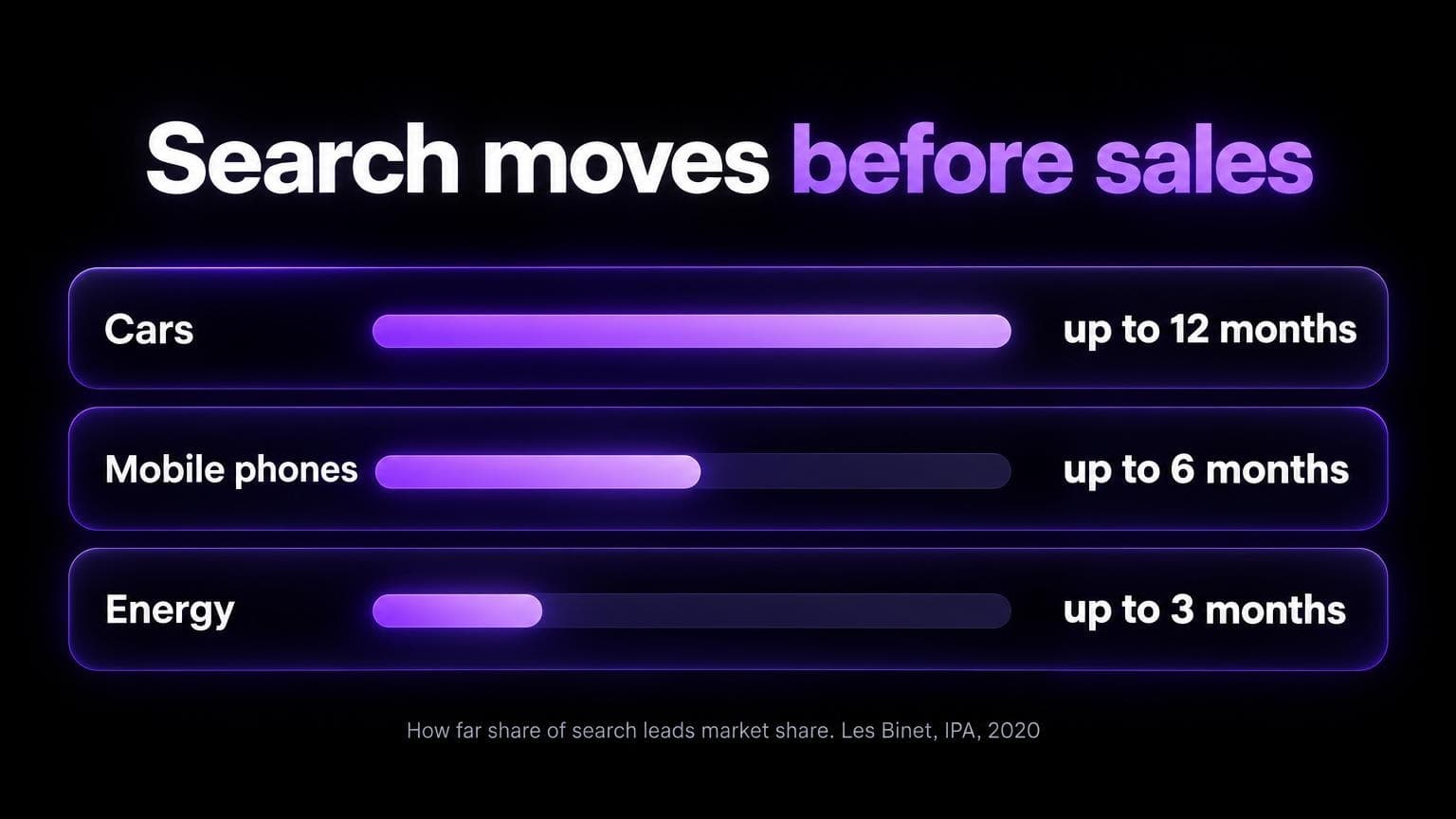
What he found:
- Share of search tracked market share. In all three categories.
- Search moved first. Up to 12 months before for cars. Up to 6 for phones. Up to 3 for energy.
- The gap predicted growth. For 22 of 23 car brands and 10 of 12 phone brands, a year later.
And voice feeds search. Binet's slides on advertising:
- 10 points of extra SOV raised a brand's share of Google searches by about 0.4 points. At once.
- That short effect was gone within a month.
- A smaller one lasted about two years. 26 months on average.
So the chain runs: voice you buy, then searches, then sales.
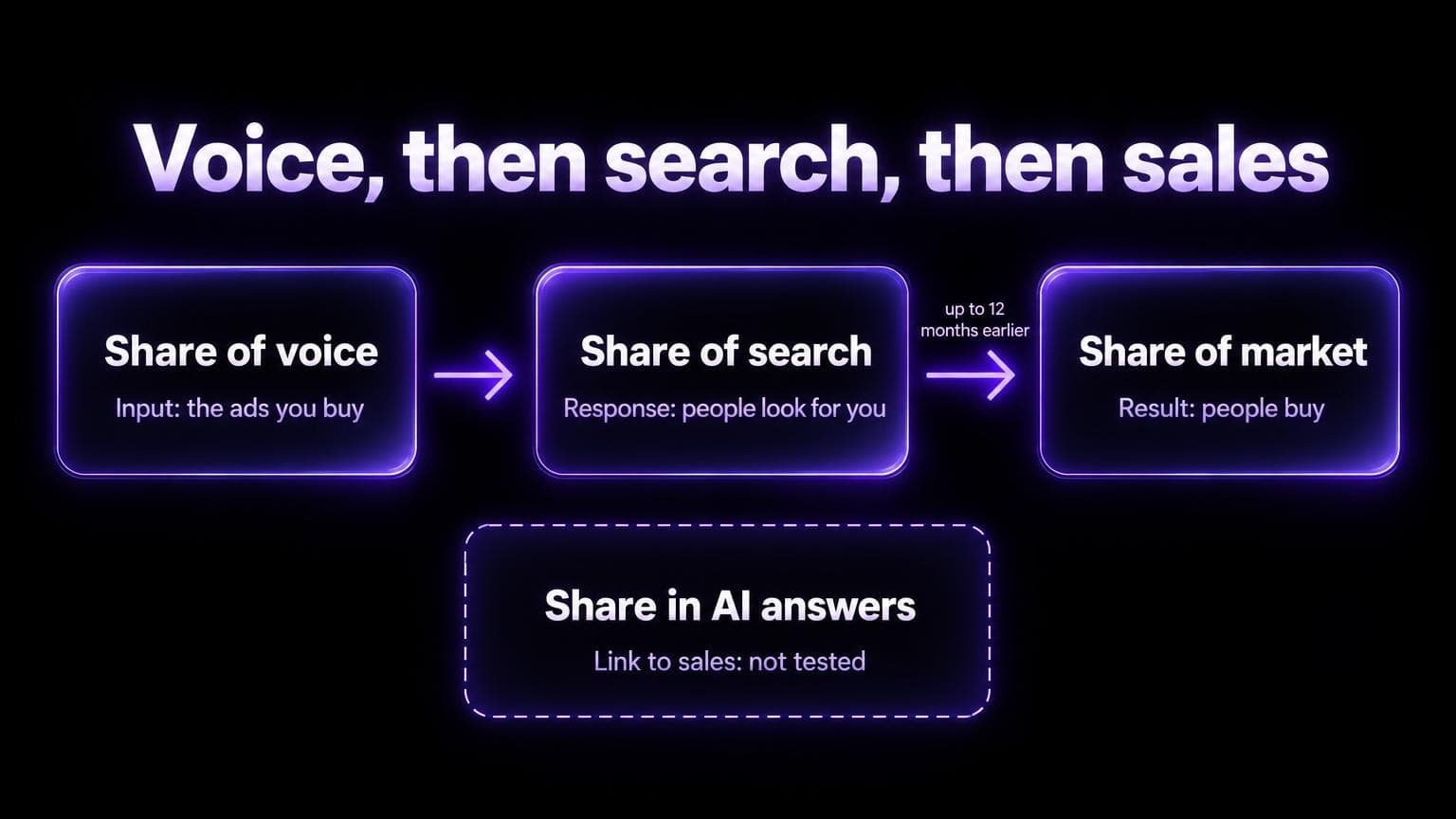
The limits. They're in his slides.
- In energy, price matters so much that he calls forecasting share from search not practical.
- Not all search activity is positive. (IPA's summary of the talk.)
LG shows the lead. I read these from Binet's chart, so they're approximate:
- Share of search peaked near 9%. Late 2008.
- Share of market peaked near 11%. Early 2009.
- Both were close to 1% by late 2012.
I like share of search for small brands. You rarely have paid ad data for a category. Google Trends is free.
Can you only measure one? Measure share of search. Compare it to your SOM.
The formula guide shows how, and where the estimate breaks.
Share of voice in AI answers and where the research stops
Now the new one.
Tom Roach defined "share of model" in 2024: mentions of a brand by one or more LLMs, as a proportion of all brand mentions in the category.
Does it link to market share? He listed that as an open question.
It still is. I found no study that tests it.
The nearest data: a Similarweb study that SparkToro summarised in June 2026. In finance, travel and beauty, direct visits and branded searches rose more for brands that AI answers recommended.
Visits. Not sales. Not share.
Compare two real numbers.
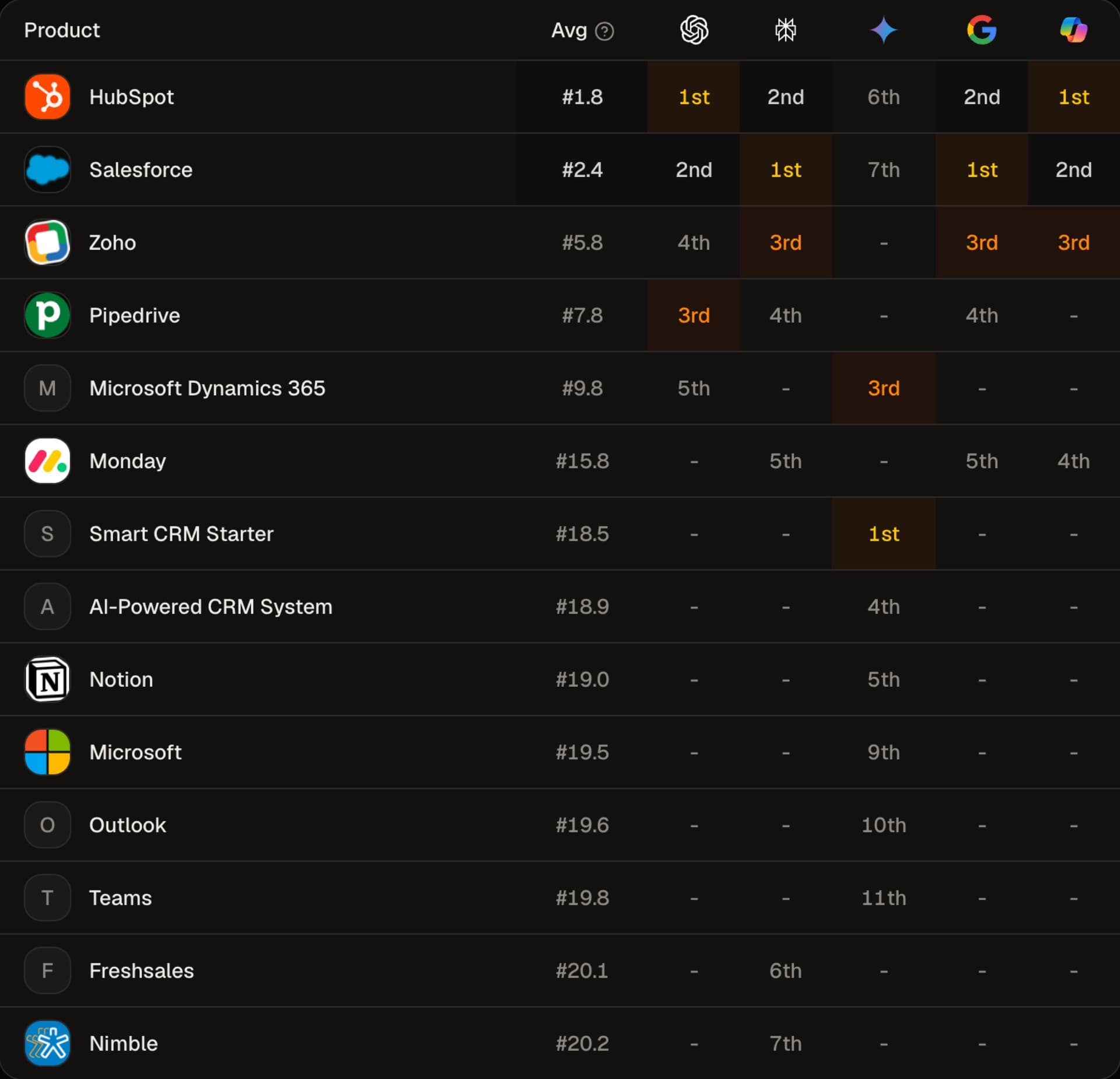
Our leaderboard scan for Best CRM Software, 23 September 2026:
| Brand | ChatGPT | Perplexity | Gemini | AI Overview | Copilot |
|---|---|---|---|---|---|
| HubSpot | 1 | 2 | 6 | 2 | 1 |
| Salesforce | 2 | 1 | 7 | 1 | 2 |
And the market? IDC says Salesforce led all CRM vendors in 2025 with 20.0% share. (Reported by Salesforce.)
So HubSpot ranks above the market leader in three of five engines. And both drop to 6th and 7th in Gemini.
A rank in one answer is not a share of sales. I found no study that shows one predicts the other.
And one answer is one sample. In SparkToro's January 2026 study with Gumshoe.ai, two runs of the same prompt gave the same list of brands less than 1 time in 100. That's ChatGPT and Google's AI. Claude was only slightly more likely to repeat a list. The study had 2,961 runs across the three tools.
How many runs you need: share of voice measurement.
So why track it?
Because a brand that's missing from the shortlist can lose a sale. And no analytics report will show it.
Our report counts it for one brand. $49, once. Up to 50 prompts written from your site. Daily for 7 days, on ChatGPT, Perplexity, Gemini, Copilot and Google AI Overviews.
Keep that number apart from the ESOV arithmetic.
More: how to measure AI brand visibility.
Your Questions, Answered
What is meant by share of voice?
In the research: a brand's share of the category's advertising spend.
Tools also use the word for impressions, search visibility, social mentions or AI mentions. Those are different measures.
Is SOV a reliable metric?
A fair guide to direction. A weak forecast.
Brands with SOV above SOM tend to grow. How much depends on sector, brand size and campaign quality.
What is ESOV in marketing?
Excess share of voice. SOV minus SOM, in percentage points.
On average, positive ESOV goes with share growth over a year. It doesn't forecast next month's sales.
What is a good share of voice percentage?
None in general. Compare your SOV to your own SOM.
A new brand can start at about 1.5 times the share it wants. See the benchmarks.
Is it better to have a high SOM or a high SOV?
SOM is the goal. SOV is a tool.
SOV above SOM pays only if product, price and distribution turn attention into sales.
Does share of voice in AI answers predict market share?
I didn't find published evidence for it.
The ESOV numbers come from paid advertising. So don't apply the 10 to 0.5 rule to AI mentions. Track it as a visibility measure.
What should a share of voice tool report?
Four things:
- The channel it measures
- Its competitor list
- The denominator behind each percentage
- A raw data export
If a blended score hides its denominator, you can't compare it to your SOM.