



TL;DR
- The short answer: run the same buyer prompts on each AI engine, several times. Count how often the answers name you and each competitor. Rank and backlink reports do not show this.
- Collect: log the brands named and the URLs cited. 20 to 50 frozen prompts, three runs each.
- Measure: mention rate, share of voice and citation rate for each brand and engine. A real scan shows the arithmetic.
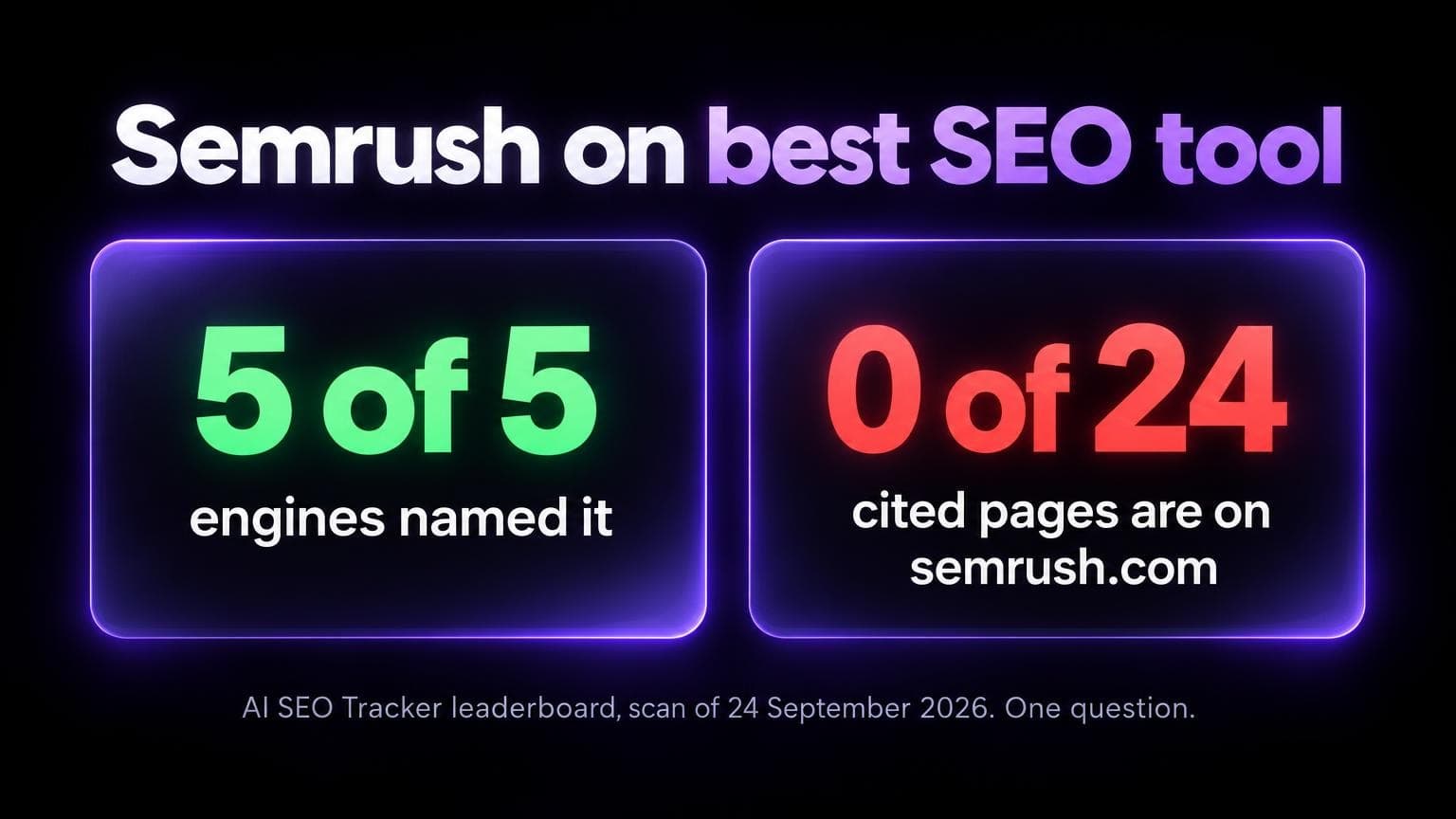
- Explain: sort each cited URL by owner. On the real scan, none of the 24 cited pages was on semrush.com, though three of five engines named Semrush first.
- Act: the source type tells you the fix.
Does AI name your brand? Check your site.
Your rank report says who beats you on Google.
It doesn't say who ChatGPT recommends.
Those are two different lists.
So here's the method:
- Write the questions your buyers ask.
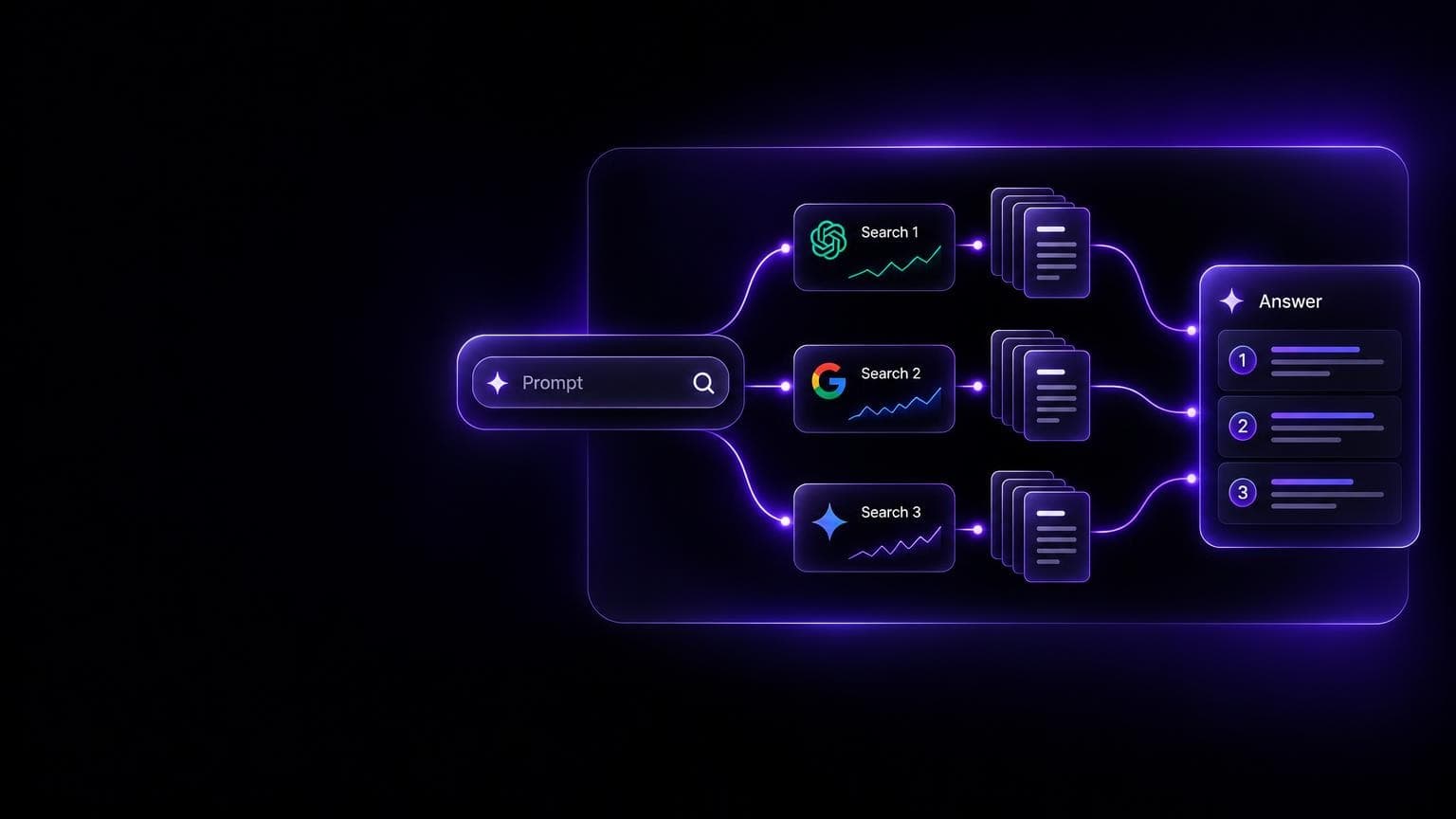
- Run each one several times on ChatGPT, Perplexity, Gemini, Copilot and Google.
- Log the brands each answer names and the URLs it cites.
- Count how often you and each competitor appear.
- Open the cited pages to see why the engine used them.
Why can't rank and backlink reports show this? Because the pages an AI assistant cites are mostly not the pages that rank.
Below: the steps, the formulas and a worked example on a real scan.
This is one part of competitive analysis for marketing. The search part is in SEO competitor analysis.
One warning. AI answers change from run to run. So some popular metrics do not hold up. I say which ones.
Why rank and backlink reports miss AI answers
I would not call classic competitive analysis obsolete.
But one assumption in it is out of date: that the brands above you in Google are the brands a buyer sees in an AI answer.
Three reasons.
1. AI assistants cite different pages from the ones that rank.
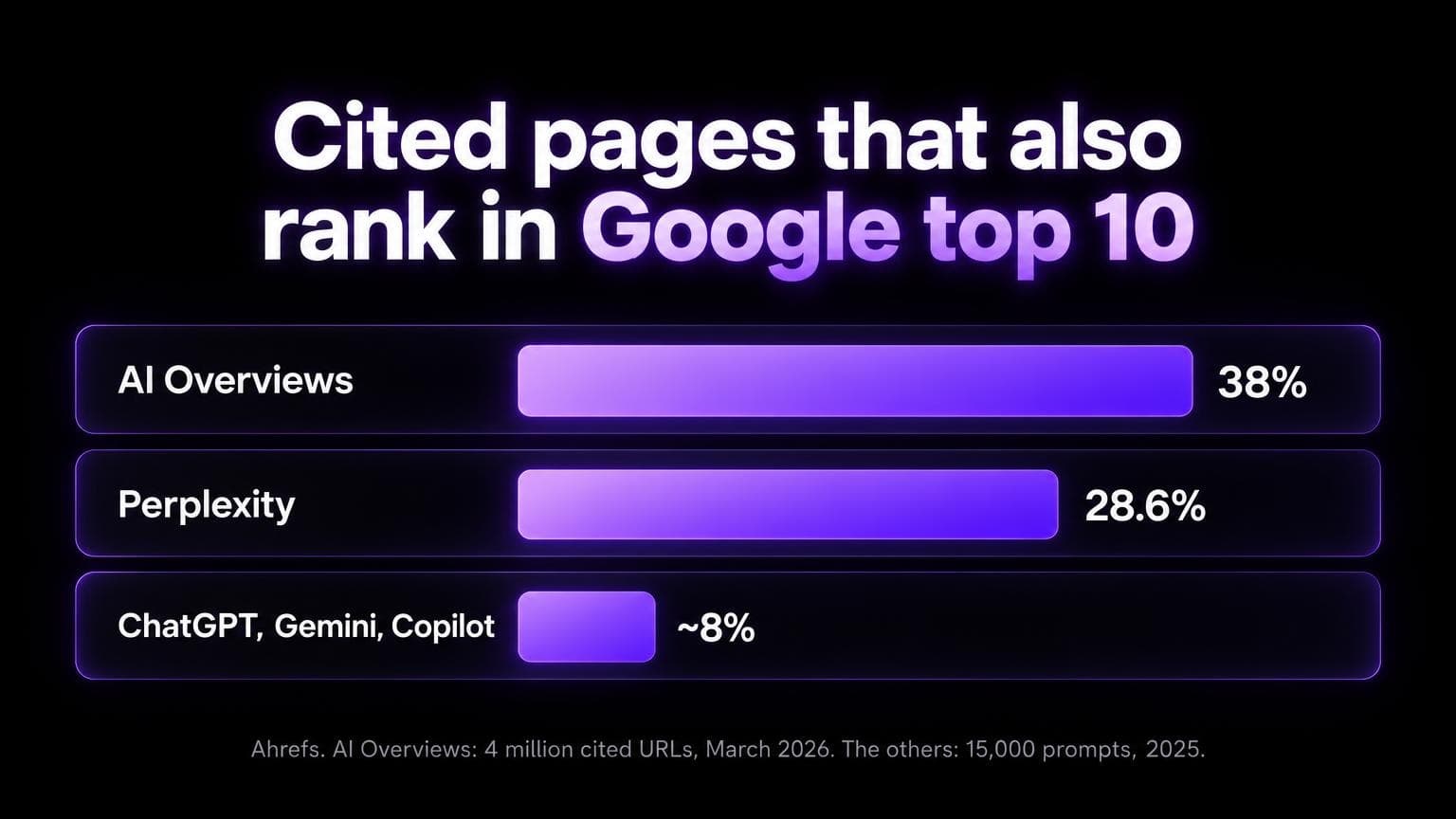
Ahrefs compared the URLs that ChatGPT, Gemini, Copilot and Perplexity cited for 15,000 long-tail queries with Google's results for the same queries (Ahrefs, 2025).
- On average: 12% were in Google's top 10.
- Perplexity: 28.6%. The highest.
- The other three: about 8%.
Google AI Overviews were not in that study.
In a March 2026 update, Ahrefs found 37.9% of cited URLs in the first 10 blocks of the results page (Ahrefs, 2026).
Its July 2025 study found about 76%. But Ahrefs improved its parser in between. So the numbers do not compare cleanly.
2. Links are a weak guide to who gets named.
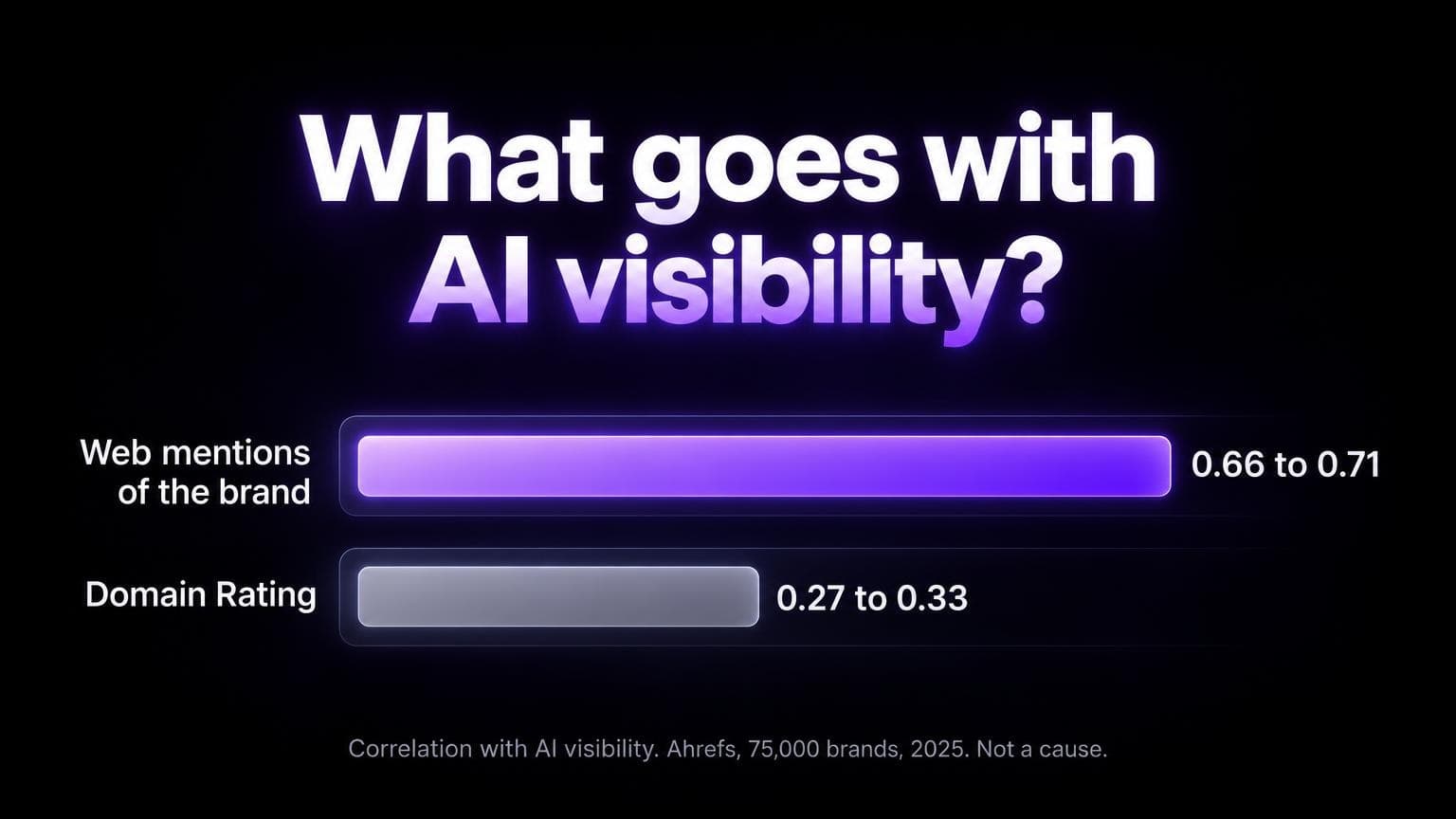
Across 75,000 brands, Ahrefs found (Ahrefs, 2025):
- Web mentions of a brand: a correlation of 0.66 to 0.71 with its AI visibility.
- Domain Rating: 0.27 to 0.33.
These are correlations. But a backlink gap measures the weaker signal.
3. First-party tools show only your own site.
Google says its Search Console generative AI reports reached all sites on 31 August 2026 (Google, 2026).
They cover your pages in AI Overviews and AI Mode. Not a competitor's.
So the competitor data must come from the answers.
What you get from each type of analysis
| Classic SEO competitive analysis | AI answer competitive analysis | |
|---|---|---|
| Question | Who ranks above me for this keyword? | Which brands does the engine name when a buyer asks? |
| Input | Keywords | Full questions, in the buyer's words |
| Data | Rank trackers and backlink indexes | Stored answers from prompts that you or a tool run |
| Unit | A position on a results page | A rate across many answers |
| Output | Keyword, link and content gaps | Prompts where a competitor is named and you are not, and their sources |
| Blind spot | Brands that AI names but that do not rank | Search demand, link data, prompts you did not run |
How to perform an AI brand visibility competitive analysis
Four steps collect the data.
Measure, explain and act come after.
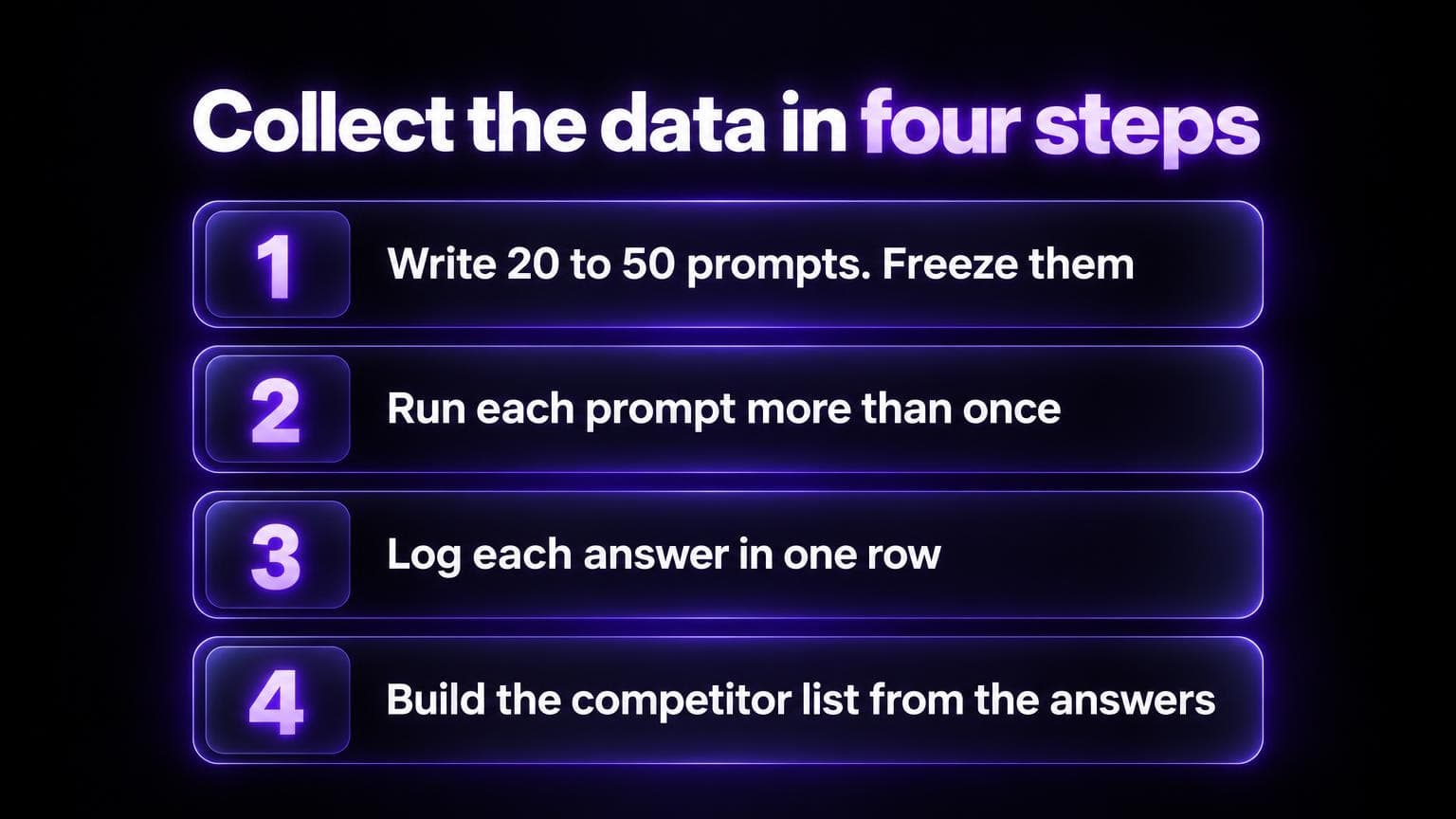
1. Write the prompt set
Write 20 to 50 questions in the words a buyer uses.
- A keyword: "project management software".
- A prompt: "what is the best project management software for a 10-person agency that bills by the hour".
Mix four types:
- Category: "best X for Y"
- Comparison: "A vs B"
- Problem: "how do I X without Y"
- Proof: "is X worth it for Y"
Take them from sales calls, support tickets and the question-style queries in Search Console.
The free Keyword research tool finds more from buyer questions. How to measure brand visibility in AI has the full method.
Then freeze the wording.
Change a prompt next month and you cannot tell if the answer changed or the question did.
Short on time? A first pass is 10 prompts on 3 engines, once each. 30 answers.
It shows which brands the engines name. It gives no rates.
2. Run each prompt more than once
Run each prompt on ChatGPT, Perplexity, Gemini, Copilot and Google (for the AI Overview).
Use a logged-out window or a temporary chat.
Add Claude or Google AI Mode by hand if your buyers use them. The AI SEO Tracker report does not scan them.
One run is a sample.
In the SparkToro and Gumshoe test, 600 volunteers ran 12 prompts 2,961 times (SparkToro, 2026).
For ChatGPT and Google's AI, the chance that two runs gave the same list of brands was under 1 in 100.
The author concluded that how often a brand appears across many runs is probably a reasonable metric.
So repeat each prompt.
I recommend at least three runs per engine, on different days.
That is a minimum. The study ran each prompt 60 to 100 times. So a rate from three runs is only a rough guide.
3. Log each answer
One spreadsheet row for each answer. Paste this header into row 1:
date,engine,prompt,prompt_type,run,brands_named_in_order,urls_cited,phrase_for_you,phrase_for_each_competitor
Copy three things:
- The brands, in the order the answer gives them
- Each URL in its source list
- The phrase used for each brand, such as "the budget option"
The phrases are the words a buyer reads about each competitor.
Mention or citation?
A mention names the brand in the text. A citation lists a URL as a source.
One can happen without the other. So log both.
4. Build the competitor list from the answers
Start with the names in the answers. Not your sales deck.
You get three groups:
- Known competitors.
- AI-only competitors. Brands you never meet in deals or in search.
- Sources. Publishers, review sites and forums that take the citations. You can get named on sources. But they are not competitors.
Then pick three to five brands. Keep that list fixed while you track.
Keep it open while you discover. A fixed, hand-picked list inflates your relative score and hides who really appears (ATAK Interactive, 2026).
The manual version is slow.
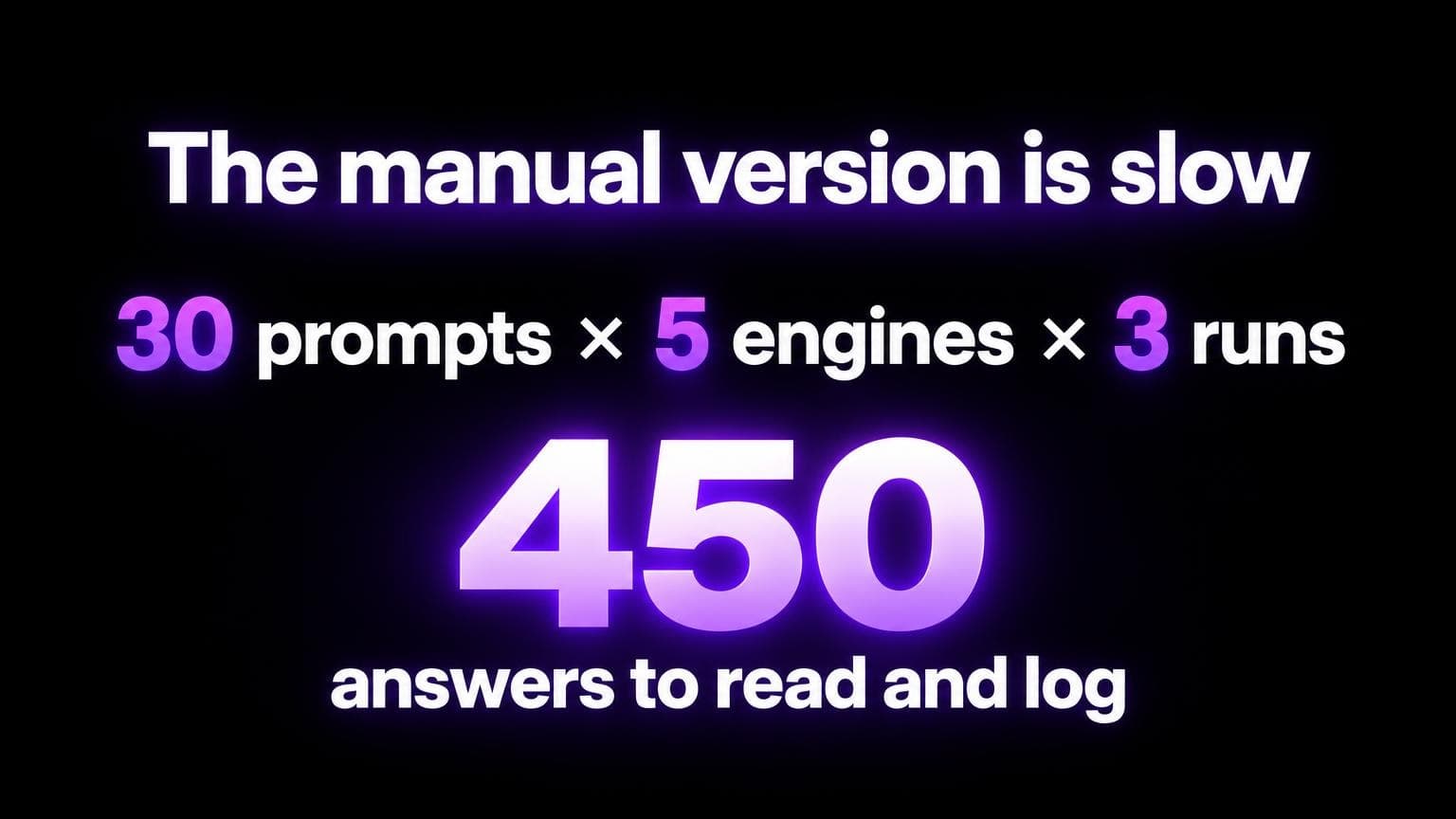
30 prompts on five engines with three runs each is 450 answers to read and log.
The AI SEO Tracker report does it for $49, one time. Up to 50 prompts written from your site. Five engines scanned each day for 7 days. You get mentions, citations, competitor visibility gaps and the sources each engine cited.
Measure mention rate and share of voice
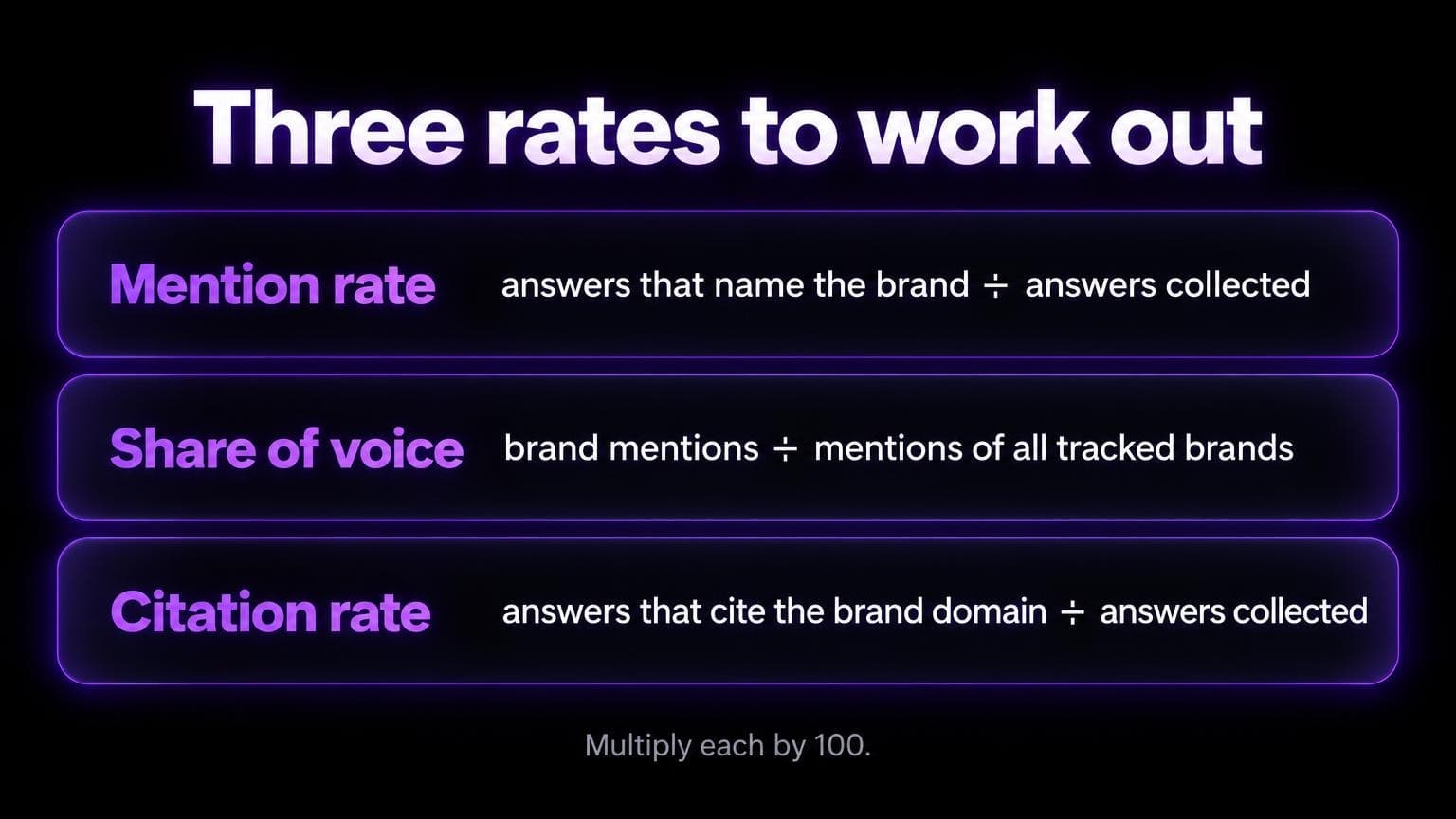
Mention rate = (answers that name the brand ÷ answers collected) × 100
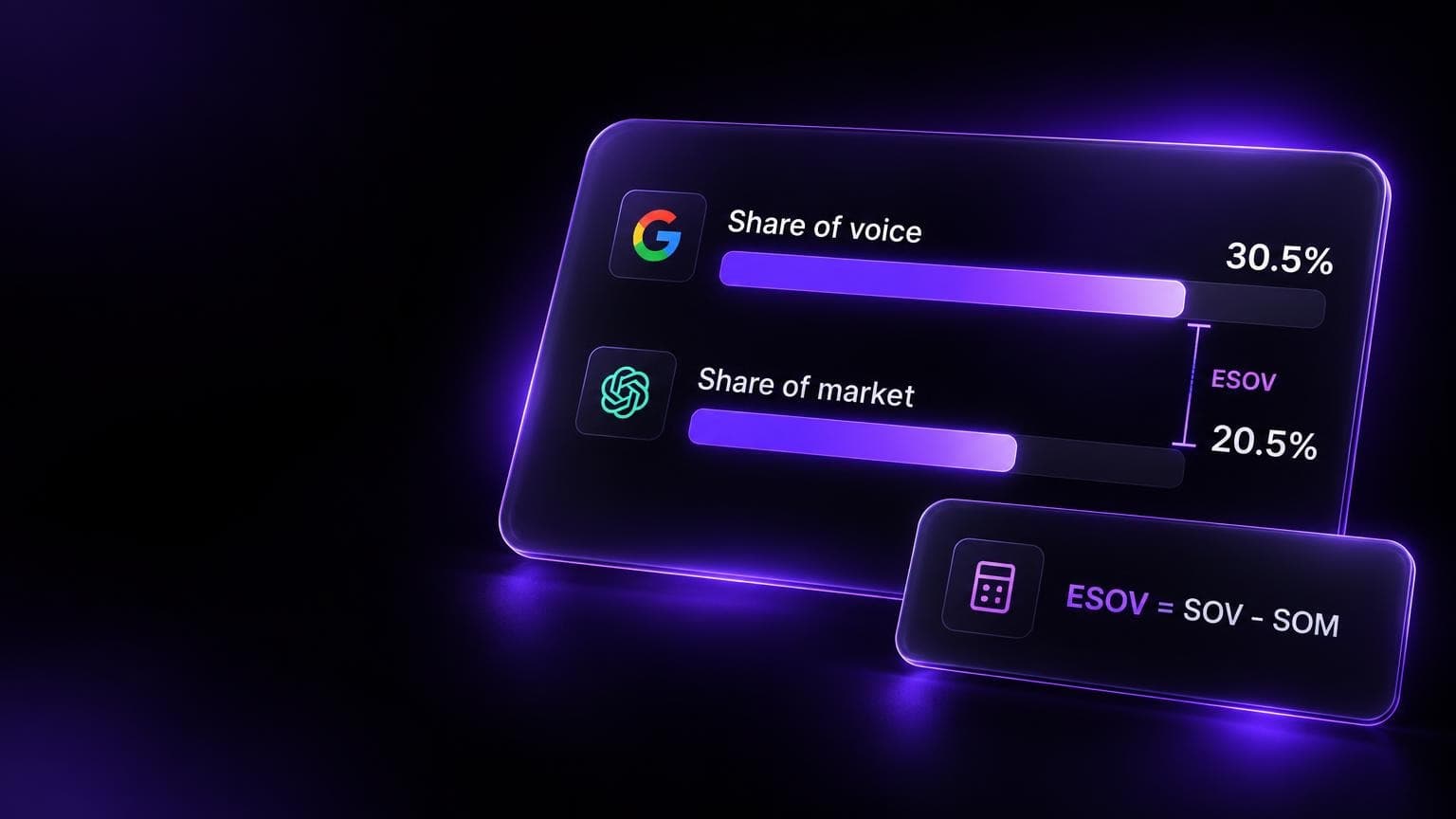
Share of voice = (mentions of the brand ÷ mentions of all tracked brands) × 100
Citation rate = (answers that cite a URL on the brand's domain ÷ answers collected) × 100
Gap prompts = the prompts where an answer names a competitor and no answer names you.
The rates tell you that you are behind.
The gap prompt list tells you where.
Two traps.
Check how a tool defines share of voice before you compare. (The FAQ shows why.)
And average position counts only the answers where the brand appeared. So a brand named once, in first place, averages 1.0. Pair it with the mention rate (SEOptimer, 2026).
Four rules keep the numbers honest:
- Do not report a rank from one answer. In the SparkToro data, two lists came out in the same order about 1 time in 1,000 runs. Record whether you were named first, later or not at all, as an average across runs.
- Do not blend the engines. A brand can lead on ChatGPT and be absent on Perplexity.
- Keep branded prompts out of the headline. "Is [your brand] good" will name you.
- State the set. Write down the prompts, engines, runs and dates next to each rate.
A mention is not a sale. So treat mention rate as a visibility number.
How to calculate share of voice covers other channels. Share of voice measurement covers the AI version.
A worked example on a real scan
AI SEO Tracker's leaderboard asked five engines "best SEO tool" on 24 September 2026.
The page lists 14 tools and the rank that each engine gave each one.
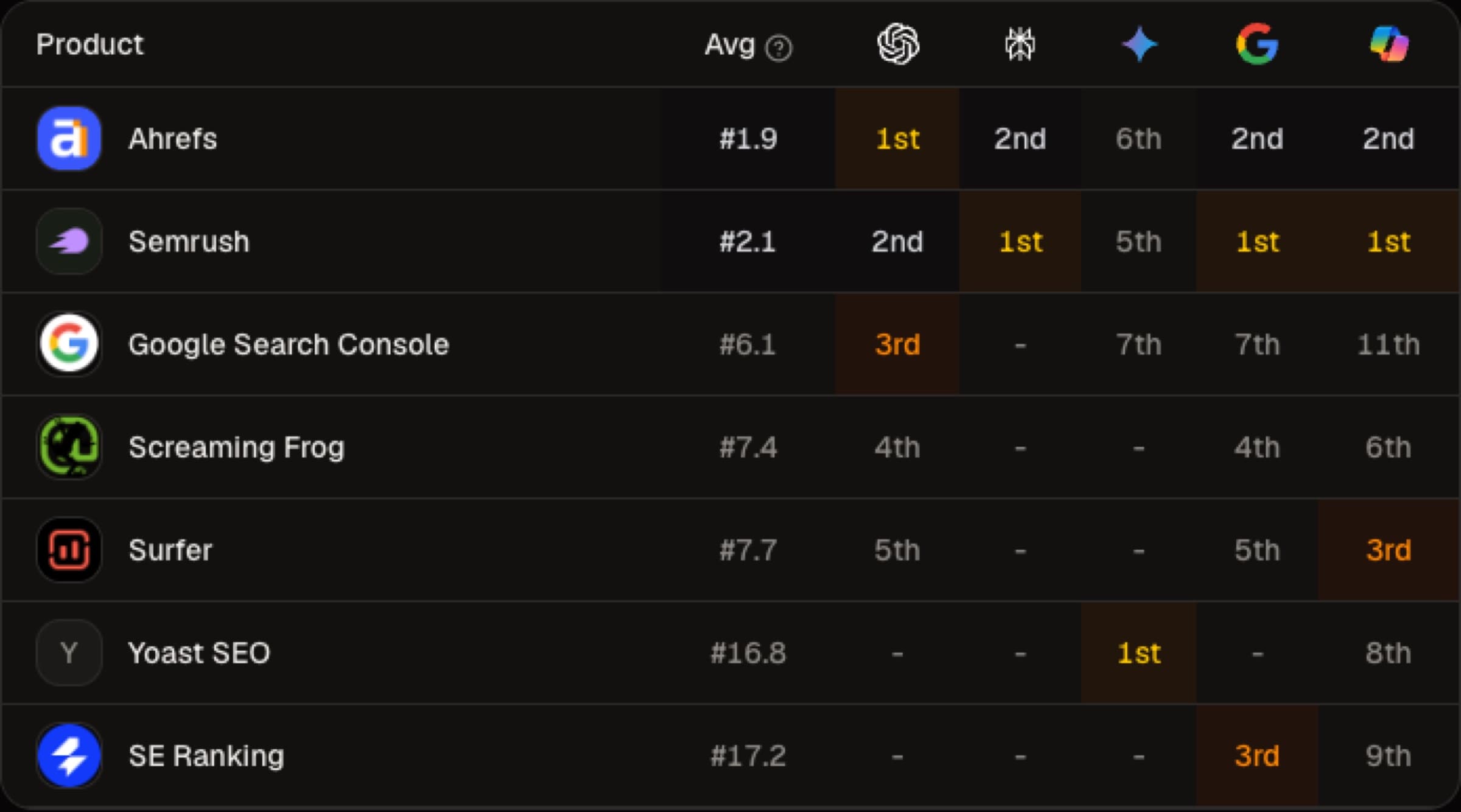
That is five answers and 31 mentions in all.
So a tool's share of voice is its mentions divided by 31.
Ahrefs: 5 ÷ 31 = 16.1%.
| Tool | Mention rate | Share of voice |
|---|---|---|
| Ahrefs | 100% (5 of 5 engines) | 16.1% |
| Semrush | 100% (5 of 5) | 16.1% |
| Google Search Console | 80% (4 of 5) | 12.9% |
| Screaming Frog | 60% (3 of 5) | 9.7% |
| Surfer | 60% (3 of 5) | 9.7% |
| Yoast SEO | 40% (2 of 5) | 6.5% |
| SE Ranking | 40% (2 of 5) | 6.5% |
| Each of the other 7 tools | 20% (1 of 5) | 3.2% |
What the numbers say:
- The engine changes the rank. Ahrefs is 1st on ChatGPT and 6th on Gemini. Semrush is 1st on three engines and 5th on Gemini.
- Gaps show up by engine. Take Surfer as "you". ChatGPT, Google AI Overview and Copilot name it. Perplexity and Gemini do not, although both name competitors. Those two engines are its gaps.
- Citation rate differs from mention rate. ChatGPT cited a page on ahrefs.com, so Ahrefs has a citation rate of 20%. No answer cited a page on semrush.com, so Semrush has 0%, with a mention rate of 100%.
The limit.
This is one question and one answer per engine, with product names that the leaderboard extracted.
The numbers show the method. Not a measured rate.
A second run would most likely give a different list.

Check who owns each cited page
You cannot see how an engine selects its sources.
But you can compare cited pages with yours.
Start with the owner:
- The competitor
- A third-party list or review site
- A community page (Reddit, a forum, YouTube)
- A reference page (Wikipedia, news)
Sort by who owns the domain. Not by page format.
A "best tools" post on a competitor's blog is the competitor's page.
What a real scan cited
The best SEO tool scan has 24 cited pages.
The leaderboard types each one automatically. So a type can be wrong. It labels:
- 14 as listicles
- 3 as comparison pages
- 1 as a vendor page (ahrefs.com)
Now look at Semrush.
1st on three engines. 2nd on a fourth. Yet no cited page is on semrush.com.
Perplexity named Semrush first and Ahrefs second. It cited ten pages: six listicles, two HubSpot posts, a G2 page and a TechRadar article.
None is on semrush.com or ahrefs.com.
The engines mostly name vendors and cite other people's pages.
So the fix for a gap prompt may sit on a third-party list.
And 21 of the 24 pages were cited by one engine only.
The wider picture.
Across all 343 of the leaderboard's "best X" questions on 2 October 2026, the mix of cited pages was:
| Cited page type | All 343 questions | 36 Software and AI questions |
|---|---|---|
| Listicles | 77% | 81% |
| Vendor product pages | 10% | 9% |
| Top cited host | youtube.com 5% | zapier.com 9% |
These are shares of cited pages for mostly consumer questions. The types are automatic. The figures move with each monthly scan.
Then compare the page with yours
Answer these for each competitor page that the engines cite. Then for your equivalent page.
- Does the page answer the prompt in plain text near the top?
- Does it state facts that an engine can quote, and show a recent date? Price, who the product is for, a feature list, a comparison table.
- Can a machine read the text? Facts inside an image, or behind a "contact us" form, are not there to read. The free Page Inspector shows what AI can read on a page.
- Can the crawler reach the page? OpenAI states that a site that opts out of
OAI-SearchBotis not shown in ChatGPT search answers, but can still appear as a navigational link (OpenAI). Perplexity tells site owners to allowPerplexityBot(Perplexity). For AI Overviews and AI Mode, Google requires that the page is indexed and eligible for a snippet (Google).
Look at the text before you look at schema.
In May 2026, Ahrefs added JSON-LD schema to 1,885 pages and compared them with 4,000 control pages (Ahrefs, 2026).
- AI Mode and ChatGPT: no clear citation gain.
- AI Overviews: a 4.6% fall, which Ahrefs says it cannot pin on schema.
Each page already had at least 100 AI Overview citations. So the test says nothing about pages that have none.
Turn the gaps into an action plan
For each gap prompt, look at the sources that the engines cited.
The source type sets the action.
| What the answers cite | What it tells you | Action |
|---|---|---|
| Third-party lists and review sites that name the competitor | You are missing from the pages the engine reads | Ask the authors to add you. Get listed on the review sites that appear. How to get into listicles has the pitch. |
| The competitor's own page | They have a page that answers this prompt. Yours is missing or hard to read. | Write or fix the equivalent page. Put the answer and the facts in plain text. |
| Reddit, forums or YouTube | The engine uses community discussion for this prompt | Join the threads that appear. Make the video. |
| Your page, but the answer recommends a competitor, or describes you wrongly | Your page, or a third page, is evidence for someone else | Read how the answer describes you. Fix your page so it says who the product is for. If another page is the source, ask for a correction. |
| Other people's pages only, and the answer names you | The engine knows you from lists, as it knew Semrush on the scan above | Publish one page with the facts an engine can quote, such as price and who it is for. Ask the cited lists to describe you correctly. |
On the third row: in the Ahrefs study of 75,000 brands, mentions on YouTube had the strongest correlation with AI visibility of all the factors tested.
That does not prove that a video causes a mention.
Then put the list in order:
- Fix access first. A blocked crawler is the cheapest reason to be absent. The correction is often one line in robots.txt.
- Start with the prompts nearest to a purchase. Comparison and "best for" prompts come before "what is" prompts.
- Prefer gaps that repeat. A gap on four engines matters more than a gap on one.
After each change, run the same prompts again. Compare with the baseline.
You cannot know how fast an engine picks up a change. So the re-run is the test.
How to get cited in AI answers covers the page work.
Frequently asked questions
How do you perform an AI brand visibility competitive analysis?
Write 20 to 50 buyer prompts and freeze them.
Run each one several times on each engine. Log the brands named and the URLs cited. Work out mention rate and share of voice.
Then open the cited sources for the prompts where a competitor appears and you do not.
The comparison table shows how this differs from SEO analysis.
What role does AI play in competitive analysis?
Two roles.
AI answers are a channel that you analyze.
A chatbot is also a tool for the work. But check every number it gives you against a source. ChatGPT for SEO covers where it is reliable.
How often should I run a competitive analysis?
I recommend a re-run of the frozen prompt set each month. And a full review each quarter.
The source mix can move fast. In Semrush's data, ChatGPT cited Reddit in close to 60% of responses in early August 2025. By the middle of September: about 10% (Semrush, 2025).
Can I do this for free?
Yes. The engines and a spreadsheet are enough. The cost is your time.
Search Console is a free Google service, but it shows only your own site.
AI SEO Tracker has no free scan. The report is $49, one time.
Why do two tools report different share of voice?
The term has two meanings.
- Share of mentions: a brand's mentions divided by all brand mentions. ATAK Interactive does this. So does this post.
- Share of prompts: the share of prompts where the brand appears. Cintra does this.
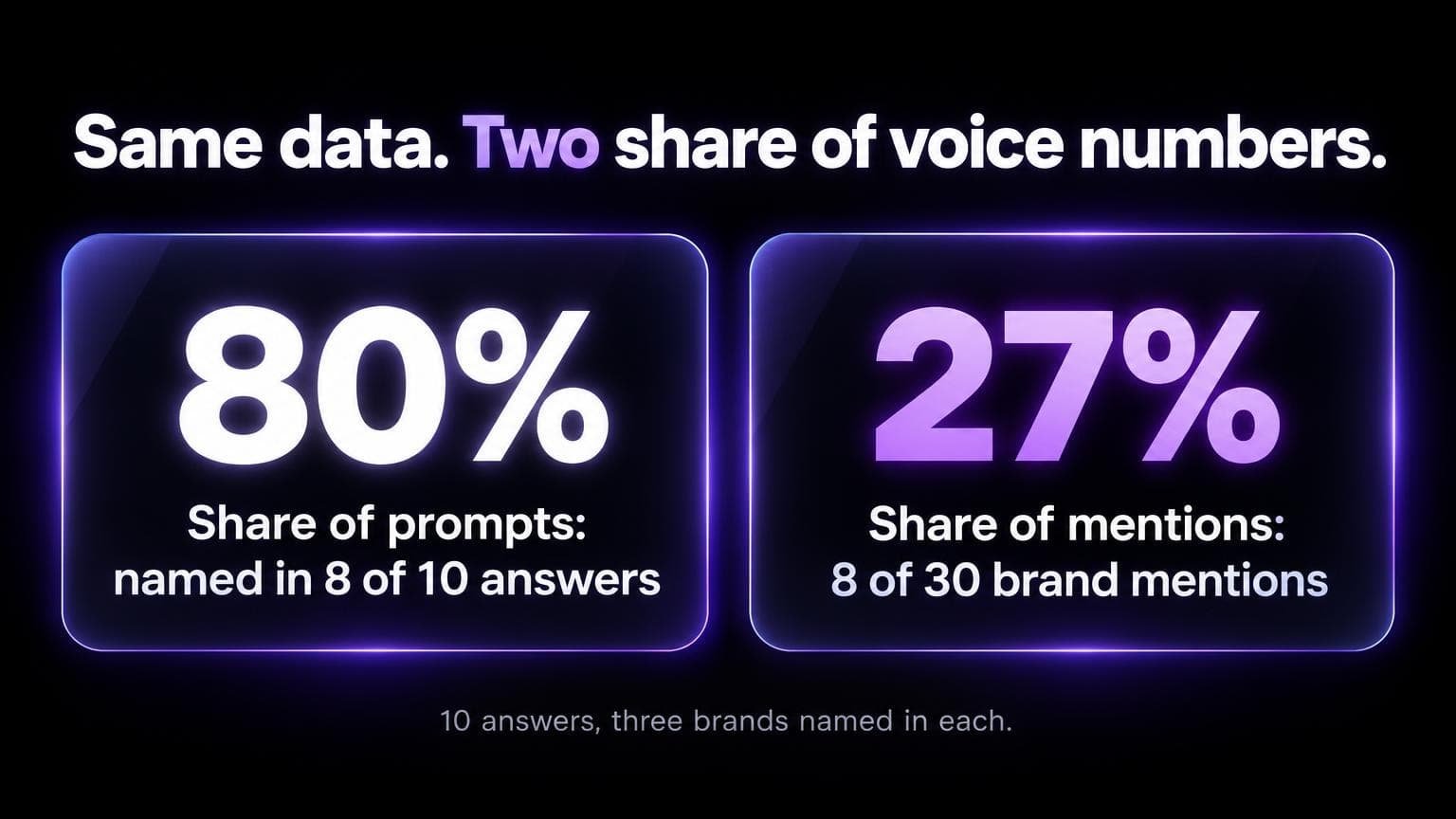
If each of 10 answers names three brands, a brand named in 8 of them scores 80% on the prompt definition. And 8 ÷ 30 = 27% on the mentions definition.