



TL;DR
- The shift: you pick prompts, not keywords. Full questions with the buyer's situation in them.
- No volume data: no engine publishes how often a prompt is asked. So you start from your buyers, not from a tool.
- Where to find them: five sources. Sales calls first.
- Which ones: three buyer stages and four prompt types. In my reading, solution-aware prompts name brands most often.
- The rules: 20 to 50 prompts, one per intent, frozen wording. Plus our own real set.
Does AI name your brand? Check your site.
Keyword research has a number for everything.
Volume. Difficulty. Cost per click.
AI search has none of that.
Nobody tells you how many people asked ChatGPT your question last month.
So how do you choose what to track?
You start from your buyers. And you follow a few rules.
This guide has the rules, the sources, and the exact prompt set we track for our own product.
A keyword is not a prompt
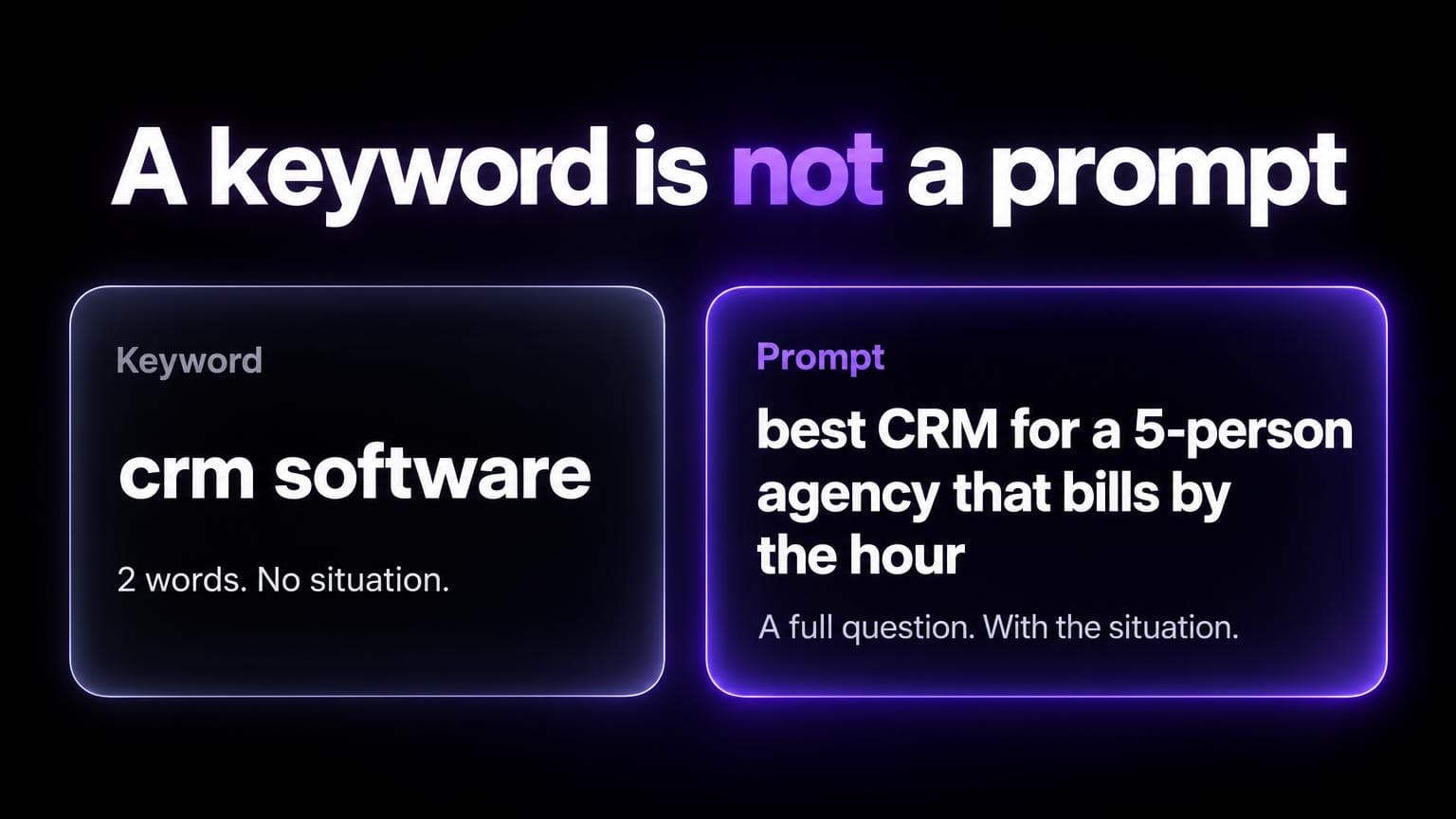
A keyword is a few words.
A prompt is a sentence. Often with the person's situation in it.
- Keyword: "crm software"
- Prompt: "best CRM for a 5-person agency that bills by the hour"
That changes what you write for.
And it changes what gets cited. In a Semrush analysis of one brand, the brand's Google keywords averaged four words. The AI prompts it showed up for averaged eight.
One brand. But the direction is clear.
There is no prompt volume
This is the part that trips up SEOs.
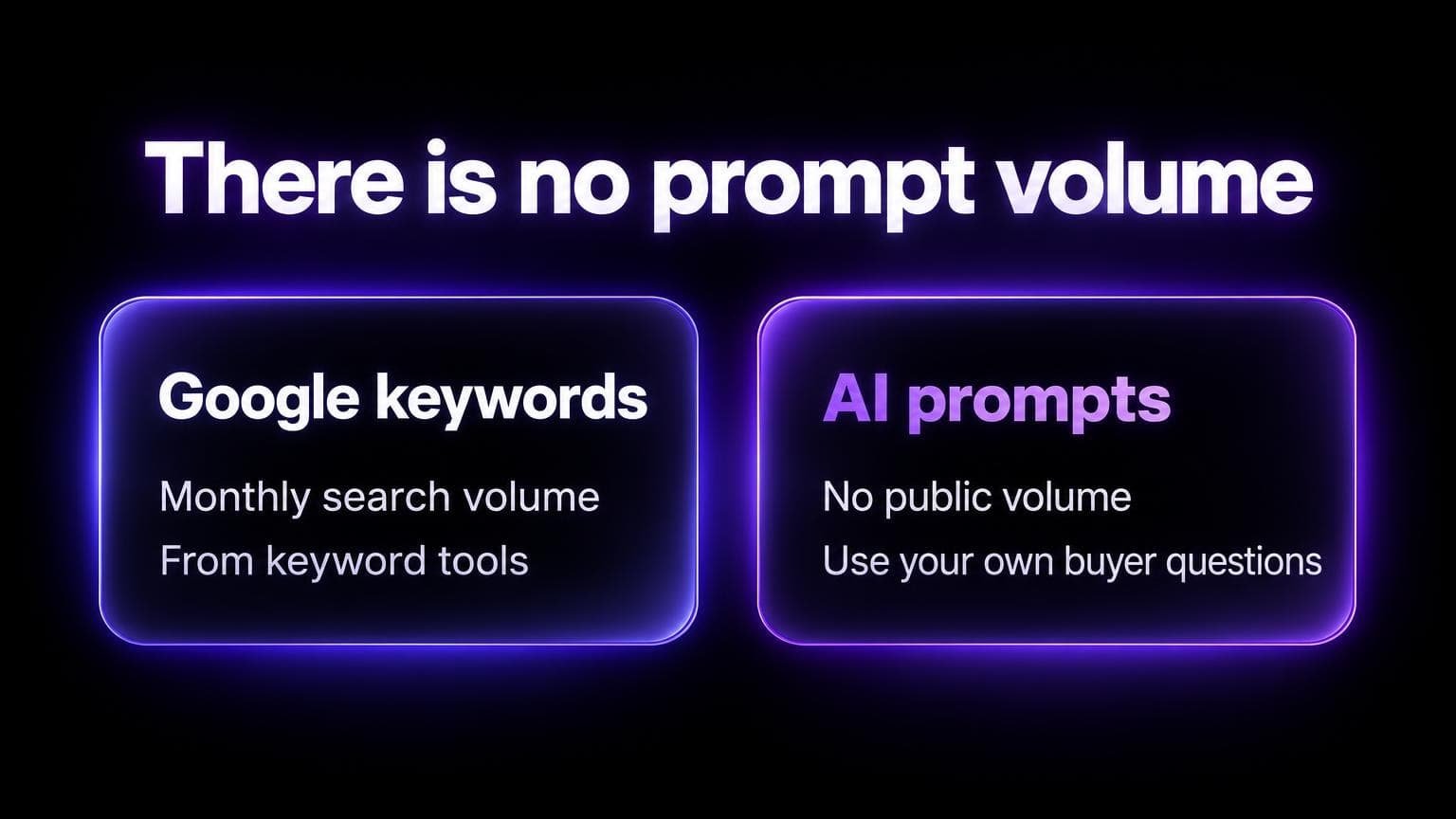
Google gives you search volume. Keyword tools build on it.
I know of no AI engine that publishes how often a prompt is asked.
Some tools show a "prompt volume". Ask where it comes from. It's an estimate.
Our own keyword research tool has no volume either. It writes prompts from your site's text with a language model. Useful for ideas. Not a demand figure.
Good news: you don't need the exact wording.
In a SparkToro and Gumshoe study, survey volunteers wrote 142 prompts for the same need. The wording had little in common.
Four headphone brands still showed up in 55% to 77% of the 994 answers.
So cover the intent. Don't chase the phrasing.
Where good prompts come from
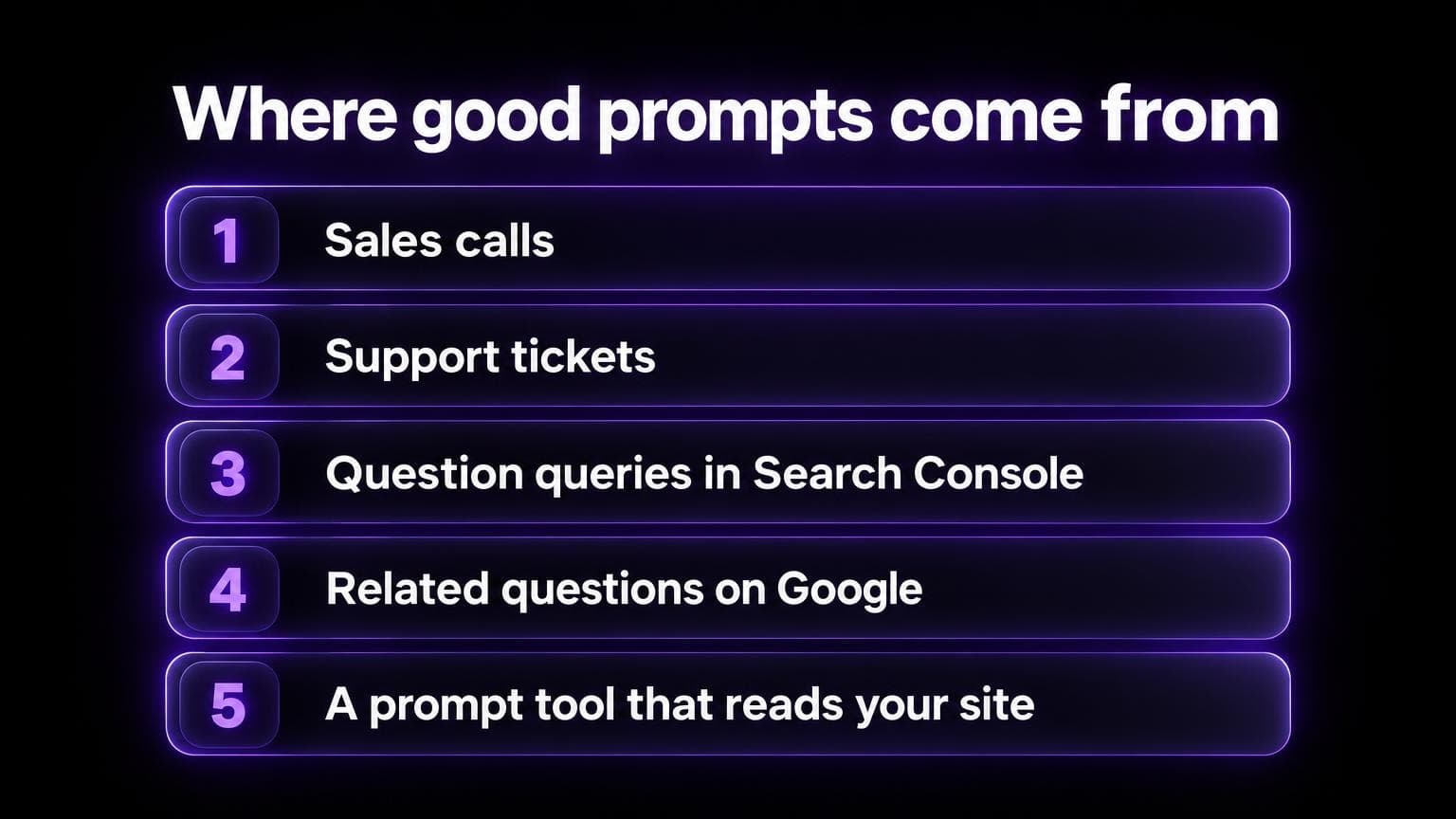
1. Sales calls.
What did the last ten buyers ask before they bought? Write it down the way they said it.
2. Support tickets.
The problems people have right before they need you.
3. Question queries in Search Console.
Open the Performance report. Filter queries with a custom regex for long ones:
^(\S+\s+){9,}\S+$
That matches queries of ten words or more. Those read like prompts. More filters like this.
4. Related questions on Google.
Search your category. Read the "People also ask" box. Each question is a candidate.
5. A prompt tool that reads your site.
Our free keyword research tool does this. You enter your site and create a free account. It suggests prompts in three buyer stages, each with a relevance score.
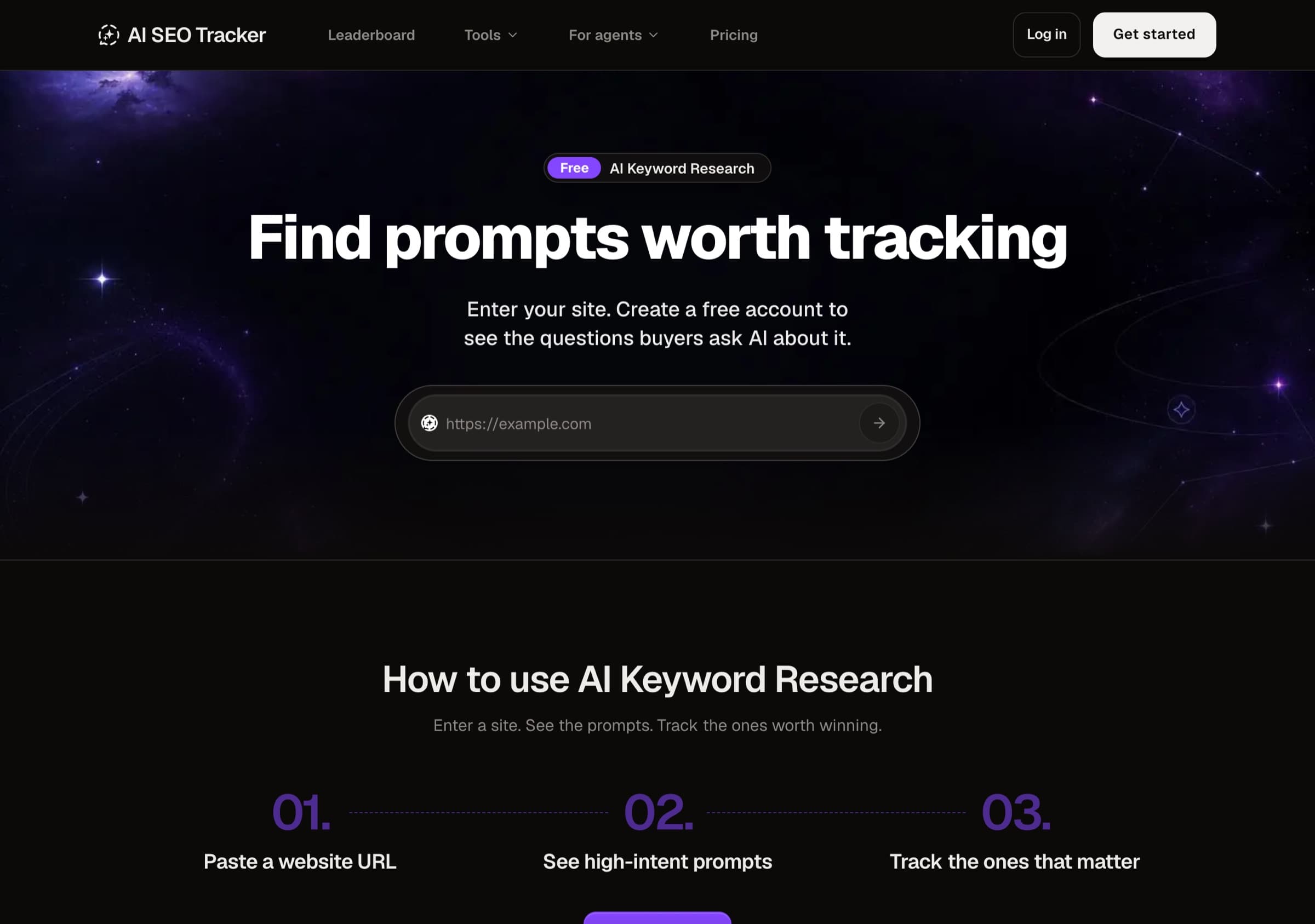
Treat its output as a first draft. It reads your website. It hasn't heard your sales calls.
Which prompts to pick
Two ways to sort them. Use both.
By buyer stage
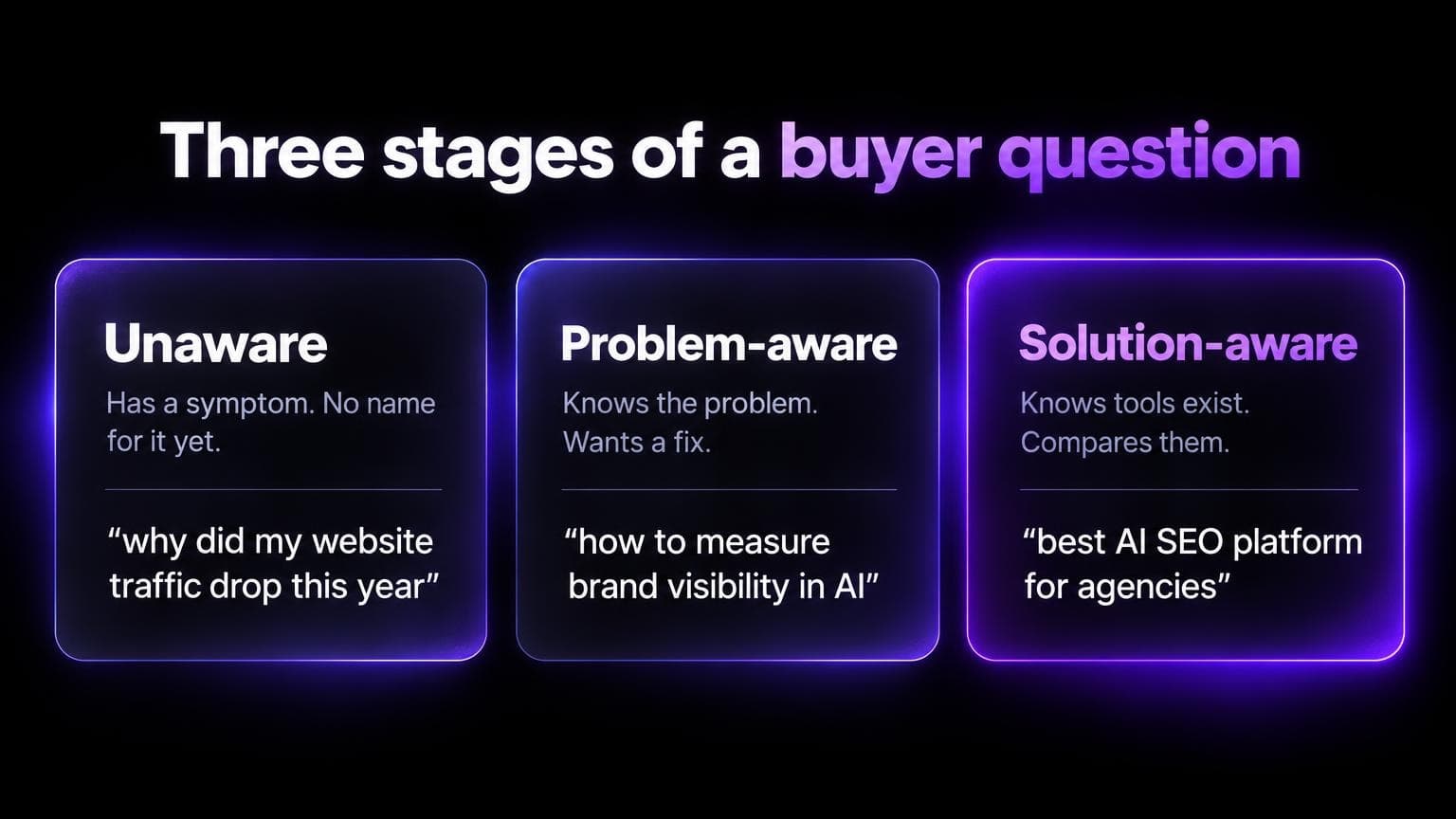
- Unaware. They have a symptom. They don't know your category exists.
- Problem-aware. They know the problem. They're looking for a way to fix it.
- Solution-aware. They know tools exist. They're comparing.
Which stage names brands? My reading: mostly the third.
Ask "best AI SEO platform for agencies" and the answer is a list of products.
Ask "why did my traffic drop" and you get an explanation. Maybe no brand at all.
So weight your set toward solution-aware prompts. Keep a few from the other two stages to see if you show up early.
By type
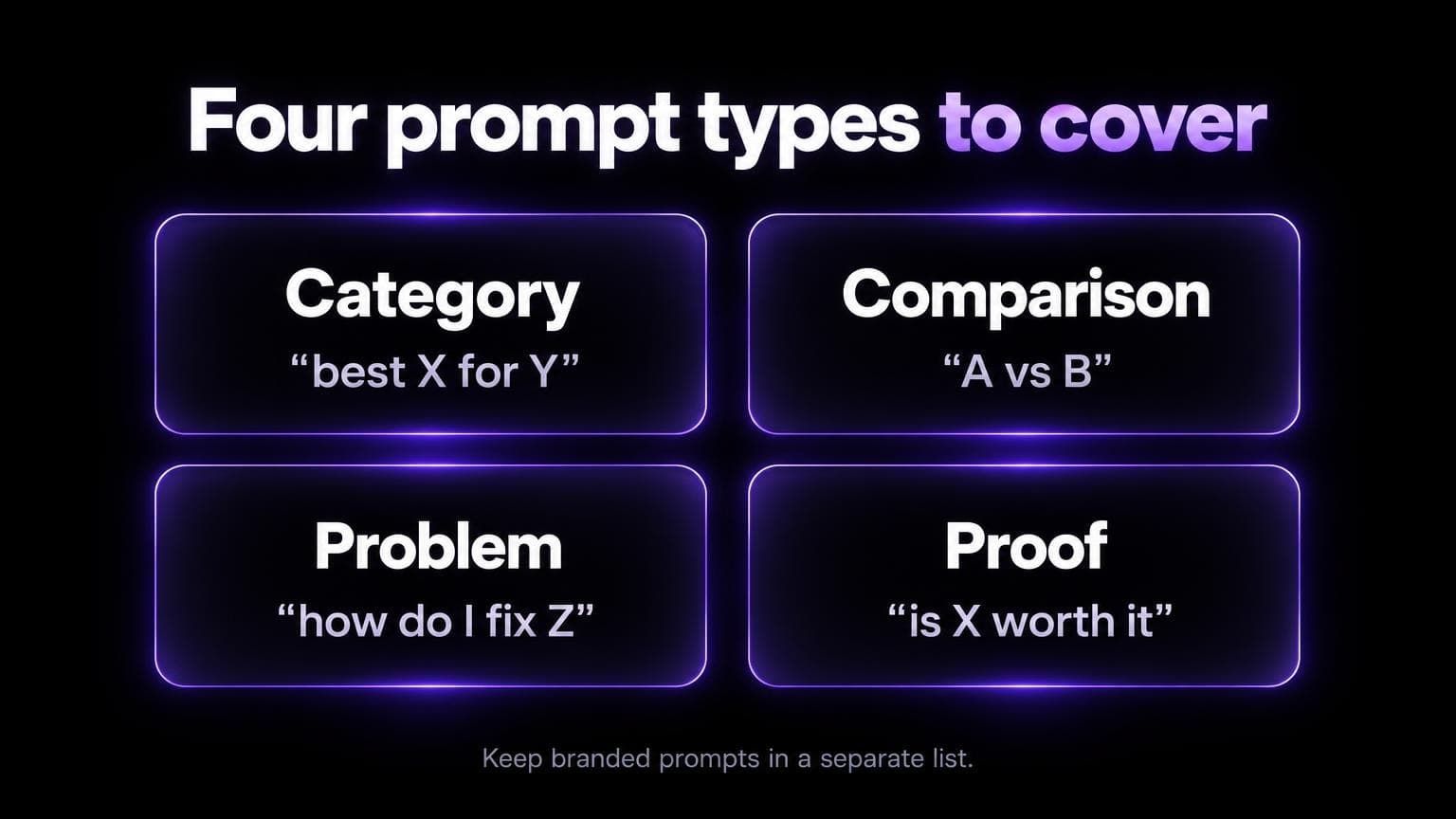
- Category: "best X for Y"
- Comparison: "A vs B"
- Problem: "how do I fix Z"
- Proof: "is X worth it"
And one more list, kept apart: branded prompts. "Is [your brand] good?"
Those name you by definition. Mix them into the main set and your mention rate looks better than it is.

Six rules for a prompt set
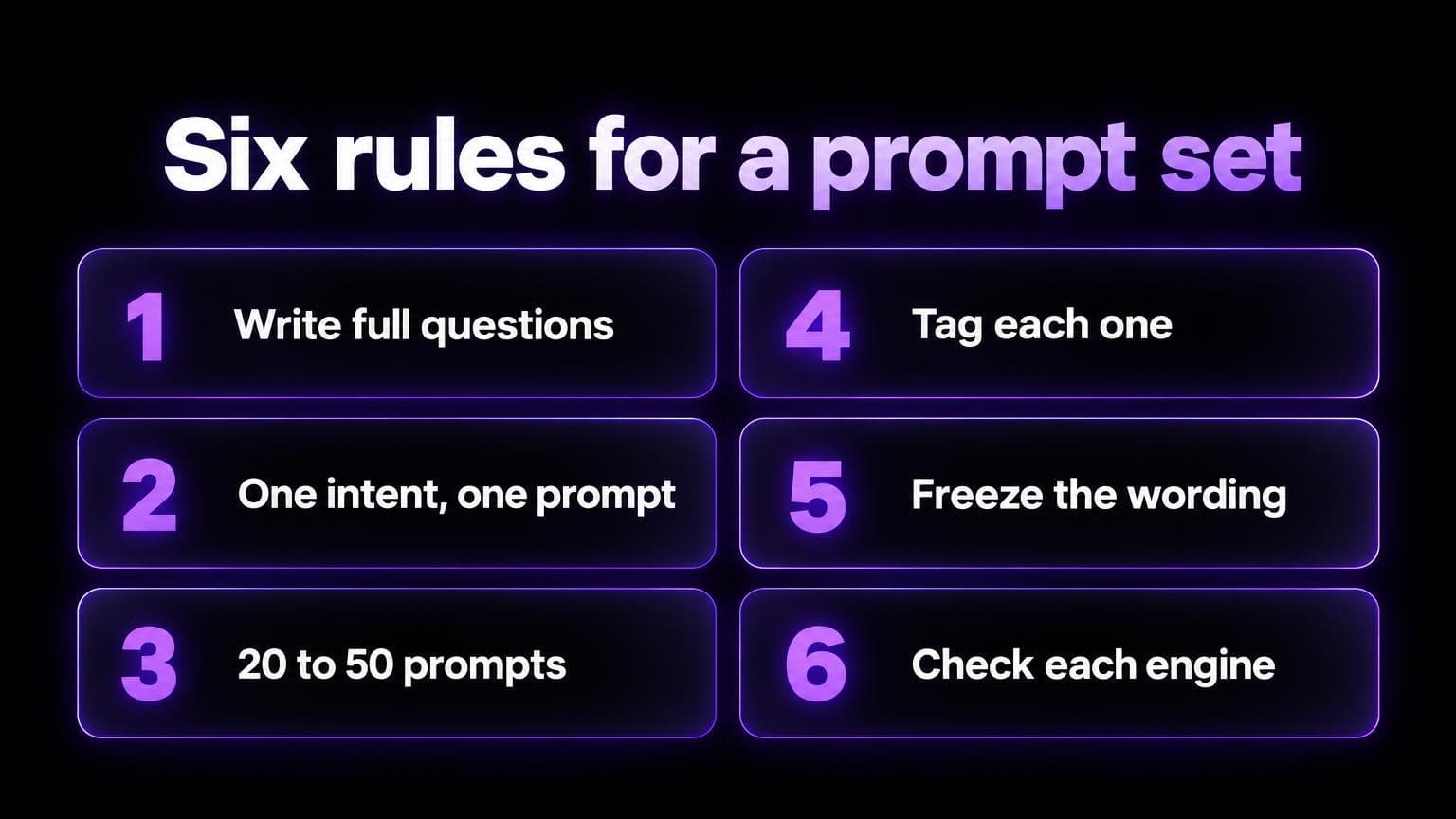
1. Write full questions.
The way a person types to a chatbot. With the situation.
2. One intent, one prompt.
Not ten variants of the same question. The SparkToro data above says the wording matters less than you think.
3. 20 to 50 prompts.
Enough to cover each intent. Few enough that you can read every answer.
I'd take 30 good prompts over 300 thin ones.
4. Tag each one.
Stage and type. So you can report "we're missing on comparison prompts" and not only a single number.
5. Freeze the wording.
Change a prompt next month and you can't tell what moved: the engine, or your question.
Need a new prompt? Add it. Don't edit an old one.
6. Check each engine.
One engine's answer tells you little about the next.
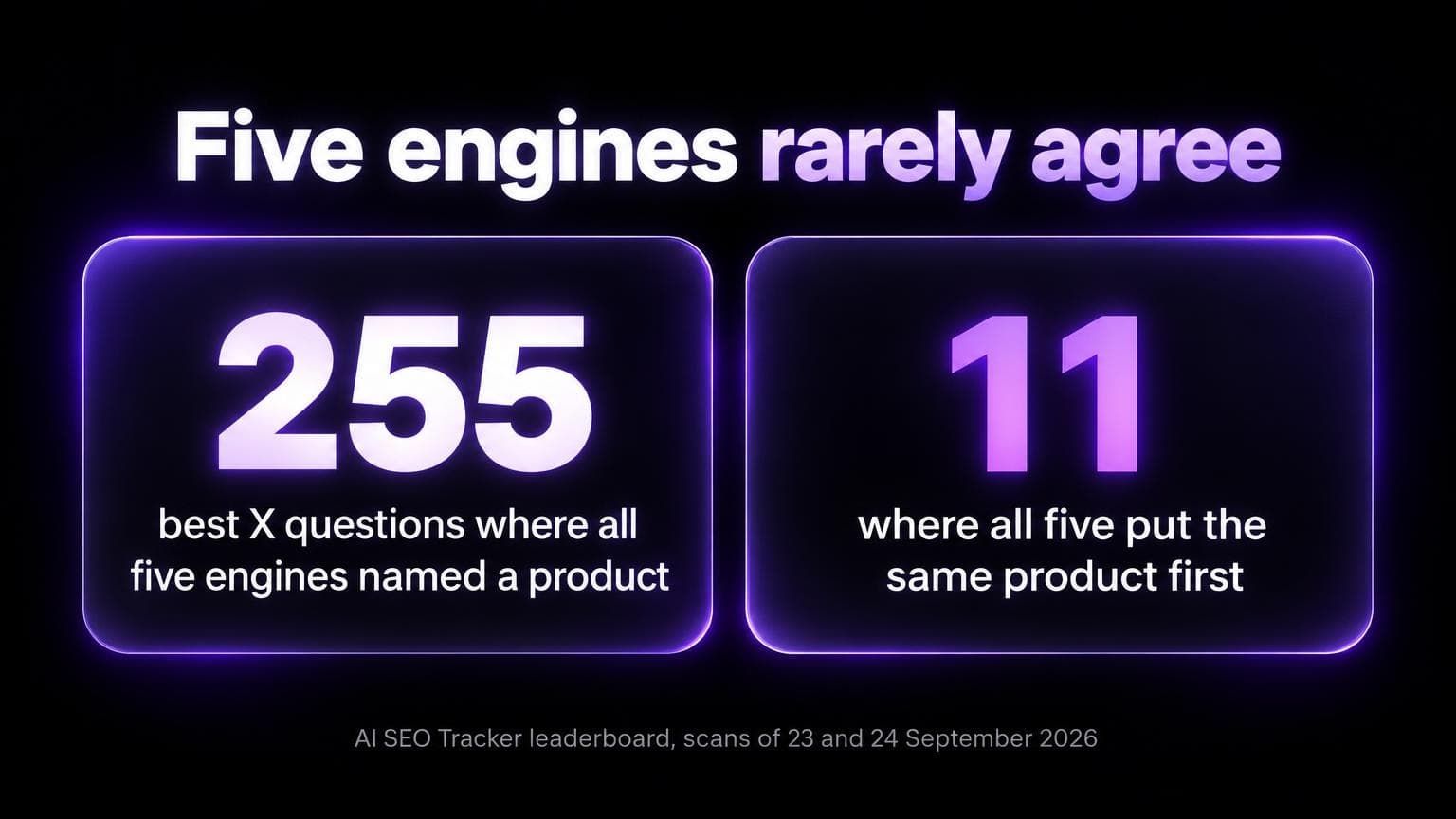
On our leaderboard, all five engines named a product on 255 "best X" questions. They agreed on first place on 11.
So a prompt isn't "won" until you've looked at each engine.
A real prompt set: ours
Most guides give you a framework and stop.
Here's a real set. The 7 prompts we track for AI SEO Tracker, with the result.
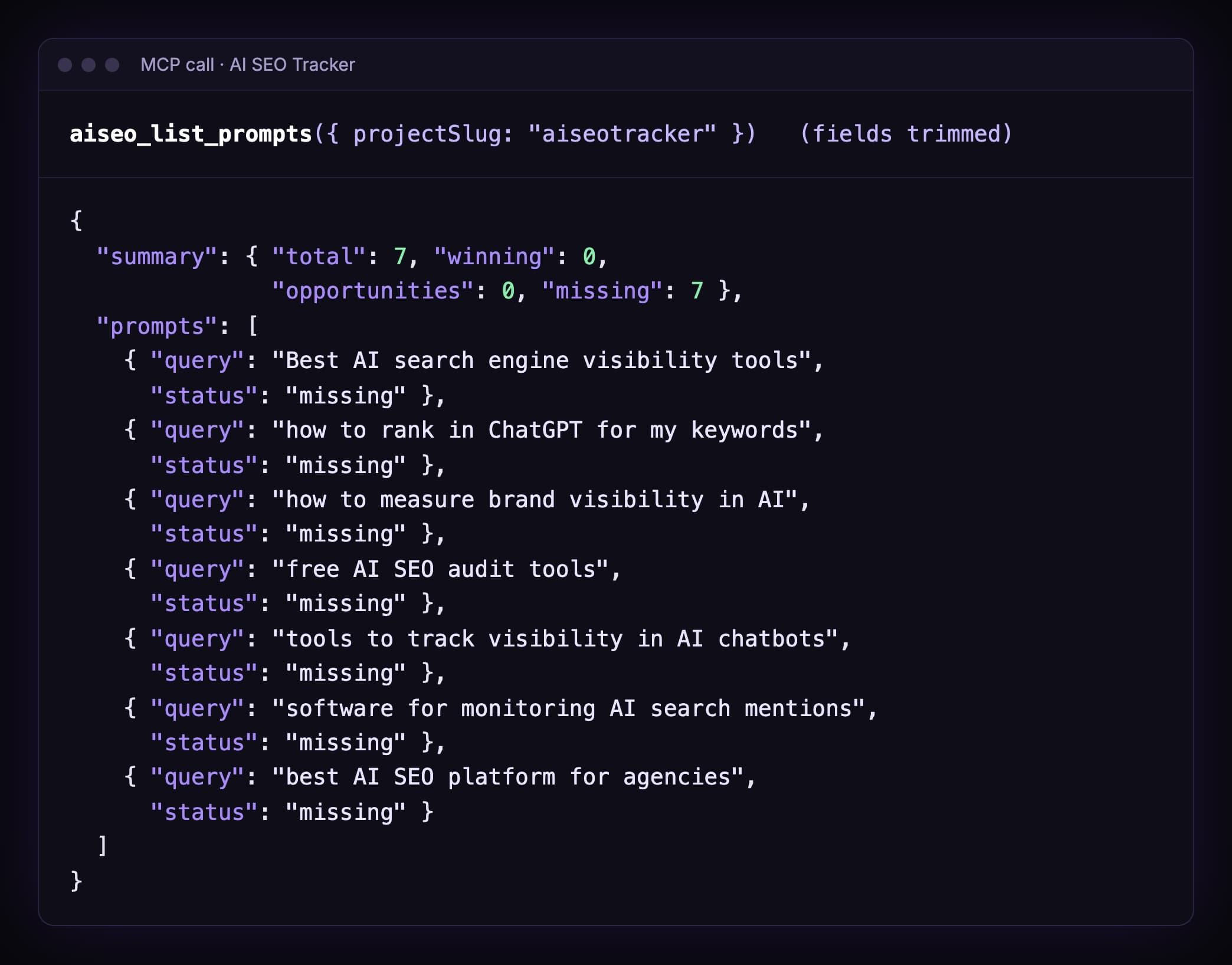
| Prompt | Stage | Type |
|---|---|---|
| Best AI search engine visibility tools | Solution-aware | Category |
| tools to track visibility in AI chatbots | Solution-aware | Category |
| software for monitoring AI search mentions | Solution-aware | Category |
| best AI SEO platform for agencies | Solution-aware | Category |
| free AI SEO audit tools | Solution-aware | Category |
| how to rank in ChatGPT for my keywords | Problem-aware | Problem |
| how to measure brand visibility in AI | Problem-aware | Problem |
Now grade it against the rules. Honestly.
- Full questions? Partly. Several read like keywords. "free AI SEO audit tools" is a keyword with no situation.
- One intent each? No. Three of them are the same intent: "tools that track AI visibility".
- 20 to 50? No. Seven.
- All types? No. No comparison prompt. No proof prompt.
So our own set breaks three of the six rules. And it covers only two of the four prompt types.
It still told us something useful. The latest answers name us on 0 of 7. And one list, Zapier's, is cited for 3 of the 7.
But a better set would tell us more.
Do as I say here, not as we did.
Add your prompts to a tracker
Once you have the list, you need answers. On each engine. More than once.
By hand: a sheet with one row per prompt, engine and date. The full method.
With our report: $49 once. Up to 50 prompts on ChatGPT, Perplexity, Gemini, Copilot and Google AI Overviews, scanned daily for 7 days. It suggests prompts from your site. You edit the list and add your own.
With an agent: our MCP server has one write tool, aiseo_add_prompts. It adds up to 20 prompts per call. Only when you ask it to.
Add these prompts to the project for [your-domain.com] with aiseo_add_prompts. Use the exact wording. Don't add any others:
1. best invoicing software for freelancers who bill by the hour
2. [your next prompt]
After the first scan, look for one thing.
Prompts where no engine names any brand.
My rule: those aren't buying prompts. Move them to a separate list, and put a buying prompt in their place.
FAQ
Is keyword research dead for AI search?
No. Keywords still tell you what people search on Google, and AI Overviews sit on Google.
But for chat engines you track prompts. Longer, and with more context.
How many prompts should I track?
20 to 50 to start. One per intent.
Are there tools that show prompt volume?
Some show a number. No engine publishes one, so it's an estimate. Ask the vendor how they get it.
Should I track branded prompts?
Yes, in a separate list. They tell you what AI says about you. They don't tell you if AI recommends you to someone who hasn't heard of you.
How often should I change the set?
Rarely. Add prompts when you launch something. Keep the old ones frozen so the trend stays readable.
Can I use Google keywords as prompts?
As a start. Rewrite each one as the question a buyer would type, with their situation in it.