
Meta Description: Learn how to perform an accurate share of voice calculation. This practical guide covers formulas, tools, and common mistakes to avoid.
Share of voice seems simple: it’s your brand’s visibility compared to competitors. The classic formula is (Your Brand Mentions ÷ Total Market Mentions) x 100. This number is supposed to tell you how much of the conversation you own.
But that formula is broken.
Why Your SOV Calculation Is Probably Wrong

Most marketers track share of voice, but their method is stuck in the past. Just counting brand mentions is a blunt instrument.
Your real SOV isn't about volume; it’s about appearing in the conversations that drive revenue.
Relying on a distorted number leads to bad strategy. You might pour money into channels that generate noise but no real impact. Or you might completely miss where your audience actually listens. The core issue is that many calculations are built on flimsy, incomplete data, giving you a funhouse mirror reflection of your performance.
The Limits of the Basic Formula
That classic formula—your mentions divided by the total—is a decent starting point, but it has massive blind spots.
It makes one critical error: it assumes every mention is created equal.
A throwaway comment on social media is not the same as a feature in a major industry publication. This simplistic approach misses the context of a mention entirely. A quick look at different SOV metrics shows why relying on just one is so misleading.
Common SOV Metrics and Their Blind Spots
| SOV Metric | How It's Calculated | What It Misses |
|---|---|---|
| Keyword Rankings | Your average rank for target keywords vs. competitors. | Ignores unbranded search, social media, and offline talk. |
| Paid Impressions | Your ad impressions vs. total potential impressions in an auction. | Blind to organic search, PR, social mentions, and content. |
| Social Mentions | Number of times your brand is mentioned on social media vs. competitors. | Lacks context on sentiment, reach, and the influencer’s authority. |
| Media Mentions | Volume of press coverage vs. the competition. | Doesn't account for publication authority or article sentiment. |
Fixating on a single metric means you're operating with incomplete intelligence. You might dominate paid search but lose the war for organic trust.
A true share of voice calculation must go beyond simple counting. It requires a smarter approach that weighs the quality, context, and impact of each mention, not just the raw quantity.
Take the consumer packaged goods (CPG) world. The top brands typically have an SOV between 10% and 30%. A 2023 Nielsen analysis showed the leading beverage company holding a 28% SOV, with its closest competitors trailing at 18% and 12%. Those numbers don't just reflect who got mentioned more; they reflect a strategy built on high-impact visibility in the right places.
Getting this right starts with acknowledging these limitations. Then, you can build a more accurate picture of your market presence—the whole point of effective share of voice measurement.
How to Source Data for an Accurate SOV
A share of voice calculation is only as good as the data you feed it. Garbage in, garbage out. The entire analysis depends on sourcing comprehensive, accurate information.
Your goal is a 360-degree view of the conversation. This means pulling data from four core pillars of digital visibility.
- Organic Search Visibility: How often you appear for the keywords that matter. You'll need data on rankings, estimated traffic, and even click-through rates.
- Paid Media Impression Share: The percentage of available ad impressions your campaigns are actually capturing. This is your most direct SOV metric in paid channels.
- Social Media Conversations: Tracking everything—direct @mentions, untagged chatter, and conversations around relevant topics and hashtags.
- Earned Media Coverage: Tracking your presence in news articles, blog posts, reviews, and other third-party publications.
Define Your Competitors (The Right Way)
Before you touch a tool, define your battlefield. This is the single most common failure point in SOV analysis. Measuring against the wrong competitors gives you a useless and dangerously misleading number.
Most businesses only track direct competitors. That's a huge mistake.
You need to map out three distinct types:
- Direct Competitors: The obvious players. For HubSpot, this is Marketo. They fight for the same customer with a similar solution.
- Indirect Competitors: These brands solve the same problem with a different solution. For HubSpot, this could be Mailchimp or a collection of point solutions for email and social.
- Aspirational Competitors: Brands that own the conversation you want to be part of. A B2B fintech startup might track Stripe to understand how to dominate high-level financial tech discussions.
By mapping all three, you get a realistic picture of the entire market conversation, not just your tiny corner. This is how you prevent strategic blind spots.
Choose Your Data Sourcing Tools
Once your competitive set is locked in, pick the right tools. No single tool does everything perfectly, so you'll need a small stack. A thoughtful selection of competitor analysis tools for SEO and social listening is critical.
Here are reliable options for each data pillar:
- For Organic & Paid Search: A tool like Semrush or Ahrefs is non-negotiable. They provide the essential keyword ranking data and paid search intelligence needed for any search SOV calculation.
- For Social & Media Listening: You need a dedicated listening platform. Brandwatch is excellent for deep social conversation analysis, while a tool like Meltwater excels at tracking earned media and PR mentions.
The key is to use these tools systematically. Define your brand, your full competitive set, and your core topics, then let the platforms aggregate data consistently over time. This foundational work makes the actual calculation process far more accurate.
Three Practical Ways to Calculate Share of Voice
A proper share of voice calculation isn't a single number—it's a metric you piece together from different channels.
Here are three distinct methods to get a clear handle on market visibility. Each tells a different part of the story. Use them on their own or combine them for a more complete view.
1. Organic Search SOV: The Visibility Score
Organic search is the main battleground. This method measures your visibility on search engine results pages (SERPs) for the keywords that drive your business. It’s not just about hitting #1; it’s about consistently showing up where customers are looking.
The formula is straightforward:
Organic Search SOV = (Your Brand’s Clicks for a Keyword Set ÷ Total Monthly Searches for that Set) x 100
You need two pieces of data: your average click-through rate (CTR) for your ranking positions and the monthly search volume for your target keywords.
Mini Case Study: TaskFlow vs. The Giants
- Imagine a project management tool, "TaskFlow," measuring SOV against Asana and Monday.com.
- They track 15 high-intent keywords like "best project management software" and "Asana alternatives."
- These keywords have a combined monthly search volume of 120,000.
- Using Semrush, TaskFlow finds their current rankings pull in about 9,600 clicks a month from this set.
- The math: (9,600 clicks ÷ 120,000 searches) x 100 = 8% SOV.
That 8% SOV gives TaskFlow a solid baseline. It's not massive, but now they know their exact slice of the search pie and can set a realistic goal to grow it.
This whole process relies on a disciplined approach to sourcing your data.
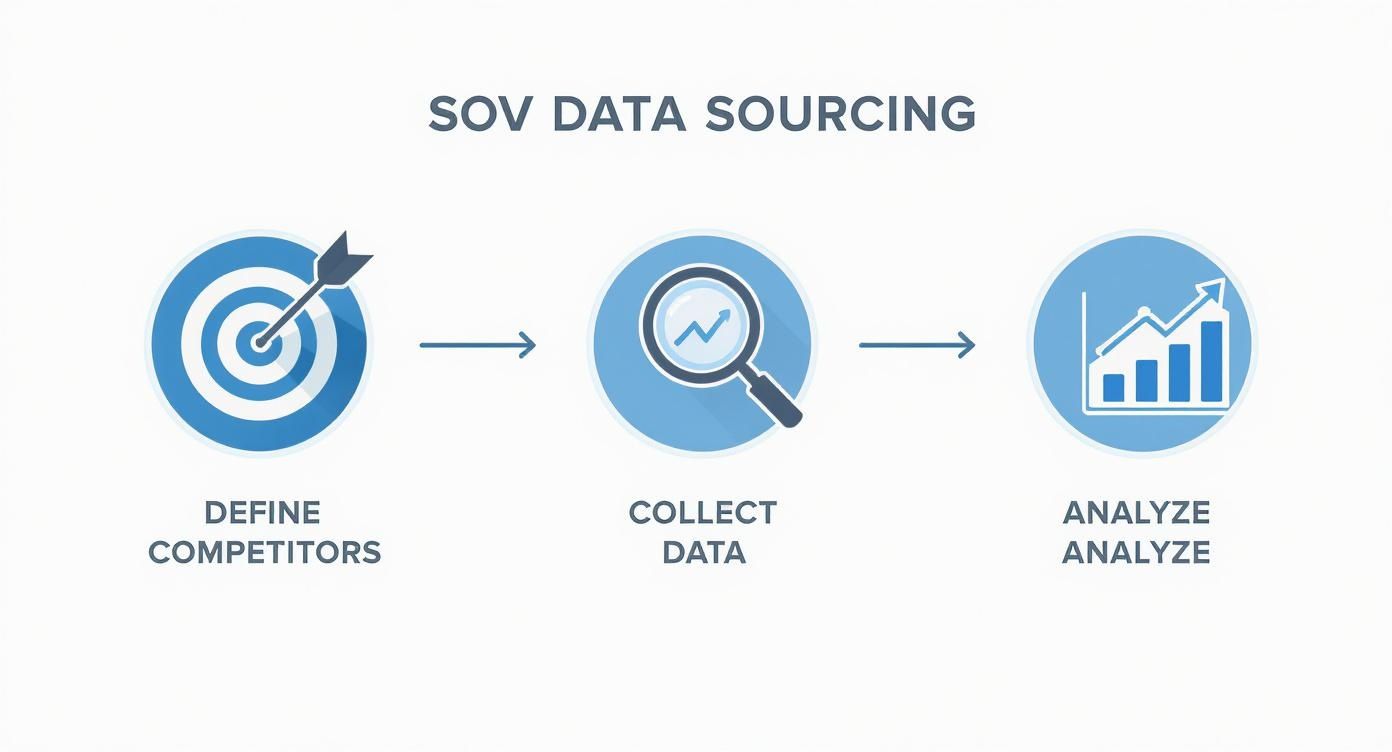
You have to define your competitive set, collect the right data, and then analyze the results. Skip a step, and your numbers are meaningless.
SOV Calculation Cheat Sheet
This table breaks down the three core methods for calculating SOV, giving you the formula and best-use scenario for each.
| SOV Method | Core Formula | Primary Data Source | Best For Measuring |
|---|---|---|---|
| Organic Search SOV | (Your Clicks ÷ Total Search Volume) x 100 | SEO tools (Semrush, Ahrefs) | Visibility on search engines for target keywords. |
| Social & Media SOV | (Your Mentions ÷ Total Market Mentions) x 100 | Social listening tools (Brandwatch, Sprinklr) | Brand presence and conversation in online discussions. |
| Paid Media SOV | (Your Impressions ÷ Eligible Impressions) x 100 | Ad platforms (Google Ads, Meta Ads) | Dominance and visibility in paid advertising auctions. |
Keep this handy as you decide which channels matter most for your brand.
2. Social and Media SOV: The Conversation Score
While search SOV is about intent, social and media SOV is about the conversation. Here you track every mention—direct and indirect—across social media, news sites, and blogs to see who’s dominating the discussion.
The formula is simple on the surface:
Social & Media SOV = (Your Brand Mentions ÷ Total Market Mentions) x 100
"Total Market Mentions" includes your brand's mentions plus those of all tracked competitors. Trying to do this manually is a nightmare, which is why a social listening tool like Brandwatch is essential.
Mini Case Study: Smartphone Launch Buzz
- When Apple launched the iPhone 14 in September 2022, they owned the online conversation.
- They captured 45% of all social media chatter related to new smartphones.
- For comparison, Samsung sat at around 25% during the same period.
- This shows how a massive product launch can give a brand a temporary but powerful spike in conversational dominance. You can see more of this in the full Brandwatch analysis.
3. Paid Media SOV: The Impression Score
For paid ads, calculating share of voice is more direct. Platforms like Google Ads give you a specific metric called Impression Share. This is your SOV for a specific set of keywords, telling you how often your ads were shown out of the total times they could have been.
The formula is baked into the platform:
Impression Share (SOV) = (Impressions Received ÷ Eligible Impressions)
Eligibility depends on your budget, bids, and ad quality. An 80% Impression Share means your ads show in 8 out of every 10 relevant auctions. Your competitors are snagging the other 20%.
Think about an e-commerce brand selling running shoes.
- They're bidding on the keyword "best running shoes for marathon."
- Their Google Ads dashboard shows an Impression Share of 65%.
- This tells them they're a strong player but are leaving 35% of potential visibility on the table. The culprit could be their budget or competitors outbidding them. This gives their marketing team a clear mission: increase the budget or improve ad quality to capture that remaining share.
Each method offers a different lens. Pick the right one for the channel you care about, and you'll get an accurate, actionable number. You can then track everything in a powerful share of voice report.
Avoid These Common SOV Calculation Mistakes
A flawed share of voice calculation is worse than none at all. It can give you a false sense of security and steer you toward poor decisions.
If you want a number you can trust, sidestep the common traps. Most errors fall into a few buckets: using bad data, ignoring context, or defining your market too narrowly.
Mistaking Mentions for Meaning
The most common error is treating all mentions as equal. They’re not.
A fleeting tweet is not the same as a feature in The New York Times. One builds a flicker of awareness; the other confers deep authority. Simply counting every mention without weighing its impact will dramatically skew your results.
Another classic blunder is failing to filter for relevance. If your company is named "Apple," you must exclude conversations about the fruit. This seems obvious, but listening tools will happily count every irrelevant mention unless you apply strict filters.
Your share of voice calculation must account for both the quality and the context of a mention. A high volume of low-quality mentions creates a dangerous illusion of market leadership. The context of the conversation is everything.
Using a Skewed Keyword Set
When calculating organic search SOV, your keyword list defines your market. If that list is too narrow or too broad, it will distort reality.
Many teams only track their primary "money" keywords. This ignores the vast landscape of long-tail and problem-aware queries where competitors might be scooping up customers earlier in their research.
Watch for these red flags in your keyword strategy:
- Ignoring problem-based keywords: Competitors might own "how to fix slow sales reports" while you only track "CRM software."
- Forgetting competitor brand names: Tracking searches for "Salesforce alternative" is crucial if you're a competing CRM. This is a direct signal of buyer intent.
- Using a static list: The language your customers use changes. Your keyword set must be a living document, updated quarterly based on search trends.
Build a comprehensive keyword map that covers the entire buyer's journey, not just the final decision stage. This reveals the true size of the battlefield, ensuring your calculation reflects the real competitive landscape. Making smarter decisions starts with accurate data, a core principle in understanding how to measure marketing campaign success.
Turn Your SOV Data Into Actionable Insights
You calculated your share of voice. You have a number. Now what?
That percentage is useless on its own. The real value comes from turning it into a strategic advantage.
First, look at the trends. A single SOV snapshot is interesting, but tracking it quarterly tells the real story. Did your SOV jump 5% after that product launch? Did it dip when a competitor rolled out a huge ad campaign? This is where insight begins—connecting the dots between shifts and specific actions.
Segment Your SOV to Find Hidden Opportunities
An overall SOV score is dangerously misleading. A high number might feel great, but it could mask a critical weakness on a channel that actually drives sales. This is why you have to segment your SOV data.
Break it down. Don't settle for the top-line number.
- By Channel: Compare your SOV on LinkedIn versus TikTok. You might be dominating a professional conversation but be invisible where younger audiences form opinions.
- By Topic: Are you winning the conversation around "enterprise software" but getting crushed on "small business accounting tools"? This shows you exactly where to aim your content.
- By Sentiment: A high SOV is a liability if 60% of the mentions are negative. Segmenting by sentiment is non-negotiable for gauging brand health.
This granular view uncovers the true story behind the numbers. It shows you precisely where to double down and where to play defense.
A Framework for Asking Smarter Questions
With segmented SOV data, you can finally ask the right strategic questions. This is the bridge between analysis and action. The goal is to challenge your assumptions and find gaps your competitors are missing.
Use your SOV analysis to answer these critical business questions. Don't just report the number; use it to find an edge.
- Where are we consistently losing ground to our top competitor, and why?
- Which topics are competitors owning that we haven't even touched?
- Is our highest SOV on the channels that actually contribute to revenue?
- How does our SOV for positive sentiment stack up against the market leader?
Answering these questions transforms your share of voice calculation from a passive metric into an active part of your growth strategy. You can present this detailed analysis in a comprehensive share of voice report to guide your team's next moves.
Let's tackle some common questions marketers have.
How Often Should I Calculate Share of Voice?
For most companies, quarterly calculation provides a strong strategic view. It’s the perfect cadence to spot meaningful market shifts without getting bogged down in daily fluctuations. This timing aligns with quarterly business reviews and lets you adjust marketing plans with real data.
However, if you're in a fast-moving space like consumer tech or in the middle of a major product launch, monthly is much better. A monthly check-in helps you see direct correlations between your campaigns and any SOV changes. Daily or weekly tracking is almost always overkill.
What Is a Good Share of Voice Percentage?
The answer is: it depends. There's no magic "good" SOV number that applies to everyone. The metric is entirely relative to your market.
In a fragmented market with dozens of competitors, a 10% SOV could make you the leader. In a duopoly dominated by two giants, holding 40% might still put you in a distant second place.
Instead of chasing an arbitrary number, your goal should be steady, measurable growth against your direct competitors. Seeing your percentage climb quarter over quarter is what progress looks like.
Can I Calculate SOV Without Expensive Tools?
Yes, but be prepared for manual work. You can get a baseline measurement on a tight budget.
- Use free tools like Google Alerts and manual social media searches to track brand mentions.
- For organic search, manually track your rankings in a spreadsheet for a core set of 10-15 high-value keywords.
This scrappy approach won't be as precise or scalable as using dedicated software, but it can provide valuable directional insights when professional tools aren't in the budget.
Ready to stop guessing and measure your visibility in AI search? AI SEO Tracker shows you exactly where your brand appears in ChatGPT, Gemini, and Perplexity answers. See your true AI share of voice and get an actionable plan to win high-intent prompts.